

A Green-led council is planning to tax employers offering free car parking to staff.
Bristol city council wants to charge businesses who provide the perk in a bid to raise an estimated £44 million and ‘discourage car commuting’.
Employers in the city would need to obtain a licence for any spaces on their premises under the new plans – these would cost anywhere between £300 and £1,250 per space, per year.
Councillors are set to decide how widespread the levy will be ahead of a public consultation in the autumn, Bristol’s transport and connectivity committee report confirmed.
One option would be to contain it within the existing Clean Air Zone (CAZ), but some are pushing for the proposals to apply to the whole of the city centre or even the entire city, including the nearby seaside town of Avonmouth.
Bristol’s business leaders have hit back at the plans for compounding existing cost pressures, while a local councillor said it was ‘madness’.
Business West said employers in the city have already faced hikes to National Insurance, energy costs and business rates in recent years.
Charges will vary heavily from business to business, with those offering more parking spaces eligible for a greater levy.

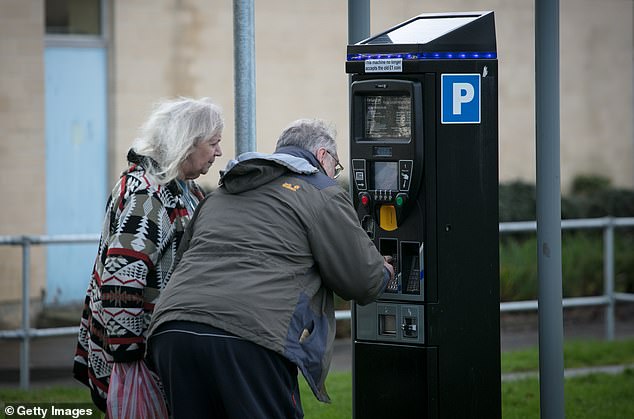
Bristol city council wants to charge businesses who provide free car parking to staff up to £1,250 per space, per year (Stock Photo)
If bosses opted for a citywide scheme, firms within the CAZ area would be hit with bigger taxes once the plans are rolled out.
Businesses with fewer than five spaces may end up being exempted from the levy, the council said.
But those facing the harshest fines might have to cough up over £5 per space every working day.
Council chiefs are hopeful the scheme could line the city’s coffers by bringing in millions of pounds per year.
The report claims this cash would be a ‘ring-fenced and locally controlled funding source for transport investment’ meaning it would only be spent on transport improvements.
It also hopes the levy would deter commuters from driving into Bristol, and encourage them to cycle, walk or take public transport instead.
‘Free workspace parking can prevent investment in sustainable transport’, the report claimed, adding that charging people to park is a more financially sustainable solution.
But Conservative councillor Mark Weston said: ‘I think its madness. We should be encouraging business and supporting enterprise.
‘The Labour Government may be doing all it can to annihilate the private sector but that doesn’t mean that Bristol City Council should jump on the bandwagon.
‘This is a bad idea that will hurt regular commuters and companies struggling to make a living. The Council should abandon these plans rapidly. Perhaps they could emulate the Government once again and perform a u-turn.’
And Business West spokesman Sauri Walker said that for many, there was no realistic alternative to driving into work.
There are also mounting concerns that the tax could be passed on to customers in the form of higher prices.
Businesses in the city are already struggling to cope with rising inflation, tax rises and energy costs.
A similar scheme has also been tried out in Nottingham, with Bristol council chiefs hailing the initiative there as a ‘success’.
In Nottingham, businesses with more than 11 spaces must pay the tax.
Ed Plowden, Chair of the Transport and Connectivity Committee, said: ‘No decision has been made on whether to introduce a workplace parking levy in Bristol.
‘The Transport and Connectivity Committee will first consider the outline business case and potential options, and any proposal would be subject to a full public consultation before any future decision is taken.
‘The consultation will give residents, businesses and other stakeholders an opportunity to have their say before councillors consider the next steps.

Bristol already imposes an anti-motorist tax via its Clean Air Zone scheme, introduced in November 2022 (Stock Photo)
‘As part of generating this proposal we visited Nottingham, where the evidence suggests that their equivalent scheme delivers overall positive economic benefits with limited adverse impacts on businesses.’
Bristol already imposes an anti-motorist tax via its Clean Air Zone scheme, introduced in November 2022.
It applies to all vehicles except a limited number of petrol-powered vehicles released since 2006; one type of diesel vehicles released since the end of 2015; fully electric or hydrogen fuel cell vehicles; Energy Saving Trust’s Clean Vehicle Retrofit Accreditation Scheme vehicles; and motorbikes.
It is one of seven such zones in England, with London boasting a similar but separate Ultra Low Emission Zone (Ulez).