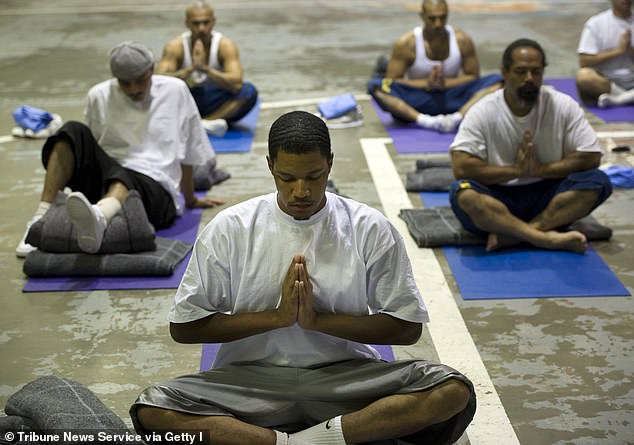
Taxpayers’ money will fund tens of thousands of pounds’ worth of ‘trauma-informed’ yoga classes aimed at reducing tensions behind bars.
The Ministry of Justice (MoJ) has awarded a £30,000 contract to Prison Yoga Project UK (PYP) to deliver classes to convicts for 21 months.
The non-profit organisation said it has developed a ‘holistic approach to rehabilitation and transformation within the criminal justice system’.
The programme will equip instructors with an understanding of how trauma can affect behaviour and wellbeing. They will also learn how yoga can be adapted to support people who have experienced trauma.
MoJ chiefs said the classes will be aimed at prisoners whose crimes are often fuelled by drug and alcohol abuse and will help to ‘reduce violence’ in jails.
But critics have questioned the ‘woke’ decision to spend thousands of pounds on yoga instead of prison staff, who are reporting increasing levels of violence.
Conservative MP Iain Duncan Smith said: ‘This is the absolute definition of woke. It’s a mistake to spend this money on yoga. Prisons are not away day holiday camps.
‘Money should not be being spent on this sort of stuff. Prisoners go to prison because they have committed a crime and they pay their penalty while there.

Taxpayers’ money will fund tens of thousands of pounds’ worth of ‘trauma-informed’ yoga classes aimed at reducing tensions behind bars

The Ministry of Justice (MoJ) has awarded a £30,000 contract to Prison Yoga Project UK (PYP) to deliver classes to convicts for 21 months
‘Then, they should come out, learn their lesson and not offend again.
‘It’s not a place for yoga.’
Former Met detective Peter Bleksley said there were better ways to spend £30,000 than ‘teaching criminals how to put their foot behind their head’.
He said: ‘With a crippling lack of prison spaces being built, with rampant drug smuggling and consumption plaguing our jails, and with record numbers of prison staff being assaulted and consequently quitting their jobs, and with dangerous rapists, paedophiles and others being released early, I can’t help but think the prison service might be able to find better uses of thirty grand, rather than teaching criminals how to cross their legs, or put their foot behind their head.’
PYP said its mission goes beyond rehabilitation, with teachers advocating for a transformative shift from ‘punitive judgement to healing-centered approaches’.
Its website states: ‘By investing in healing over punishment, we strive to change society’s perspective on the root causes of harm, addressing issues at their source and breaking the cycles that perpetuate suffering.’
One participant is quoted as saying: ‘I am tormented by voices; I hear them all the time. During the yoga class, it becomes completely silent and calm.
‘It’s like I go into “Airplane mode”, I get to rest from everything for a while and truly land in myself.’

MoJ chiefs said the classes will be aimed at prisoners whose crimes are often fuelled by drug and alcohol abuse and will help to ‘reduce violence’ in jails
Another said: ‘Through these yoga sessions, I feel brand new.’
Yoga is already offered to inmates at HMP Leicester, a Category B men’s prison which primarily holds prisoners on remand awaiting court appearances.
A recent inspection of the jail found the level of violence was the highest of any comparable reception prison and the mandatory drug test rate was too high.
The report stated: ‘Unsurprisingly, use of force was also too high and much higher than similar establishments. The regime was inconsistent, which frustrated prisoners and meant staff could not always account for prisoners’ whereabouts.’
News of the contract comes amid warnings the UK’s prison system is in crisis with severe overcrowding and funding concerns.
A survey by the Prison Officers’ Association found that 85 per cent of officers did not believe there were enough staff to supervise prisoners safely.
Sobering data from the Prison Reform Trust in 2024-25 showed almost three quarters (72 per cent) of prisons in England and Wales were overcrowded.
A Prison Service spokesperson said: ‘This is a limited scheme, targeted at prisoners whose crime is often fuelled by drug and alcohol use.
‘It is proven to help control their behaviour to reduce violence and keep staff safe.’