For the Aug. 12, 2026, total solar eclipse, Spain’s great cities will be pulling in eclipse-chasers from across Europe, but not every famous destination is equally well placed. In Barcelona and Madrid, the eclipse is a near miss — dramatic on paper, yet ultimately disappointing. Madrid gets a 99.96% partial eclipse, which means no totality, so no corona, no twilight sky and no plunge in temperature. Cue a mass exodus from Spain’s two biggest cities in search of totality.
To experience a total solar eclipse, you need to be inside the narrow path of totality stretching across northern Spain, from the northwest coast to the east coast. Timing and geography matter because this is a very low-sun eclipse, with totality arriving close to sunset. Coastal beaches, riverbanks, hilltop miradors and elevated parks with unobstructed west-northwest horizons will become prime real estate for one of Europe’s most anticipated astronomical events. Here are 10 cities for the eclipse, with recommended viewpoints.
Essential resources for checking and re-checking intended destinations for totality include Xavier Jubier’s Interactive Google Map, which has timings and built-in sight lines from Peak Finder, as well as The Eclipse App, Eclipse Horizon Checker and the Instituto Geográfico Nacional. However, nothing beats being in place the night before to check for trees and other obstructions at the time of the eclipse. All times and cloud statistics come from Time and Date and are for totality only.
1. Valladolid

Location: Castilla y León, northwestern Spain
Time and duration of totality: 8:29 p.m. CEST; 1 minute, 29 seconds
Height of eclipsed sun above west-northwest: 8.7 degrees
Chance of clouds: 19% (since 2000)
Surrounded by flat land and with an excellent chance of clear skies, Valladolid is one of the top spots for the eclipse. There will be some clear sight lines from the east bank of the Pisuerga River, specifically its Playa de las Moreras river beach, though buildings will complicate things, so play it safe and head to the Parque Urbano de las Contiendas on the west side.
2. Palencia

Location: Castilla y León, northwestern Spain
Time and duration of totality: 8:29 p.m. CEST; 1 minute, 42 seconds
Height of eclipsed sun above west-northwest: 8.7 degrees
Chance of clouds: 23% (since 2000)
One of the destinations most likely to have clear skies, Palencia is surrounded by flat, open landscapes perfect for viewing a low-altitude eclipse. Key locations include the scenic Mirador de Palencia, overlooking the city from the southwest, and the elevated Cristo del Otero, overlooking the city from the north.
3. León

Location: Castilla y León, northwestern Spain
Time and duration of totality: 8:28 p.m. CEST; 1 minute, 44 seconds
Height of eclipsed sun above west-northwest: 10 degrees
Chance of clouds: 26% (since 2000)
This historic city south of the Cantabrian Mountains is bound to be one of the hotspots for the eclipse. Considered one of the best spots to watch the sunset because of its panoramic views of the city, Mirador de las Lomas (specifically Mirador de Las Lomas Tres), overlooks León from the east and offers panoramic sunset views across the city.
4. Zaragoza

Location: Aragon, northern Spain
Time and duration of totality: 8:29 p.m. CEST; 1 minute, 23 seconds
Height of eclipsed sun above west-northwest: 6 degrees
Chance of clouds: 19% (since 2000)
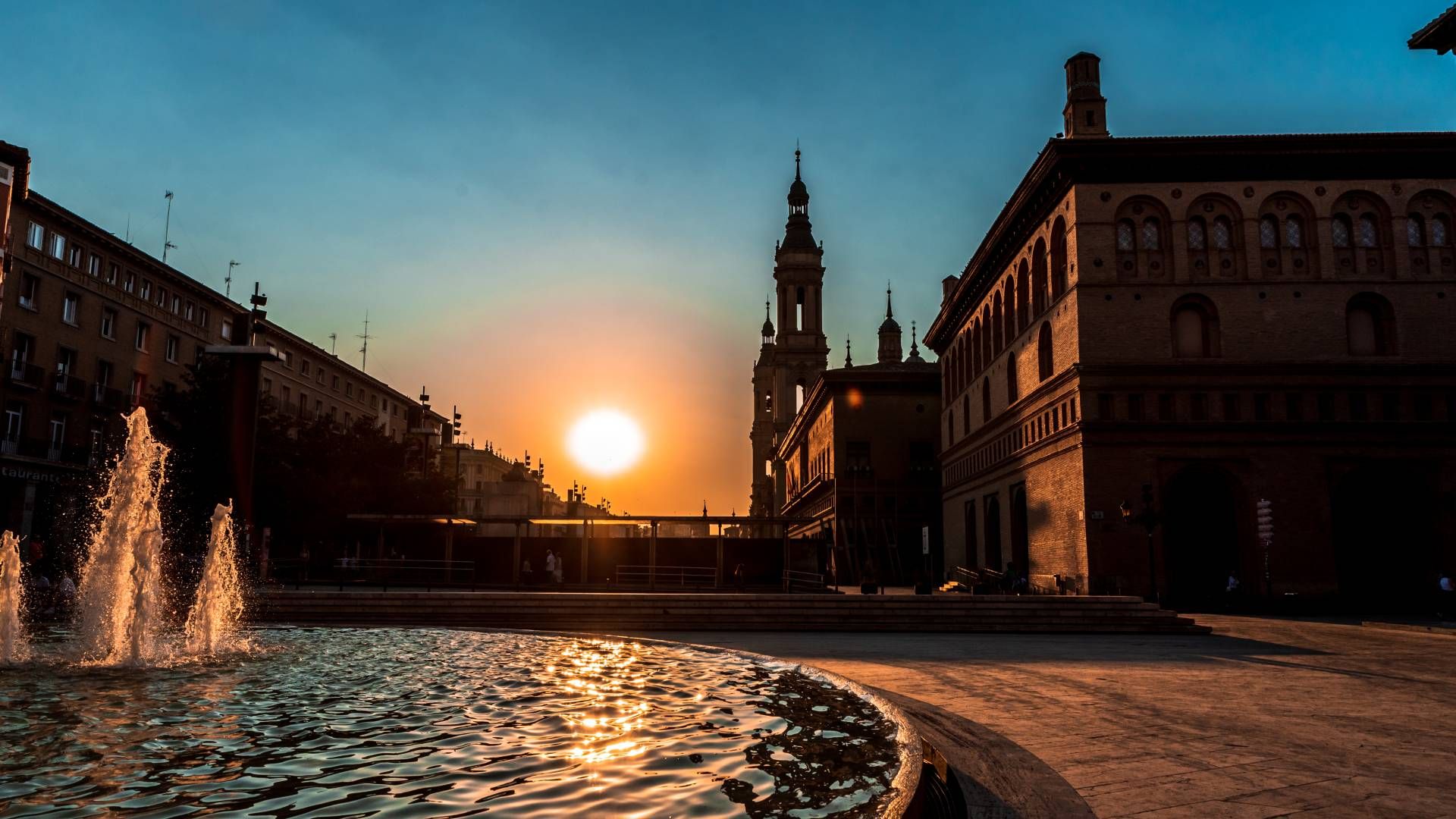
On the Ebro River between Madrid and Barcelona, Zaragoza is best known for its spectacular Basilica of Nuestra Señora del Pilar (Basilica of Our Lady of the Pillar). It just so happens that, from the historic Puente de Piedra bridge, photographers may be able to capture the totally eclipsed sun just above the silhouette of its spires. Expect crowds here, and also on the San Lázaro riverfront behind. For a quieter spot, follow the Ebro River northwest away from the city center.
5. Burgos

Location: Castilla y León, northwestern Spain
Time and duration of totality: 8:28 p.m. CEST; 1 minute, 44 seconds
Height of eclipsed sun above west-northwest: 8.3 degrees
Chance of clouds: 31% (since 2000)
Famed for its medieval architecture, this provincial capital will be busy for the eclipse, but pay close attention to sight lines. Many will be close to the historic Arco de Santa María, but it’s poorly placed, so instead get yourself on the northwest bank of the elevated Parque del Castillo for a low panoramic view of the city — and the eclipse.
6. Logroño

Location: La Rioja, northern Spain
Time and duration of totality: 8:28 p.m. CEST; 1 minute, 19 seconds
Height of eclipsed sun above west-northwest: 7.5 degrees
Chance of clouds: 38% (since 2000)
A stop on the pilgrimage route to Santiago de Compostela, Logroño — 92 miles (148 km) south of Bilbao — is famed for the twin towers of its Cathedral of Santa María de la Redonda. Its Parque de Ebro, on the banks of the River Ebro, is ideal for eclipse-viewing, with the Puente de Piedra bridge also offering a clear view.
7. A Coruña

Location: Galicia, northwestern Spain
Time and duration of totality: 8:27 p.m. CEST; 1 minute, 16 seconds
Height of eclipsed sun above west-northwest: 12.1 degrees
Chance of clouds: 53% (since 2000)
The first major city on mainland Europe to experience totality will be A Coruña in northwestern Spain, where its crescent-shaped Riazor and Orzan beaches will doubtless be crowded for the occasion. They’re close to the city center, home to exquisite Galician seafood restaurants.
8. Gijón

Location: Asturias, northern Spain
Time and duration of totality: 8:26 p.m. CEST; 1 minute, 44 seconds
Height of eclipsed sun above west-northwest: 10.3 degrees
Chance of clouds: 54% (since 2000)
There are lots of places to watch the eclipse from this large coastal city in northern Spain. The clifftop park on Santa Catalina hill is bound to be busy, but there’s plenty of space on the beaches on either side — the crescent-shaped Playa de San Lorenzo on the east and artificial Playa de Poniente on the west.
9. Bilbao

Location: Basque Country, northern Spain
Time and duration of totality: 8:27 p.m. CEST; 26 seconds
Height of eclipsed sun above west-northwest: 8.2 degrees
Chance of clouds: 57% (since 2000)
Bilbao, on the Bay of Biscay at the northern edge of the path, gets a short totality, but has a spectacular elevated spot to watch the eclipse close to the center. Artxanda Viewpoint is a three-minute journey via funicular railway and gives panoramic views of the city. It’s a popular sunset spot in August, so it’s bound to be busy.
10. Madrid (San Sebastián de los Reyes)

Location: San Sebastián de los Reyes, Madrid, central Spain
Time and duration of totality: 8:31 p.m. CEST; 24 seconds
Height of eclipsed sun above west-northwest: 7.3 degrees
Chance of clouds: 15% (since 2000)
Frustratingly for madrileñas, madrileños, and eclipse planners, Puerta del Sol (Gate of the Sun), at the heart of Madrid, gets a 99.96% partial solar eclipse. Only its northern suburbs see totality, including San Sebastián de los Reyes, 12 miles (20km) north. El Mirador de Pichón has a clear sight line to a short, dramatic totality. San Sebastián de los Reyes is one of 11 observation points curated by the Community of Madrid.