

A wealthy Seattle enclave is facing bankruptcy as lawmakers and experts warn that a huge increase in property taxes is the only way to balance the books.
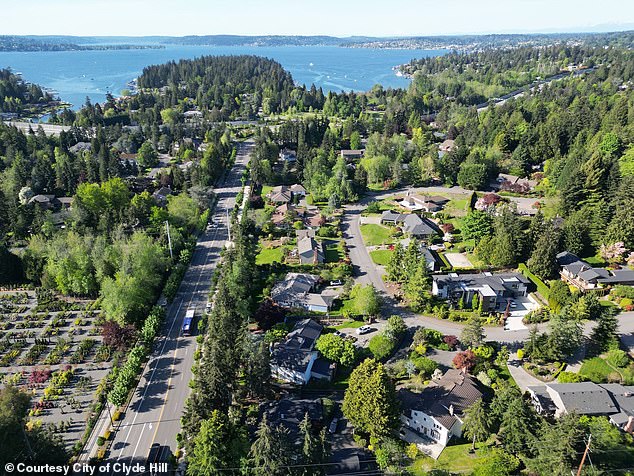
In Clyde Hill, with a population of around 3,100, the average home is valued at around $4.3 million on a lot of at least 20,000 square feet, yet the wealthy area is projected to go bankrupt in a mere four years.
‘I call it “school bus going over a cliff,”‘ Wayne Burns, a business executive who served on a fiscal committee for the town, said at a City Council meeting last week.
‘The city is going to run out of cash sometime between 2029 and 2030. The city would go bankrupt.’
According to city leaders, a sharp increase in property taxes is the only way to remedy the dire situation.
‘It’s been incorporated for 73 years,’ City Administrator Heather Thomas-Murphy said. ‘That’s really the question, can we remain a viable city?’
Thomas-Murphy argued that their gloomy future isn’t from overspending but ‘structural imbalance with how property tax revenue works.’
‘The one percent cap is the reason,’ she added.

In Clyde Hill, with a population of around 3,100, the average home is valued at around $4.3 million on a lot of at least 20,000 square feet, yet the wealthy area is projected to go bankrupt in a mere four years

Clyde Hill officials are planning on pitching a levy increase to voters in November, with the city’s Financial Stability Task Force recommending a rate of $0.50 in 2027 with a three percent annual increase until 2036

City Administrator Heather Thomas-Murphy argued that their gloomy future isn’t from overspending but ‘structural imbalance with how property tax revenue works’
The cap restricts cities and counties from raising their overall property tax revenues by more than one percent each year.
For Clyde Hill, property taxes in 2025 garnered a total of $1.37 million. This year, the city would be granted the one percent increase, totaling $13,700, the Seattle Times reported.
‘We’ve got insurance increases, salaries, contracts and so on,’ Thomas-Murphy said, noting the expenditures that such little increase in tax revenue wouldn’t afford.
‘We’re no different than any city. No one can keep up at one percent.’
The cap was approved by voters in 2001 as part of an anti-tax initiative. As years rolled on, local property tax revenues were limited to around 28 percent total growth, yet inflation rose by around 101 percent, the outlet reported.
Clyde Hill’s last two mayors event spent years warning of the worrisome future that the city’s budget was heading toward, and yet little changes were made, The Urbanist reported.
This year, voters are expecting to be hit with another petition for a levy lift in a bid to raise funds.
Clyde Hill officials are planning on pitching a levy increase to voters in November, with the city’s Financial Stability Task Force recommending a rate of $0.50 in 2027 with a three percent annual increase until 2036.

Mayor Dean Hachamovitch, who was appointed last year, warned in 2023 that the city’s condition was a result of ‘denial and delay’

For those with an average home worth $4.3 million, homeowners could see their local taxes rocketing up by around $1,000
The Clyde Hill Council’s plans would see a property tax increase of around 69 percent compared to the current rate, according to the outlet.
‘Unless the city did something, it was going to go bankrupt or it was going to get absorbed by another city,’ Burns said. ‘In that case, taxes go up, and police services probably go down and local control goes down.’
For those with an average home worth $4.3 million, homeowners could see their local taxes rocketing up by around $1,000, the Seattle Times reported.
‘It’s a very big ask, for your residents to vote for this,’ a council member raised.
Mayor Dean Hachamovitch, who was appointed last year, warned in 2023 that the city’s condition was a result of ‘denial and delay.’
‘The city administration has repeated different versions of “further action is required” annually. There is no clear progress on a plan, or a plan for a plan,’ he wrote.
In 2026, the city’s $6.7 million budget was largely spent on police and fire services, with around $2.8 million set to the police department and another $900,000 to the Bellevue Fire Department, according to The Urbanist.
In June, the financial sustainability taskforce wrote to voters that the city was ‘at a crossroads.’
‘In order to remain an independent city with local control of our own police department and land use, as well as fire and emergency medical services that we have all come to expect, the city needs to increase its property tax rate,’ the letter said.
‘As fellow residents and neighbors, we agree than an increase in the city’s portion of our property taxes is a necessary investment to maintain the services we value and the community we all call home.’
The Daily Mail reached out to the City of Clyde Hill for comment.