Nearly 50million Brits – including minimum wage workers – could end up in the higher rate of tax unless the Government gets spending under control.
The stark scenario has been raised by the Treasury’s OBR watchdog, in an assessment of the long-term ‘fiscal risks’ facing the country.
The report pointed to ‘challenging’ spending pressures – largely from demographic change – on areas such as health and social care, state pensions, defence and Net Zero.
Primary government spending is projected to rise from 40 per cent of GDP in 2030-2031 to 49 per cent by 2075-2076, according to the independent body’s baseline scenario.
That would drive the public sector’s debt mountain to three times the size of the economy – around £8.5trillion in today’s money – by the end of the period.
The OBR said that if the country was hit by shocks over the coming decades similar to those of recent years, the debt levels ‘very quickly become unsustainable’ – potentially topping 1,000 per cent of GDP.
But it cautioned that trying to bridge the gap in the finances with tax would mean ‘increasing risks and worsening trade-offs’.

An alternative scenario of thresholds being uprated in line with CPI inflation would give a radically different outcome

Public sector net debt could soar towards 300 per cent of GDP over the coming decades

The OBR said that if the country was hit by shocks over the coming decades similar to those of recent years, the debt levels ‘very quickly become unsustainable’ – potentially topping 1,000 per cent of GDP
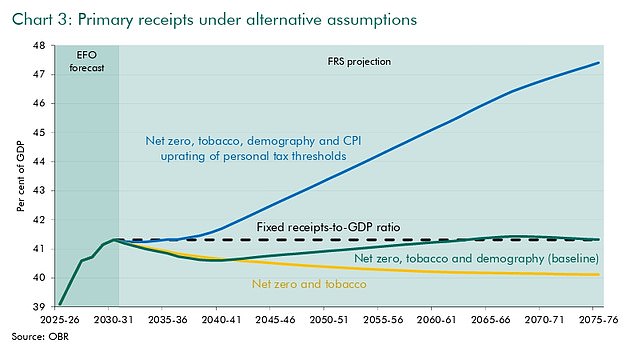
The report said that factors such as dwindling fuel duty revenues and the ban on the next generation buying tobacco would in theory keep revenues roughly stable at 41 per cent over the next 50 years.
But that assumes the revenues are not replaced by other levies such as on electric cars, and also that income tax thresholds rise in line with earnings.
The OBR highlighted that in fact, personal tax thresholds have been frozen for eight years, dragging millions of people deeper into tax.
An alternative scenario of thresholds being uprated in line with CPI inflation would give a radically different outcome.
The watchdog suggested two-thirds of earners – roughly 47million of an anticipated population of around 71million – could end up in the higher rate of tax, resulting in a ‘large impact on work incentives’.
‘It would imply that by the end of the 50-year projection period, around two-thirds of the income distribution might expect to pay income tax at the higher rate of 40 per cent or above,’ the report said.
‘Indeed, in this scenario, a full-time worker on the National Living Wage would become a higher-rate taxpayer at some point in the late 2060s.
‘We would expect this sustained and substantial rise in average and marginal tax rates to induce a large negative labour supply effect, which would significantly dent the static estimates of revenue increases set out above.
‘The long-term increases to average and marginal tax rates implied by this assumption would be additional to the significant increases in taxation in the period since the pandemic.
‘The UK’s overall tax-to-GDP ratio is forecast to rise to 43 per cent of GDP in 2030-31, from 37 per cent of GDP in 2019-20. This would take it from around 4 per cent of GDP below the average of advanced economies to slightly above, though still below the G7 average.
‘OECD comparisons suggest that UK average and marginal labour tax rates across a range of household types are currently broadly in line with the advanced-economy and G7 averages, so additional long-term increases in labour taxation would likely take the UK above them.
‘Moreover, there are many points in the UK income distribution where marginal tax rates are much higher than presented in these stylised comparisons, where further increases in tax rates could have particularly sharp impacts on labour supply.
‘The message is not that there is no scope to raise taxes, but that raising revenues consistently over the long term as a means of putting the public finances on a more sustainable path would entail increasing risks and worsening trade-offs.’
Even with tax thresholds only rising annually in line with CPI inflation, public sector debt is seen as increasing to 150 per cent of GDP by 2075.

Health is one of the biggest factors in the finances, going from 8 per cent of GDP in 2030–31 to 13 per cent of GDP by 2075–76

The OBR said the ‘degree of tightening required to prevent debt from following an unsustainable path increases if it is delayed to future years’
The OBR stressed that its scenarios should not be seen as forecasts because it was ‘almost certain’ that future governments would have to take action to prevent them from happening.
But it stressed it was ‘today’s challenge, not tomorrow’s’ to address debt levels.
‘The degree of tightening required to prevent debt from following an unsustainable path increases if it is delayed to future years,’ the report warned.
‘This would make it more costly and place more of a burden on future generations.’
The OBR’s baseline outcome suggests spending on the state pension will go from 5 per cent of GDP to 9 per cent of GDP due to the ageing population.
Meanwhile, spending on benefits for children, working-age adults and other support for pensioners is projected to stay relatively flat at 6 per cent of GDP.
Health is one of the biggest factors in the finances, going from 8 per cent of GDP in 2030–31 to 13 per cent of GDP by 2075–76.
That is partly due to the older age profile, but also increasing demand and lower productivity progress in the sector.
A spokesman for HM Treasury said: ‘We have the right economic plan to deal with economic shocks.
‘Our plan to reduce the deficit has been endorsed by the IMF (International Monetary Fund) and the OBR forecast that it will fall every year this parliament, meaning we will be borrowing less than the G7 average.
‘This Government has remained committed to protecting households and businesses through providing economic stability via our non-negotiable fiscal rules while protecting over a £120 billion increase in capital spending.’