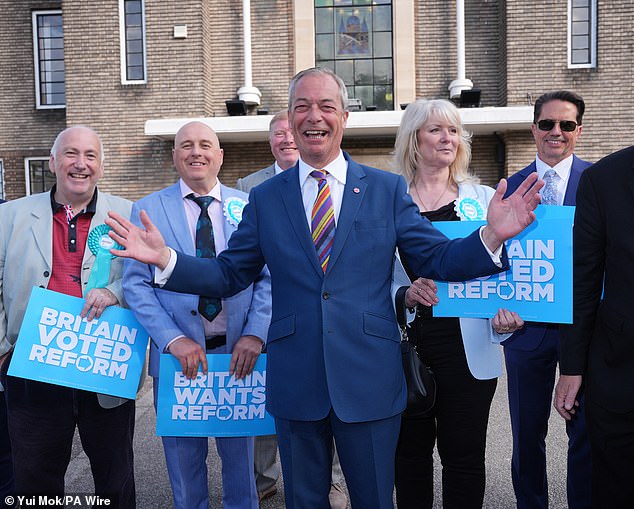
Trade union members are as inclined to support Reform UK as they are Labour, a new poll has revealed.
A study led by JL Partners has shown the two parties are tied at 28 per cent backing among union members since the general election.
Since 2024, Labour has suffered a 20-point drop in support, while the number of union members turning to Reform has risen by 12 per cent.
The general secretaries of GMB and Unite – two of Labour’s strongest affiliates – have sounded the alarm following the findings, which come as Reform made rapid gains in Labour safe seats in the local and devolved elections in May.
Sharon Graham, leader of Unite, has labelled the figures as ‘damning but not surprising’.
Union leaders have blamed Labour’s misfortunes on cuts to the winter fuel allowance, welfare and green energy policies, with 62 per cent of members polled saying Labour had ‘lost touch with working people’.
Reform UK leader Nigel Farage was ranked as the polled union member’s most favourably viewed party leader, and their preferred candidate for prime minister.
Farage was considered the party leader who would do most for working people if in No10, however, Sir Keir Starmer took a four-point lead when only Labour and Reform UK leaders were included in the polling.

Reform UK made considerable gains from Labour during May’s council elections

Since 2024, Labour has suffered a 20-point drop in support from trade union members, according to a new poll
Gary Smith, Starmer ally and GMB member, pushed back against the findings, saying Reform are ‘no friends of workers’.
He said: ‘They want to cancel hugely important union rights and are targeting the pensions of the low paid.
‘But Labour has to show working-class people it can be on their side – as it did with last week’s essential help for our ceramics industry.’
Farage, speaking to The Times, said the poll revealed ‘exactly’ what he had seen on campaign trails.
He said: ‘Labour is no longer the party of the patriotic working class.
‘That mantle now belongs to Reform, which is now the party of those who work hard but for whom the system doesn’t work.’
The findings came as Reform UK made dramatic gains of more than 1,400 council seats across England during May’s local elections, while Labour suffered historic defeats in safe seats including Birmingham and in Wales.
The party swept through Labour’s northern heartlands, picking up dozens of council seats in the North-West and North-East.

Reform emerged as the second-largest party in Wales following May’s council elections, with 34 seats, while Welsh Labour were catastrophically defeated with nine seats
Labour lost Tameside council, which includes Angela Rayner’s constituency, as her party shed 16 councillors and Reform UK gained 18.
Wigan, represented by the Culture Secretary Lisa Nandy, saw Reform win 24 out of 25 seats.
And in Sunderland, which includes the constituency of the Education Secretary Bridget Phillipson, Reform UK took overall control of the council as it gained 46 seats and Labour imploded.
Following Labour’s disastrous council elections, trade unions affiliated with the party expressed a similar disdain – with some calling for a leadership election.
Maryam Eslamdoust, Transport Salaried Staffs Association (TTSA) general secretary said unions such as the TTSA ‘will not stand by’ while the Prime Minister paves ‘the way for a hard-Right government led by Nigel Farage.’
She said: ‘People voted for meaningful change they could actually feel in their lives.
‘That’s why Labour urgently needs a leadership election to allow members to pick a candidate who is much more responsive to the needs of working people and who can stop the very real danger of a far-Right government coming to power in this country.’
Unite general secretary, Sharon Graham, added it was ‘now or never’ for Labour in the wake of the results.
She said: ‘The writing is on the wall for this Labour government and it could be the beginning of the end for the party itself.
‘Only fundamental, irreversible change will stem the tide. If the party does not shift decisively towards the working class it is finished.
‘It is change or die. Now or never.’