Family Court Bomber Leonard John Warwick left a trail of death and destruction across years of violence, but he died in a jailhouse hospital ravaged by dementia, diabetes and hydrocephalus.
By the time his end came, Warwick was barely able to speak and had to be raised on a hoist by two nursing staff to be showered.
The notorious Family Court Bomber spent the last two years of his life bedridden and unable to use the hands that had once constructed his deadly explosives.
A former fireman, Warwick had become enraged during a Family Court dispute with his ex-wife Andrea Blanchard over custody of their daughter, Trudi.
Over five bloody years, Warwick shot dead the judge handling his dispute at his front door, killed the wife of a second judge with a bomb, and bombed a Jehovah’s Witness prayer hall, killing the minister and injuring 13 people.
He also bombed a Family Court building, attempted to murder his ex-wife’s lawyer by planting a car bomb and blew up the home of another judge, injuring him and his two children.
The attacks took place between 1980 and 1985. Decades later, police charged Warwick after a drop of blood found at a crime scene was matched to his DNA.
The rampage took place between 1980 and 1985, but it would take decades until police charged Warwick after they found a drop of blood on a piece of cardboard from a 30-year-old crime scene that matched his DNA.

Leonard John Warwick was an evil killer whose ruthless reign of terror tore lives apart. He roamed free for 30 years until he was finally caught and spent his final days a miserable wreck

Warwick’s final gesture to the outside world before being locked up for the last time in 2020

Warwick was enraged by Family Court decisions over his custody battle with ex-wife Andrea Blanchard over their daughter Trudi (pictured with her mother) and sought revenge
Warwick had long been the prime suspect and was finally convicted in 2020, five years after his arrest, aged 73, before he was sentenced to life without parole.
According to the NSW Coroner’s report obtained by the Daily Mail, Warwick was diagnosed in custody with advanced vascular dementia, hydrocephalus, type 2 diabetes and hypertension.
The killer, whose trial took a mammoth 23 months before his conviction amid the accused’s claims he had been ‘bullied’ by lawyers and had no money to pay them, initially found prison ‘stressful’.
He was transferred between seven different jails, where he was held in protective custody at each due to safety concerns and his high-profile status.
The coroner’s report notes his 1974 marriage to his first wife and their separation in 1979, the year before the attacks began.
The reign of terror effectively began on February 22, 1980, when Warwick’s brother-in-law, Stephen Blanchard, was shot in the head while sleeping at his father’s home.
His body was found six days later dumped in a creek at Ku-Ring-Gai National Park, weighed down with bricks. Warwick was never convicted of this crime and it technically remains unsolved.
Four months later, on June 23, 1980, Justice David Opas, who had been handling Warwick’s family law dispute, was eating dinner with his wife and two children at their Woollahra home when the doorbell rang.

Pearl Watson was killed when she opened the door of her Greenwich unit (above), triggering an improvised explosive device left on the doorstep. Her husband, Justice Ray Watson, survived

Justice Ray Watson and his wife Pearl, who was murdered by a bomb left on her doorstep by Family Court Bomber Leonard Warwick on July 4, 1984

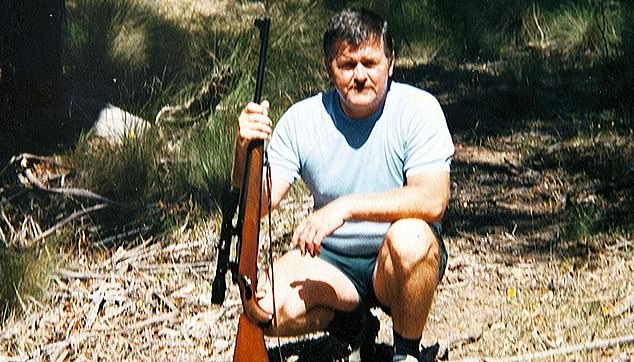
Leonard Warwick and daughter Trudi in the early 1980s when the one-time army recruit enjoyed hunting trips while he was secretly killing people with bombs and guns
He was shot in the abdomen as he answered it. He died later that night in hospital.
In mid-1983 Justice Richard Gee, who had taken over Warwick’s case after Justice Opas’s murder, ruled against him in the custody case.
On March 6, 1984, a bomb exploded on the doorstep of Justice Gee’s home in Belrose, injuring him and his two children.
Justice Ray Watson took over the case as Justice Gee recovered from his injuries.
On April 14, 1984, a bomb exploded at the Parramatta Family Court. No-one was injured.
Bomb threats became commonplace and Family Court registries at Sydney and for 18 months Parramatta were assigned two uniformed police officers for 24-hour security.
On July 4, 1984, Pearl Watson opened the door of her Greenwich unit, triggering an improvised explosive device on the doorstep. She died in the explosion and her husband, Justice Watson, was injured.
In February 1985, Warwick planted a bomb in a car outside the former home of Gary Watt, the lawyer representing his ex-wife. Watt had since moved and the new owner discovered the device when he opened the bonnet.

Justice David Opas was eating dinner with his wife and children at their Woollahra home when the doorbell rang. He was shot in the abdomen as he answered it and died that night in hospital

Leonard Warwick was a shuffling wreck in the last years of his life before he died a miserable death in Long Bay prison hospital
Ms Blanchard fled Sydney for the mid-north NSW coast with the help of her sister and members of her Jehovah’s Witness congregation at Casula in south-western Sydney.
In July 1985, the Jehovah’s Witness prayer hall at Casula – the Casula Kingdom Hall – was broken into twice.
A week later, on July 21, 1985, as 150 men, women and children were praying, an explosion flattened the hall and destroyed it.
The bomb killed the minister, Graham Wykes, a 37-year-old father of three, and seriously injured 13 worshippers.
Blood found at the hall after the bombing was later tested and matched to Warwick’s DNA, providing the key evidence that led to his arrest.
His 207-day trial was delayed after Warwick ran out of money to pay his lawyer, Alan Conolly, who argued the accused lacked the skill or time to carry out the attacks.
Mr Conolly said prosecution testimony about Warwick’s bombing and shooting expertise was ‘out of Monty Python’.
Warwick was a former army recruit who had never seen combat but kept a gun collection and took his young daughter on hunting trips.

In 1985, a massive explosion flattened the Casula Kingdom Hall as 150 men, women and children were praying, killing Jehovah’s Witness minister Graham Wykes and seriously injuring 13 worshippers

As he was nearing death and during outings in the yard at Long Bay Hospital, Warwick was moved to a wheelchair and at 10.40am on 14 February 2025 he was declared deceased
NSW Supreme Court Justice Peter Garling rejected the defence arguments as ‘fanciful’. Warwick’s nature was later characterised as ‘malevolent violence’.
From 2022, Mr Warwick became increasingly less mobile in prison and by 2023 had deteriorated significantly.
By mid-2023, according to the coroner’s report, he had been diagnosed with advanced dementia and placed under the care of the Palliative Care Team.
The coroner’s report states that by July 2024 he was ‘increasingly drowsy and non-responsive’.
‘Although it was often possible to rouse him by verbal commands, he would close his eyes shortly after,’ it added.
The coroner noted it ‘became challenging to provide food and fluids to him’ and that he ‘would not open his mouth’.
During outings in the yard, Mr Warwick was moved to a wheelchair and ‘often slept during his time outside’.
Warwick had three children from a second marriage. Between February 9 and 13, 2025, they visited him several times at Long Bay prison hospital.
Join the discussion
What do you think justice truly looks like for victims of crimes committed decades ago?
He had an open cell door for continuous monitoring, and a no CPR order if he went into cardiopulmonary arrest.
By February 14, 2025, Warwick was completely immobile. At 10.40am, nursing staff found him unresponsive and he was declared deceased.
His cause of death was advanced vascular dementia and pneumonia.