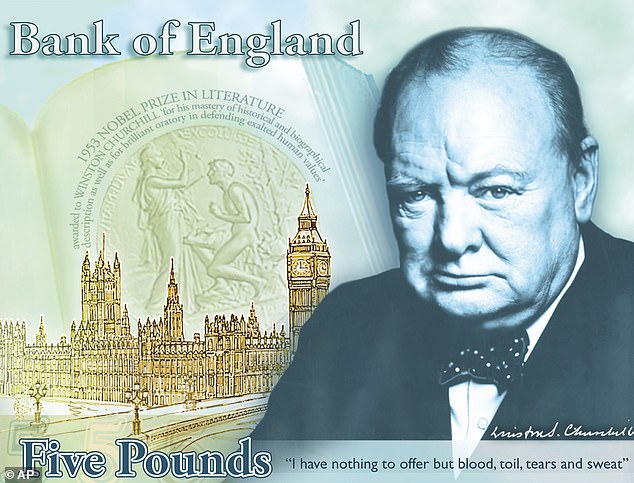
The Bank of England dropped Winston Churchill and other famous Britons from future banknotes after research warned that historical figures could be seen as ‘elitist and divisive’, it has emerged.
Documents show officials were advised that figures including wartime leader Churchill, codebreaker Alan Turing and novelist Jane Austen were viewed by some as ‘not representative of the UK’s cultural and natural diversity’.
The research, carried out by market consultancy Savanta in October last year, suggested portraits of notable Britons risked promoting a ‘backward-looking vision of the UK’ that could prove divisive.
Instead, researchers recommended nature-themed designs, arguing that images of wildlife and the natural world would be less controversial and more broadly appealing, The Telegraph reports.
The findings were delivered months before the Bank announced plans to replace historical figures on the next generation of banknotes with images celebrating nature.
The move will mark the end of a tradition that has seen prominent Britons appear alongside the monarch on banknotes for more than 50 years.
The Bank has maintained that the decision was driven primarily by security concerns and public preference rather than the Savanta report.

The Bank of England dropped Winston Churchill and other famous Britons from future banknotes after research warned that historical figures could be seen as ‘elitist and divisive’, it has emerged
Join the discussion
Is removing historic British figures from banknotes erasing our heritage or making money more inclusive?
Writing in The Telegraph this week, Bank of England Governor Andrew Bailey said the organisation’s ‘foremost objective’ was maintaining the security of banknotes and combating increasingly sophisticated counterfeiting techniques.
The Bank also pointed to an earlier public consultation which found a majority of respondents favoured nature as the theme for future notes.
However, the newly disclosed research is likely to fuel questions over whether concerns about potential controversy also played a role in the decision.
Robert Jenrick, Reform UK’s Treasury spokesman, said the central bank ‘should stop wasting time and money on this’.
James Cartlidge, the shadow defence secretary, said Churchill and Turing were ‘heroes to be celebrated’.
Colonel Richard Kemp, a retired British Army officer, said: ‘Without great and courageous figures like Churchill and Turing, we may have swastikas on our banknotes today.’
He described the decision as ‘shameful’ and called for it to be reversed, accusing the Bank of succumbing to ‘the woke desire to erase Britain’s proud and remarkable culture’.
In one focus group, a member of the public described Turing, the World War Two codebreaker and mathematician, as ‘imperialistic’, The Telegraph reports.
The participant said: ‘It does kind of still feel a little bit imperialistic … Even Alan Turing, who was obviously a famous scientist, is within the context of winning the Second World War.
‘It does feel like there is that kind of boomer, imperialistic, ‘we’re the ones who won the Second World War and saved the world’ feeling to the [bank]notes.’
While Churchill was not specifically named, the research prepared for Bank of England staff warned that most of the 119 participants in Savanta’s focus groups felt that featuring historical figures on banknotes was ‘potentially divisive, elitist and disconnected from their own experiences’.
Researchers said: ‘Many participants – especially younger ones – questioned the relevance of current figures, suggesting the theme feels outdated.
‘There was a clear desire for banknote imagery to evolve and better reflect modern Britain by being more inclusive.’
A spokesperson for the Bank of England said: ‘To select the theme for our next series of banknotes, the Bank canvassed a range of opinion through a public consultation last year.
‘This consultation received 44,000 responses and nature had the highest proportion of nominations and was the driver for our decision.
‘This theme also received additional positive feedback in Bank commissioned focus groups that took place once we had the results of the public consultation.’
The Bank of England first introduced historical figures on sterling notes more than half a century ago, when William Shakespeare appeared on the £20 note in 1970.