
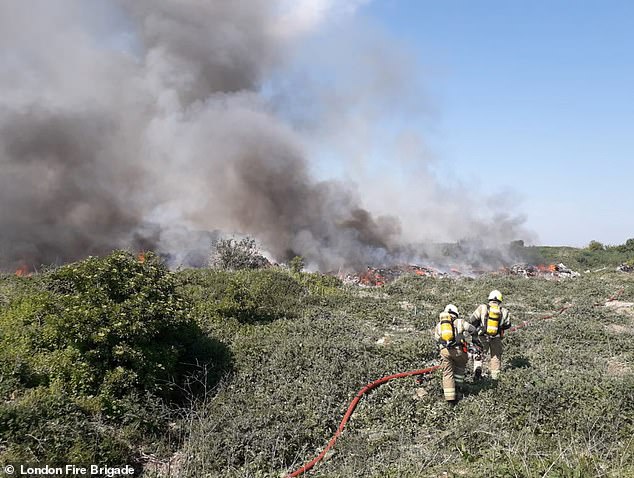
‘You wake up to the taste of rubbish in your mouth,’ says 60-year-old Michelle Joyce. ‘And the smoke is thick across the main road. I’m amazed there hasn’t been an accident, but that’ll be the next thing.’
The 30,000 residents of Rainham in east London are fed up. For the past 22 years, the community has been terrorised by an illegal waste dump on Arnolds Field, next to the local park, which is rumoured to contain everything from old ammunition cases and animal carcasses infected by foot-and-mouth disease to toxic detritus from the construction of the London Olympic Stadium.
When temperatures rise, parts of the 17-hectare site – filled with hot decomposing organic material – catch fire. As a result, the town is covered in a blanket of foul-smelling smoke which some are linking to the area’s unusually high cancer rates.
Since 2019, more than 100 such fires have blighted the so-called ‘Rainham Volcano’, where the ground is so treacherous that, in 2011, a young boy who was walking on the site found that his trainers melted on his feet, causing serious burns.
Most alarming of all, what’s been happening here for years is taking place with increasing frequency all over the country.
In May this year, the Environment Agency (EA) published a list of 117 ‘high priority waste sites’ in England, all of which are illegal and pose a risk to public safety, either due to combustion or ‘toxic run-off’. This is despite the agency closing 743 such dumps last year, including 143 assessed to be high risk.
The problem appears to be getting worse and is estimated to cost the economy a staggering £1billion per year in lost taxation and remedial fees.
Malcolm Lythgo, director of environmental markets and enforcement at the EA, said: ‘This is not the odd rogue trader. We’re seeing increasing amounts of organised crime groups coming in… preparing sites, securing thousands of tonnes of waste and then finding ways to hide it, sometimes in plain sight.’

For the past 22 years, the community of Rainham has been terrorised by an illegal waste dump on Arnolds Field, next to the local park

More rubbish is seen dumped alongside Arnolds Field in Rainham. The town is home to 30,000 residents who are fed up with the situation
The Daily Mail has investigated some of the worst illegal super-dumps in Britain and is now asking why fly-tipping has become an industrial-scale criminal enterprise, which has turned swathes of our countryside into a steaming hellhole.
The model is simple. Criminals pretend they are running legitimate waste removal companies. They secure lucrative contracts with businesses, then dump the waste illegally without paying fees or taxes and dissolve the firm before the authorities catch up with them.
Dan Cooke, from the Chartered Institution of Wastes Management, explained: ‘By illegally fly-tipping and avoiding professional fees and costs, criminals can make hundreds of thousands of pounds quite quickly and millions of pounds on some of the “super-sites”.
They lay careful trails, with shell companies leasing the land… to throw the regulators off the scent. So, when enforcement notices are issued, it’s hard to know who to pin those notices to. And as soon as you shut one company down, another one opens up down the road.’
So where are the worst examples of such criminality in action?
In Rainham, in 1999, a former gravel pit was granted permission for temporary landfill with the stated aim to level the area and eventually turn it into a pleasant woodland. But, by 2004, dumping on the site continued and enforcement notices were first served.
In 2012, it was discovered that the landowner, John Reilly, had buried shipping containers beneath the field, where he was growing cannabis and storing everything from petrol bombs to shotguns and an AK-47 assault rifle. Reilly, 47, was jailed for 12 years for drug production and possession of firearms.
Between 2012 and 2016, further waste was dumped there before the site was bought in 2017 by Jerry O’Donovan who remains locked in a dispute with Havering Council over who is responsible for the clean-up of the site.
Mr O’Donovan, who insists he is not responsible for any of the dumping, claims he bought the site at an auction in good faith – on the understanding it had been cleared. He also says he has submitted a pre-application for the development of the site which would see three-quarters of the field handed over to public use. However, as the land was designated ‘green belt’ in 2021, the application went no further.
It is, however, the residents and business owners of Rainham who suffer. Gemma Medlock, who runs Pampered Pooches Essex, which lies just a few hundred feet from the dump, declares: ‘You can smell it as far as Upminster Road South [a mile or so away].
‘But we’re just so used to it in Rainham. It’s been a long, long time. Just the other day I smelled smoke and thought: “Oh, who’s having a barbecue?” I realised it was probably Arnolds Field on fire again, as soon as there’s a bit of heat. And the smoke blocks off the whole of the A1306. People have to drive through it, which is obviously really dangerous.’
Next door, at Perfect Bites cafe, several local matriarchs have met for their weekly coffee morning. As soon as I mention Arnolds Field, the women erupt into a chorus of frustration.
‘I’ve got cancer,’ said one, who didn’t wish to be named, ‘and they’re saying it’s the dump that’s giving so many people cancer.’
Shockingly, figures appear to support her claim. A 2022 report from Havering Council found: ‘The incidence of all cancers is high in Havering in comparison to the rest of England.’
Furthermore, the report cites a 2021 study from Public Health England which declared: ‘Premature mortality by respiratory disease is also high in Havering.’
Lauren Sharpley, 62, who has lived in the area for six decades, said: ‘I’ve never smoked, not once in my life. And yet when I’ve been in hospital for operations, they put me on oxygen and think that I’m a smoker. I believe it’s from breathing in the smoke from the fires. In the summer, you sit in the garden and just breathe in smoke constantly.’
Another woman says: ‘Mr Khan [London mayor Sir Sadiq] says he’s all about [countering] air pollution, but because it costs money to fix, he’s not interested in our air pollution. He’s never come here and taken accountability. And yet, we’re paying Ulez [fees to drive around Greater London], but we don’t even have fresh air.’
Havering Council’s leader Keith Prince explained: ‘The council’s plans to carry out urgent fire-prevention works at Arnolds Field were blocked by the landowner despite ongoing risks to residents from smoke pollution.
‘Following its designation as Contaminated Land in 2025 [which sparks a formal legal process of inspection, risk assessment and remediation], the council developed a targeted plan to address fire hotspots and committed significant public resources.
‘Access was refused and the landowner has failed to provide a credible alternative, submitting only a late and insufficient proposal.’
For his part, Mr O’Donovan has previously expressed concerns that the council’s plans would not put out fires burning underground and would only delay the ecological surveys required to properly develop the site.
‘All the money the council has wasted over the last seven years and the £300,000 they are now committing to spending is part of a vanity project,’ he declared earlier this year.
Under the Environment Act, if landowners and local authorities cannot come to a voluntary agreement, the council can apply to the courts to take unilateral action. However, this can take several years if the landowner appeals. So there appears to be no end in sight for the residents of Rainham.
But how does the situation at Arnolds Field compare to the rest of the country?
Illegal dumping surged after the Tories introduced a landfill tax in 1996. Back then, the standard rate was just £7 per ton.
Thirty years on, the rate has soared to just over £130. It’s no wonder then that last year, according to a House of Lords report, 38 million tons of waste were illegally dumped in the UK.
At the same time, the Department for Environment, Food and Rural Affairs data for 2024/5 shows that just 0.2 per cent of reported fly-tipping incidents resulted in any court action.
The largest known dump in England is on a farm in Northwich, Cheshire. It contains a staggering 280,000 tons of waste across 50 acres, predominantly made up of dumped soil piled two metres high and thought to have contributed to the flooding of nearby homes and farmland.
Due to an ongoing criminal investigation, the EA was unable to reveal further details regarding the scale of the criminality here. However, as the cost of landfill tax stood at around £126 per ton (rising to £130.75 from April this year), it appears the site accounts for more than £35million in dodged tax. No arrests have yet been made.
The best-known site is in Kidlington, near the River Cherwell, off the A34 in Oxfordshire, which made headlines last year as the 50ft-wide, 30ft-high dump resembled a tsunami of litter.
As the Daily Mail reported, the site was the result of a ‘very long-prepared criminal operation’, with gangsters planning months ahead before dumping the waste ‘over a very short period of time’.
It later emerged that some of the waste was likely to have come from local schools, which had later been sub-contracted to a criminal organisation for disposal.
After an intervention from Parliament, £8million was found to clean up the site, leading many to accuse the Government of prioritising dumps in affluent areas.
In the village of Bickershaw – part of would-be PM Andy Burnham’s Makerfield constituency in Greater Manchester – 25,000 tons of waste have sat untouched for just under two years despite a fire raging at the site for nine days last year which caused a nearby school to close.
On Hey Head Farm, near Rochdale, Lancashire, 30,000 tons of commercial waste rots in the summer sun. The site has recently been subject to a six-month restriction order by the court, which can enable the council to block access to it.

The largest known dump in England is on a farm in Northwich, Cheshire. It contains a staggering 280,000 tons of waste across 50 acres

Kidlington, off the A34 in Oxfordshire, made headlines last year as the 50ft-wide, 30ft-high dump resembled a tsunami of litter

In the village of Bickershaw – part of would-be PM Andy Burnham’s Makerfield constituency in Greater Manchester – 25,000 tons of waste have sat untouched for just under two years

On Hey Head Farm, near Rochdale, 30,000 tons of commercial waste rots in the summer sun

Cave’s Inn Pits is a Site of Special Scientific Interest (SSSI), near the village of Shawell in Leicestershire, where 30,000 tons of dumped waste has obliterated some of what was the most biodiverse marshland in the county

In Hoads Wood, Kent, during a six-month period in 2023, more than 30,000 tons of waste were illegally dumped in the ancient woodland
Mr Lythgo, from the EA, says that such orders can be highly effective. ‘The first thing we’ll do is write cease-and-desist letters and sometimes that works,’ he explained. ‘The restriction orders can be really helpful if we’re worried [the criminals] might come back. It gives us the legal basis to do things like put concrete blocks down to block access.’
Yet, in spite of the restriction order, the waste on Hey Head Farm remains. This is because while the agency can identify and ‘shut down’ sites, the responsibility to clean it up typically falls to the local authority, which often argues that the cost is prohibitive.
Cave’s Inn Pits is a Site of Special Scientific Interest (SSSI), near the village of Shawell in Leicestershire, where 30,000 tons of dumped waste has obliterated some of what was the most biodiverse marshland in the county and is home to newts, toads, dragonflies and small mammals.
Aerospace engineer Rob Deer, 49, from Shawell, said: ‘It is supposed to be a habitat for endangered species and it has become a free-for-all dumping site. They have been layering it, covering it with soil on repeat. It’s about four metres deep.’
Local gamekeeper Duane Sutch, 67, said: ‘We just don’t know how bad it will be for the wildlife because no one knows what is in there. It all needs to be removed. But who will undertake that, where will it go and who will pay for it?’
South Leicestershire MP Alberto Costa has written to the Prime Minister asking if the EA has the resources to catch those responsible. He told the Daily Mail it was an ‘appalling act of environmental vandalism that has rightly outraged residents’.
In Hoads Wood, Kent, during a six-month period in 2023, more than 30,000 tons of waste were illegally dumped in the ancient woodland, designated as a SSSI due to its biodiversity. The clean-up of the 1.5-acre site began last summer and required 2,000 lorryloads of removals.
The sad truth is that these deeply troubling case studies are just a fraction of the whole sordid picture nationally. So what hope is there of cracking down on this epidemic of criminality?
Mr Lythgo says: ‘If we just chase the criminals and try to prosecute them, we wouldn’t stand a chance. What we need to do is cut off the supply. It’s about knowing where our waste is going and stopping it from leaking out of the legitimate system.’
For now, however, millions of tons of dumped waste are not just leaking out of the system but into our rivers, forests and homes.
The EA’s ‘high priority’ list alone accounts for close to two million tons of illegal waste. And as the residents of Rainham know all too well, what today is an eyesore, may tomorrow be a blazing, toxic inferno.