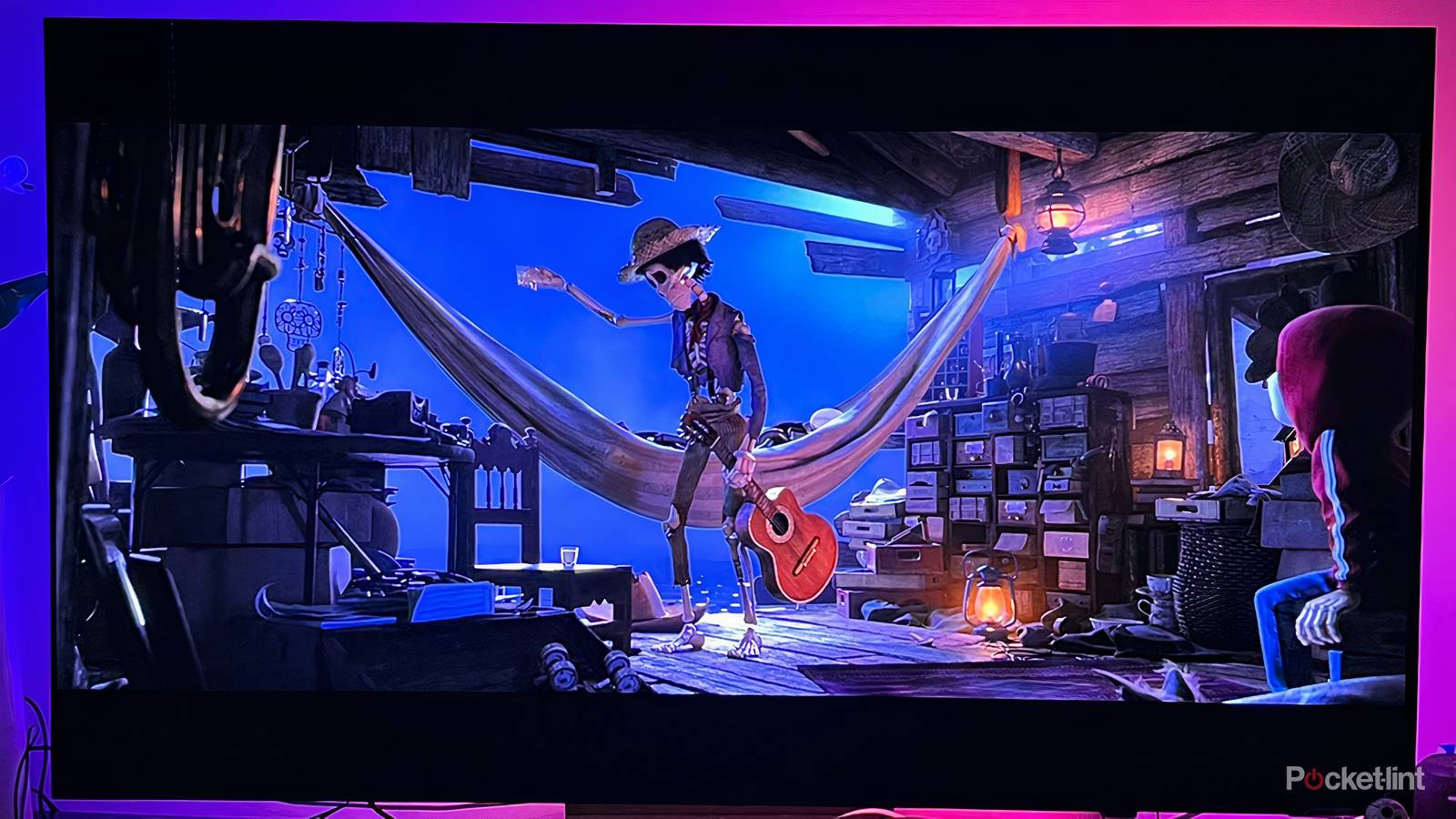
For what feels like ages now, OLED has often been treated as the pinnacle of TV technology. OLED models are typically the most expensive options at your local big-box retailer, and they’re practically the default for high-end home theater systems. There’s certainly some logic to that, since the tech is capable of perfect contrast, as well as better color representation than the LCDs most of us have. If you want to make a movie or TV show really “pop,” OLED is the answer.
Lately, though, there have been hints that OLED’s reign is coming to an end. Two recent formats — RGB mini-LED and MicroLED — are finally starting to enter the realm of affordability for people who aren’t among the wealthiest elite. That’s a relative term, but it’s not hard to imagine the new standards pushing OLED out of the limelight, and eventually killing it off entirely. But it’s not going to happen anytime soon, for reasons that extend beyond greedy pricing decisions. There are some barriers that even the biggest corporations would love to overcome.
Why would anyone think OLED is dying?
The race to perfection

Ultimately, it’s about technological evolution. If you’re not familiar, RGB mini-LED (which I’ll dub “RGB” from now on) replaces the single-color backlighting in regular mini-LED sets with dedicated red, green, and blue backlights, hence the name. MicroLED takes this concept a step further, ditching the need for backlighting entirely by assigning LEDs to each pixel. With the ability to produce many colors directly, less filtering is required.
The difference isn’t just academic. Both technologies offer fundamental advantages over OLED, the first one being color accuracy. While OLED TVs do offer a high degree of accuracy, the best RGB and MicroLED sets are claimed to cover up to 100% of the industry-standard BT.2020 color gamut. That’s something you won’t get with OLED, which means that if you want to see the most natural-looking imagery — and the most authentic to a filmmaker’s intent — there’s a new sheriff in town. This may be especially important with Dolby Vision 2 and HDR10+ Advanced right around the corner. HDR expands color depth, and indeed, natural skin tones are one of Vision 2’s selling points.
Improved accuracy wouldn’t be huge if it weren’t for the fact that RGB and MicroLED also avoid OLED’s major pitfalls. OLED is notoriously dim — while the best models can hit 4,000 nits of peak brightness or more, most others fall well below that, and brightness outside of HDR highlights tends to be lower still. OLED TVs are best viewed with as little ambient lighting as possible. RGB and MicroLED, meanwhile, can hypothetically hit up to 10,000 nits, which is ludicrous — consider that my 3,000-nit Apple Watch Ultra 2 is readable under the midday sun. Real-world numbers aren’t up to 10,000 yet, but the fact is that even a “cheap” RGB or MicroLED is automatically preferable for daytime viewing. Cranked to the max, it’s going to be blinding.
Improved color accuracy wouldn’t be huge if it weren’t for the fact that RGB mini-LED and MicroLED also avoid OLED’s major pitfalls.
RGB and MicroLED are also entirely synthetic, whereas OLED relies on an organic electroluminescent layer. That organic component is prone to faster decay under heat, resulting in problems like burn-in — the permanent “shadow” images created by leaving static content onscreen too long, such as news channel logos. On top of that, peak brightness inevitably decreases over time, and a color tint can develop if the associated materials decay at different rates. An OLED TV can potentially last longer than an LCD, which might surprise you — but it’s all too easy to cut real-world usefulness short, in spite of the countermeasures implemented by TV makers. It’s a terrible choice for heavy gaming sessions or leaving news on in the background.
OLED still holds an advantage over RGB in contrast, but not MicroLED. Without the need for a backlight, MicroLED can shut off individual pixels to achieve true blacks, just like OLED. At a glance then, the obvious implication is that MicroLED is poised to steamroll not just OLED, but all other TV formats.
Why OLED is here to stay
For a while longer, that is

As I suggested earlier, the key factor is price. RGB TVs are still far from affordable for the average person. As of April 2026, you probably won’t find one for less than $3,500, and you can easily spend thousands more. Conversely, it’s possible to buy an older OLED TVs for less than $1,000, and you’ll score an excellent new model without breaking the $3,000 mark. $3,500 is a tough sell when many working-class shoppers would consider $1,000 excessive.
MicroLED has yet to descend from the heavens, frankly. Samsung’s 115-inch model is priced at $40,000, and there are Planar Luxe video walls that cost over $1 million apiece. Cheaper models are on the horizon, but let’s say I’m not holding my breath.
What’s holding back these price cuts is manufacturing. RGB and MicroLED are new technologies with comparatively low production yields — referring to the number of usable panels churned out. While yields are improving, it’s going to take a while for them to exceed OLED, let alone conventional mini-LED or LCD panels. Both of the new formats are intristically more complex, with RGB requiring thousands of LEDs, and MicroLED employing millions.
The industry is waiting for a tipping point, a breakthrough in manufacturing yields and/or capacity. It’s only once the new standards are as affordable or cheaper to produce that OLED might start to lose its grip.
Then there’s the matter of capacity. OLED TVs have been around for over a decade, and LCDs longer still. Most production lines are therefore devoted to these older technologies, since they’re core profit drivers, and conversion takes time and money. The result is a Catch-22: if consumers were buying RGB or MicroLED in droves, companies would be racing to convert as many lines as possible, pushing prices down. Yet because prices remain high, only rich buyers are dipping their toes in.
Realistically, then, OLED is going to sit alongside RGB and MicroLED as a high-end option for the foreseeable future. The industry is waiting for a tipping point, a breakthrough in yields and/or capacity. It’s only once the new standards are as affordable or cheaper to produce that OLED might start to lose its grip.
When that moment hits, though, a transition could happen fast. I remember that once the first reasonably-priced HD TVs were introduced, interest in SD TVs plummeted, all but evaporating within a few years. OLED will likely maintain some sort of footprint for a time in the budget and mid-range markets, but it could be primed for extinction given its technical problems. A better analogy in that sense might be plasma TVs. For a few years, plasma was cutting-edge — but LCDs closed the performance gap, while plasma sets were stuck with both burn-in risk and high power consumption. You haven’t been able to buy a new plasma TV since 2014, and it’s not worth tracking down a used one.