


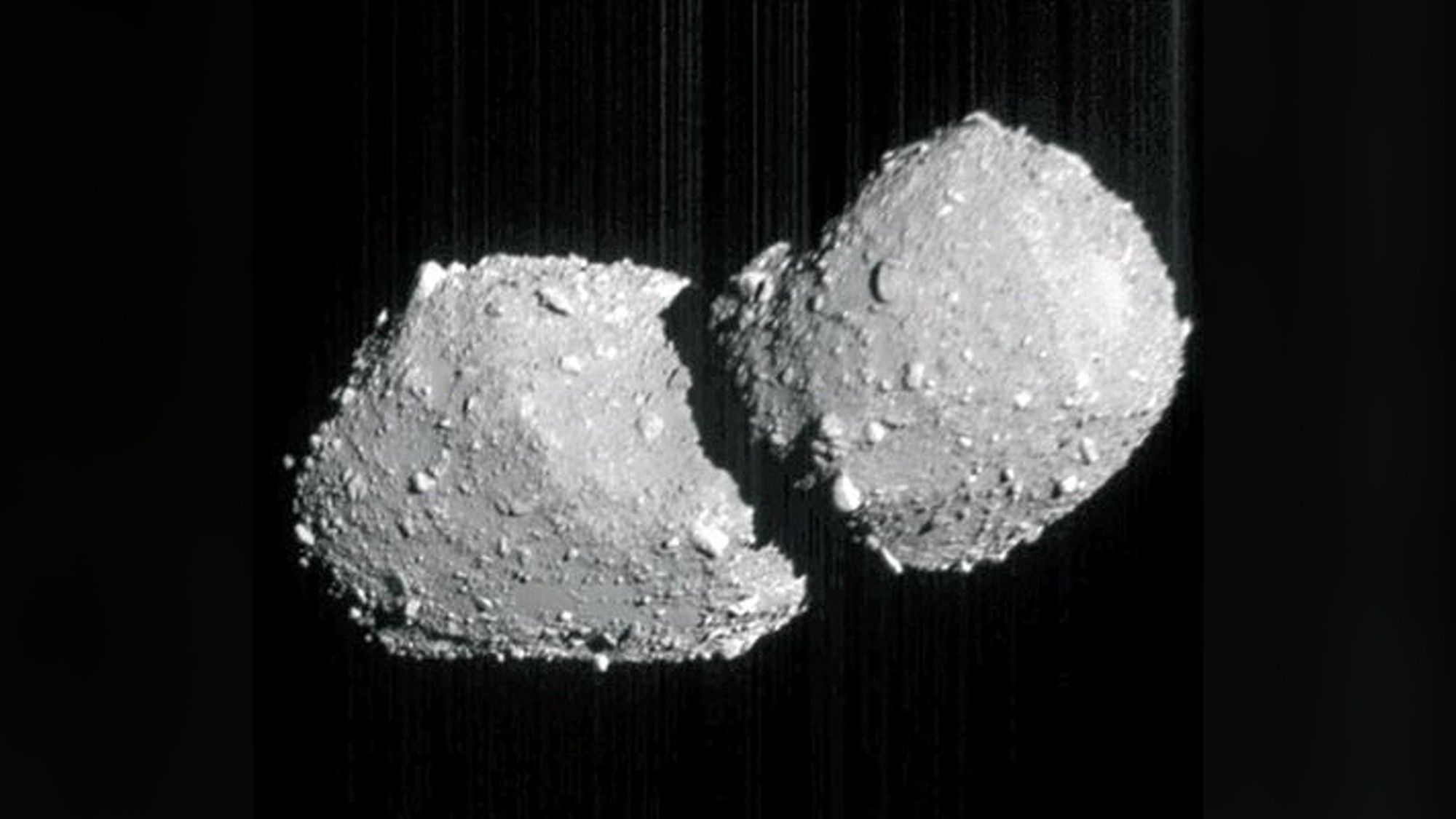
Japan’s Hayabusa2 spacecraft returned spectacular images of a near-Earth asteroid following a super-close flyby on July 5, but heated debate was needed before teams signed off on the daring attempt.
When images of the asteroid Torifune arrived on the morning of July 6 Japan time, Makoto Yoshikawa and his team at the Japan Aerospace Exploration Agency (JAXA) got two surprises at once. Torifune turned out to be a contact binary, in which two chunks of rock have come together under gravity, and the returned images were also larger than hoped.
“We did not imagine such a contact binary,” Yoshikawa, former mission manager of Hayabusa2, told scientists gathered at the Asteroids, Comets and Meteors conference in Poznan, Poland, on July 10. “Originally, we didn’t think we could have such a very big image. Maybe we will take a very small one, but the image was much larger than we expected.”

The double surprise was the payoff of months of debate between science and engineering teams, and a last-minute proposal that alarmed some of the scientists it was meant to serve. In the end, the flyby was so close as to be at the very edge of what the aging spacecraft was designed to conduct.
Hayabusa2 launched in December 2014 and rendezvoused with the asteroid Ryugu four years later. The spacecraft collected samples and delivered them to Earth in 2020, completing its primary objectives. JAXA then made plans for an asteroid flyby and a rendezvous with the tiny asteroid 1998 KY26 in 2031.
Usually for flybys, the closest distance is 100 kilometers (62 miles), Yoshikawa said, but in Hayabusa2’s case this would not be close enough to gather good images. Hayabusa2 was designed for rendezvous and proximity operations, including hovering, correcting and landing — not for a high-speed pass at 5.3 kilometers per second (3.3 miles per second). Its cameras were also not designed for high-speed slewing.
According to Yoshikawa, science team members pushed back. At a distance of 100 kilometers, Hayabusa2’s cameras would barely resolve the asteroid‘s global shape. Engineering responded with a proposal of 10 kilometers (6.2 miles). Science said that was acceptable, but the team kept pushing. Eventually, engineers confirmed they could get to within 1 kilometer (0.6 miles) of the asteroid’s center. “Science people were very happy, because they could have a nice photo,” Yoshikawa said.
Then, just one month before the flyby, extended mission team leader Yuya Mimasu proposed going even closer. “Yuya Mimasu said the closest distance should be 800 meters,” Yoshikawa recounted. “Some science people said ‘No, it’s too dangerous,’ and a very heated discussion started.”
One major issue was the unknown size and dimensions of Torifune and the safety of the spacecraft. The team had assumed a worst-case asteroid size of 1,400 meters by 400 meters (4,600 by 1,300 feet) based on ground-based observations. A pass 800 meters (2,625 feet) from the center of the target would sit just outside that exclusion zone. The spacecraft’s optics had also been affected by dust from sampling Ryugu. The final navigation analysis put the targeting error ellipse at around 200 meters (656 feet). “The distance fixed is 800 meters,” Yoshikawa said, “but this is quite a big challenge for us.”
Hayabusa2 detected Torifune on June 19. The spacecraft used ground-based guidance up to three hours before the flyby, before switching to onboard guidance. “This is quite new,” Yoshikawa said. “We developed software for this, and we sent it to the spacecraft.”
The result was the stunning, up-close imagery of the dual-lobed Torifune, captured by the probe’s Optical Navigation Camera Telescope (ONC-T). But all four of Hayabusa2’s science instruments returned data. The Thermal Infrared Imager (TIR) captured nine seconds of thermal imaging between 09:29:50 and 09:29:59 GMT on July 5, just a second before closest approach, independently confirming the contact binary structure in heat emission.

The Near Infrared Spectrometer (NIRS3) and laser altimeter (LIDAR) also got data, with the latter delivering what Yoshikawa described as possibly the first successful LIDAR ranging measurement during an asteroid flyby. But while the most urgent 25 MB of data was downlinked, teams will need to wait months for the rest of the 300 MB of total science data. Hayabusa2’s ion engine system restarted on July 9 to begin the cruise toward two Earth flybys in 2027 and 2028 and will fire for around four months. Only after this can the rest of the data be sent to Earth.
Yoshikawa explained that the Torifune flyby was more than just a bonus milestone and photo and science op. The successful super-close flyby means that “JAXA has acquired the technology to collide spacecraft with a small celestial body,” he said in his closing remarks at ACM, drawing a parallel to NASA’s DART mission. “This flyby mission can be said to serve as a demonstration of the fast reconnaissance concept in planetary defense,” verifying the ability to characterize an unknown asteroid rapidly — a capability that could provide crucial information ahead of an impactor mission.
This is not the end for Hayabusa2. The ultimate destination for the spacecraft’s extended mission is the tiny asteroid 1998 KY26, a roughly 36-foot-wide (11 m), rapidly rotating rock with which it is scheduled to rendezvous in 2031.

