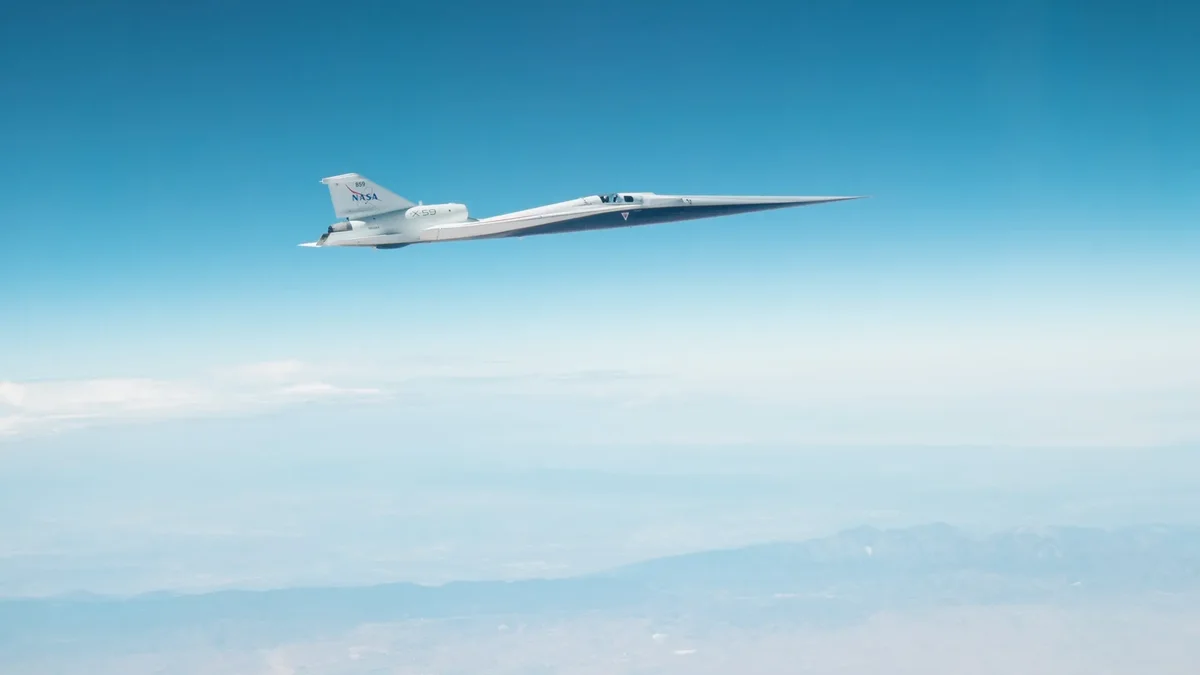
Just days after NASA’s experimental X-59 plane flew at supersonic speeds for the first time, the space agency has announced another milestone for the research aircraft.
The plane is designed to travel faster than the speed of sound without creating loud sonic booms—instead it generates what NASA describes as a “sonic thump.”
On Friday the X-59 flew at Mach 1.4, or around 924 miles per hour, at an altitude of 55,000 feet. This is the speed and altitude the plane must reach in order to fly over populated areas. Future flights will give NASA crucial data about how quiet people perceive the plane to be.
On supporting science journalism
If you’re enjoying this article, consider supporting our award-winning journalism by subscribing. By purchasing a subscription you are helping to ensure the future of impactful stories about the discoveries and ideas shaping our world today.
When aircraft travel faster than the speed of sound, the pressure waves they produce are funneled toward the rear of the aircraft, where they form a cone; if the aircraft flies low enough for the cone to glance off Earth, the result is a sonic boom. These loud bangs (and the high cost of the technology) were the reason why the world’s only supersonic passenger plane, the Concorde, was retired in 2003.
The X-59 is designed for a quieter faster-than-the-speed-of-sound flight. It has a long nose that dissipates the pressure waves to the point that the aircraft may produce only a “supersonic thump,” which NASA has said will sound somewhere between a distant thunder crack and a car door slamming down the block.
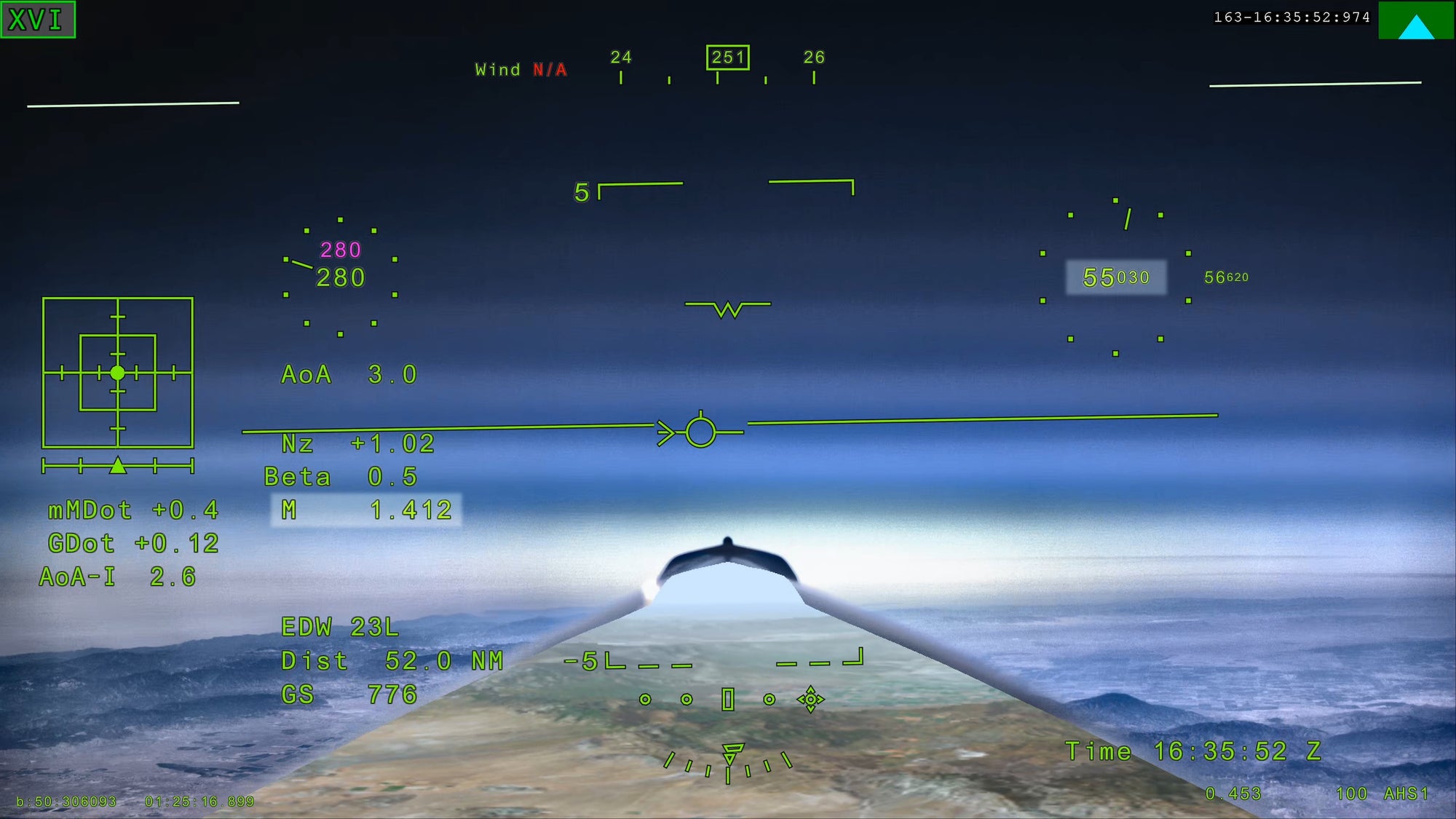
NASA’s X‑59 eXternal Vision System (XVS) shows Mach 1.4 at 55,030 feet on Friday, June 12, 2026.
An F-15 research jet has been chaperoning the X-59 on its flights so far; because the F-15 is a traditional supersonic aircraft, its sonic booms have obscured whatever noise the X-59 might make. NASA plans to mount a shock sensor to the F-15 to measure the X-59’s shock wave signature during future flights to see if it is performing as desired. After that, the space agency will perform more flights at different altitudes and speeds, as well as measure the aircraft’s acoustic signature.
“Each flight brings NASA one step closer to flying the X-59 over communities and gathering feedback that could help shape the future of commercial supersonic flight over land,” NASA said in a statement.
It’s Time to Stand Up for Science
If you enjoyed this article, I’d like to ask for your support. Scientific American has served as an advocate for science and industry for 180 years, and right now may be the most critical moment in that two-century history.
I’ve been a Scientific American subscriber since I was 12 years old, and it helped shape the way I look at the world. SciAm always educates and delights me, and inspires a sense of awe for our vast, beautiful universe. I hope it does that for you, too.
If you subscribe to Scientific American, you help ensure that our coverage is centered on meaningful research and discovery; that we have the resources to report on the decisions that threaten labs across the U.S.; and that we support both budding and working scientists at a time when the value of science itself too often goes unrecognized.
In return, you get essential news, captivating podcasts, brilliant infographics, can’t-miss newsletters, must-watch videos, challenging games, and the science world’s best writing and reporting. You can even gift someone a subscription.
There has never been a more important time for us to stand up and show why science matters. I hope you’ll support us in that mission.