Conny Waters – AncientPages.com – Archaeologists in Gunma Prefecture have uncovered a remarkably well-preserved, 1,500-year-old clay figurine depicting a female shaman, or miko, at an ancient burial mound site. The discovery offers a rare, vivid glimpse into Japan’s spiritual and political landscape during the Kofun Period, an era defined by the consolidation of imperial power and elaborate funerary practices.
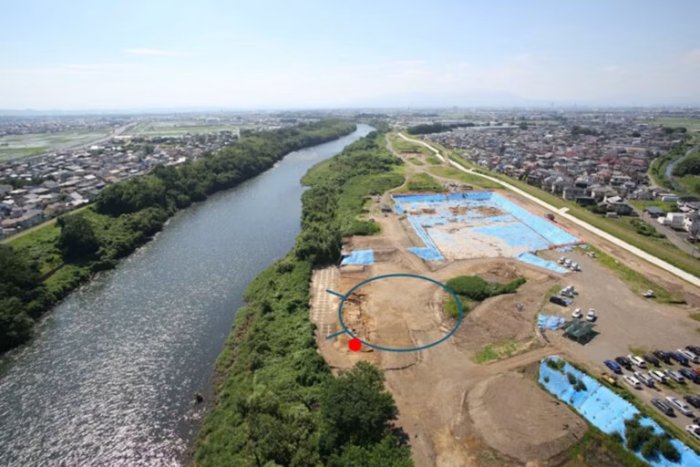
This aerial photo shows the Nishikaminomiya archaeological site next to the Tone River in Gunma, Japan. The blue outline highlights Tomb No. 1, and the red dot shows where the female haniwa figure was found. Credit: Gunma Prefecture.
The artifact was excavated from Tomb No. 1 within the Nishikaminomiya archaeological site, located near the Tone River in Isesaki City. Experts date the figurine to the second half of the 5th century, a time when powerful regional clans ruled Japan and buried their elite in distinct, earthworked mound tombs known as kofun.
Known as a haniwa—terracotta clay cylinders and statues placed on and around Kofun-era graves—the figurine stands about 41 centimeters tall and consists of an intact head and upper torso. Despite spending centuries underground, the figurine retains striking structural and ornamental details that provide clues about her ancient role. The shaman holds a scepter-like ritual tool in her left hand, a hallmark of ancient spiritual practitioners. She wears clay-molded bracelets on both wrists and a ceremonial sash draped over her shoulder. Her head features an elaborate “Kofun Shimada” topknot, meticulously styled using thick clay cords to replicate the hair trends of high-status women from that era. Furthermore, faint remnants of red paint are still visible on her face and torso. Historically, this red pigment was deeply tied to ritual purification, protection, and warding off evil spirits.
The Historical Context Of The Kofun Period
The Kofun Period marks a critical transition in Japanese history, moving away from decentralized tribal groups toward a unified state under the Yamato court. Named after the massive, often keyhole-shaped burial mounds constructed for emperors and powerful aristocrats, this era saw a dramatic escalation in hierarchical social structures. Funerary practices evolved rapidly during this time. Early Kofun mounds primarily held prestige goods like bronze mirrors and jade beads imported from mainland Asia. However, by the late 4th and 5th centuries, surrounding these tombs with haniwa became widespread.
These objects began as simple hollow clay cylinders designed to stabilize the soil of the massive earth mounds and mark the boundaries of sacred spaces. Over time, they evolved into intricate sculptures of houses, animals, warriors, and ritual performers. These figures were not buried inside the tomb with the deceased but were lined up on top of the mounds or along the surrounding moats. Archaeologists believe they served a dual purpose by acting as a spiritual barrier to protect the grave from malevolent forces while staging a permanent, symbolic funerary pageant that demonstrated the deceased ruler’s wealth and authority to the living.
The Power Of The Ancient Miko
The discovery of a clearly defined female shaman highlights the profound intersections of religion and governance in early Japan. In the Kofun period, spiritual and political authorities were intimately linked. Powerful women often held immense sway as religious intermediaries, acting as the spiritual backbone of the ruling class. Before State Shinto became institutionalized, ancient Japanese religion relied heavily on animistic practices and shamanism.
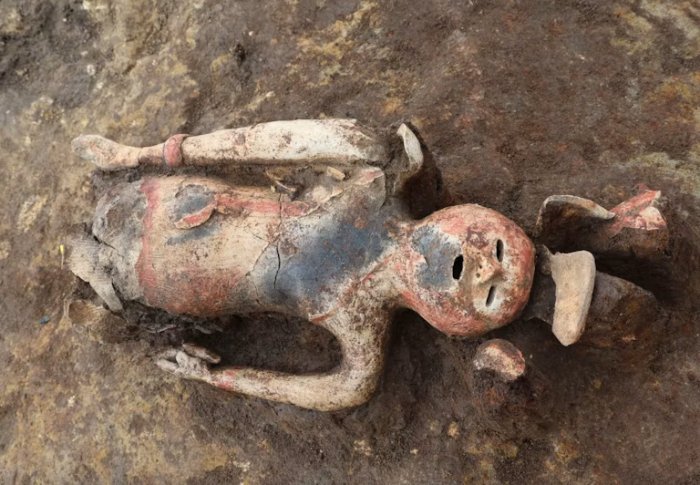
This small Japanese clay figure still shows red paint and well-preserved details, even after lying in the ground for about 1,500 years. Credit: Gunma Prefecture.
A miko was believed to have the unique ability to enter trances and communicate directly with nature spirits and ancestral deities. They guided communities through agricultural cycles, predicted battle outcomes, and performed critical purification rites. Finding an intact haniwa portraying a female shaman with such explicit ritual markers is highly unusual, suggesting that the individual buried in Tomb No. 1 likely held a high status that relied on, or deeply revered, shamanistic protection.
See also: More Archaeology News
The artifact has been transferred to the Excavation Information Museum at the Gunma Prefectural Archaeological Research Center in Shibukawa, where it is on public display for further analysis. Researchers hope that continuing excavations at the Nishikaminomiya site will shed further light on the regional power dynamics and spiritual ceremonies that helped shape early civilization along the Tone River.
Source: Gunma Prefecture
Written by Conny Waters – AncientPages.com Staff Writer