



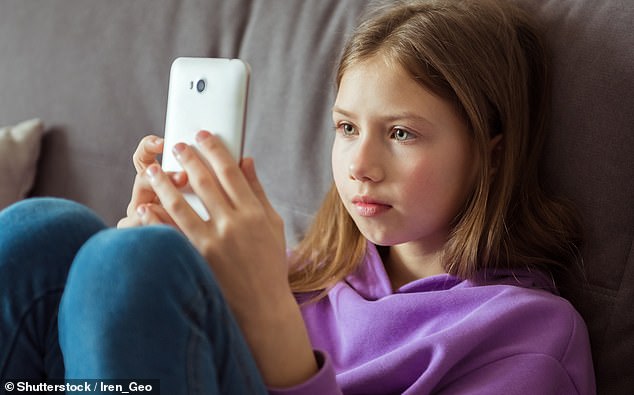
Children aged 10 to 12 are more likely to own a smartphone than know how to throw a ball properly, according to a report.
The Centre for Social Justice (CSJ) found two-thirds of this age group have a smartphone, while only 43 per cent have achieved ‘mastery’ or ‘near mastery’ of an overarm throw.
Teachers interviewed by the think tank said children were arriving at school without ‘core strength’ because they had spent too much time on tablets and not enough time running around.
Dubbing them the ‘iPad kids’, researchers said many children are rejecting outside sports and play in favour of sitting inside with their tablet or smartphone.
They warned half of children in primary school are currently not doing enough exercise – defined as doing less than 60 minutes of at least moderate-intensity physical activity per day.
At the same time, more than 40 per cent of under-13s now have a profile on social media, the report said.
And the authors said the trend is coinciding with a rise in child obesity and mental health issues – both of which have been linked to youngsters spending lots of time online.
NHS England data show one in six children aged eight to 10 have a probable mental health disorder, up from one in 10 just six years before.

Children aged 10 to 12 are more likely to own a smartphone than know how to throw a ball properly, according to a report (file picture)
At the same time, fundamental physical skills are not being developed, according to the CSJ research.
Fewer than one in five – 18.7 per cent – of six to nine-year-olds have ‘mastered’ all four fundamental motor skills of running, jumping, throwing and catching.
One teacher told the researchers: ‘I’ve got two children [in my class] who physically cannot sit on the carpet. They don’t have core strength.
‘And when I went to visit one of the girls in July, she’d never been to a nursery, she’d been sat on a corner sofa on an iPad so she hasn’t developed her core strength and it’s really affecting her whole development.’
A study in New Zealand involving around 6,000 children aged two to eight linked more than 90 minutes of daily screen time to below-average performance in communication, writing and numeracy, alongside heightened behavioural issues and precursors to anxiety disorders.
However, the CSJ also said that small changes in behaviour could have a significant impact.
It calculated that if just 15 minutes of children’s daily screen time was replaced with physical activity, almost 300,000 more primary school-aged children would reach healthy activity levels.
Last week, the Government confirmed in Parliament that it would introduce restrictions or even a ban on under-16s using social media.
The CSJ, however, said ministers must go further to combat inactivity among children.
It said the Department for Education (DfE) should introduce a ‘national school activity’ standard which would require every primary school to focus on exercise.
It said Ofsted should introduce ‘physical development’ as a key evaluation area.
The DfE and the Department of Health and Social Care should also set a target for 75 per cent of children to be sufficiently active by 2030, the report said.