


Pet insurance is sold as a service that offers owners peace of mind. If one of your pets falls ill or is injured, you can have them treated safe in the knowledge that the veterinary costs will be covered. But many owners have found that, far from being saviours in their hour of need, all too many pet insurance companies contest claims – or simply refuse to pay up.
Last month it emerged that the number of people taking disputes over their pet insurance to the Financial Ombudsman has more than doubled over the last three years.
Owners describe being treated like suspects rather than customers. Even an entry into a low-level dog show has been used to argue that cover is invalid because the pet involved is a ‘working dog’.
This is an extraordinary state of affairs. After all, we are not talking about something as mundane as lost luggage or a mislaid smartphone but life and death decisions over much-loved pets that people consider members of their family.
Many insured owners give up when claims are rejected, assuming the system is stacked against them. That insurance is just a con.
But those who fight back are now winning in record numbers. Nearly half of those who pursue an action are vindicated.
Take the case of Kim Watts. When her dog Darcey suffered a crushed spinal disc after an attack, she gave the go-ahead to life-saving surgery after checking with her insurer that it would cover the cost of the treatment.
Instead, the insurer cancelled the policy, leaving her with an £8,000 bill. Fortunately for Kim, she had taken the precaution of conducting her conversation with her insurer on speakerphone in front of the vet.

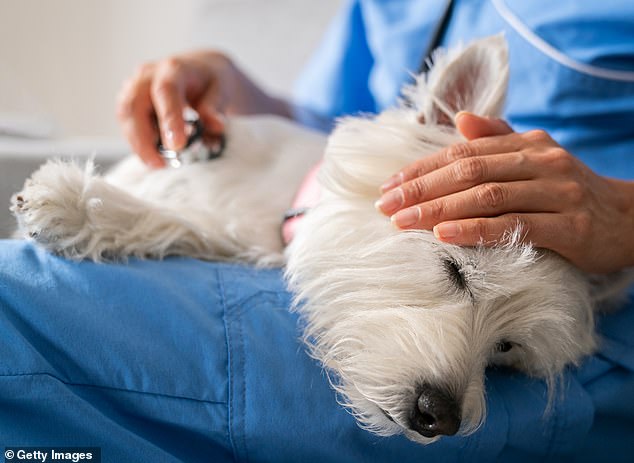
Pet insurance is sold as a service that offers owners peace of mind if one of their pets falls ill

Many pet owners have found that, far from being saviours in their hour of need, all too many pet insurance companies contest claims
She took the case to the ombudsman and won. But how many others never challenge these arbitrary decisions?
Part of the problem is structural. Pet insurance began in the 1970s as a simple safety net for unexpected emergencies. But in the decades since, veterinary medicine has advanced dramatically.
Today, if money is no object, you can access extraordinary levels of care: better cancer treatment than you can get on the NHS, state-of-the-art heart surgery, even bionic limb replacements. James Herriot would be amazed at how his profession has changed.
With vet fees rising steeply to cover increasingly sophisticated procedures, the sector became more attractive to large corporate enterprises and they began snapping up smaller operators.
A recent BBC Panorama documentary revealed this spate of takeovers coincided with a sharp rise in vets’ fees – soaring by 63 per cent between 2016 and ’23.
The Competition and Markets Authority estimates that, because of a lack of competition and informed choice in this new, consolidated market, British pet owners paid nearly £1billion more than they would otherwise have done between 2020 and 2024.
These rising costs had to land somewhere. The question is: are they destined to kill the concept of pet insurance?
Perhaps the most telling insight comes from some of the people who helped build the pet insurance industry. In researching this article, I talked to several retired pioneers and it revealed a remarkable consensus: not one of them now insures their dogs.
Abbie Holland and Elphaba

Elphaba the chihuahua has broken her neck and needs surgery – but the insurers, Animal Friends, refused to pay out
Abbie and her two children are desperately trying to raise thousands of pounds through a crowdfunding website to spare them the agony of having to put their chihuahua puppy to sleep.
Elphaba, named after the witch in the film Wicked, whined in agony after she injured her neck jumping around on a bed with her sister Barbie last month.
An initial dose of painkillers seemed to solve the problem but then the tiny dog’s condition started to deteriorate, necessitating an urgent trip back to her vet in Sittingbourne, Kent.
From there, Elphie was referred to a specialist in Basildon, Essex, who – after spending £4,000 on diagnostics – discovered she had a dislocated neck and surgery could cost up to £16,000.
Abbie, 38, contacted her insurers, Animal Friends, but they refused to pay out, claiming the injury was not an accident but congenital and it had happened during the policy’s initial ‘cooling off’ period.
Elphie is on three months crate rest with further painkillers to allow her bones to carry on growing and strengthening before she can have the operation, provided the family’s Facebook appeal can reach a revised £9,000 target.
‘We have raised £3,000 so there is still a long way to go,’ says Abbie.
‘My daughter Polly has sold all her trainers and tomorrow, bank holiday Monday, my son Oliver is doing a sponsored walk. We have had lots of kind donations to sell, too. It’s a race against time.’
Citizens Advice is helping put together a complaint to the Financial Ombudsman and Elphie’s policy has been cancelled by Abbie.
Janet Wilson and Dave

Janet Wilson with her Belgian Malinois-cross rescue dog Dave – she had her insurance denied over a pre-existing condition
Only hours after welcoming Dave, her 13-week-old Belgian Malinois-cross rescue dog, last October, Janet went to the vet because she was worried about his diarrhoea.
‘If he had been an older dog I would have waited 48 hours to see if the trouble would pass,’ she says. ‘I was an anxious new owner and knew it could be dehydration, new surroundings or just anxiety. I thought better safe than sorry.’
A sibling Dave had been separated from at seven weeks had been diagnosed with giardiasis, a parasite condition. So Dave was treated with panacur, a worming tablet, as a precaution. The vet noted this down.
No one thought more of it until five months later, this March, when Dave began vomiting.
Janet, 58, a semi-retired home tutor, from Inverness, went to an emergency vet.
It was possible he had swallowed a broccoli stalk which had lodged in his stomach but the vet could see nothing to confirm this and, after giving Dave morphine, everything seemed to calm down.
But when Janet claimed for the £420 treatment from insurer Petplan, she was astounded to be refused because there was a pre-existing condition and there would be a lifelong exemption on gastro-intestinal related claims.
‘I demanded to know why they had not only refused but also imposed such draconian conditions,’ says Janet. ‘I was told because of the giardiasis and the treatment for that. There was clearly a misunderstanding.’ So Janet went back to the vet who had originally treated Dave for the diarrhoea and they were happy to write to the insurers clarifying that the worming tablet was only given as a precaution, to enable the claim to be processed.
Even if Dave had been infected with the giardia parasite, the illness would have been a one-off, fully treated and left no long-term effects, added the vet, so he was at a loss to explain what was going on. Fortunately, Janet also had supporting letters from the people who rescued Dave and his litter, which confirmed the sibling probably contracted the illness after she had left home.
The other new owners advised they might want to treat their dog with panacur purely as a precaution. Petplan acknowledged their error, paid up and reinstated cover. ‘I know it wasn’t a life-changing amount but it was the principle,’ says Janet. ‘We could have just rolled over and accepted it but I felt they were trying to wheedle their way out of it. Clearly it pays to challenge them.’
Abbey White and Evo and Hoax

Abbey White and Evo, an Australian kelpie, live on a smallholding with a few sheep
Abbey White has a two-acre smallholding where Evo, her Australian kelpie, and Hoax, a collie, take part in sheepdog training lessons.
She regularly posts about them on social media but claims her insurance company Napo pulled the plug after monitoring her Instagram feed.
Abbey, 27, has made three claims, the first for a soft tissue injury and the second a hip problem. But it was the last, for a digestive issue, that triggered a reaction from Napo.
It checked and found her dogs took part in a number of sports: scent work, agility and even man-trailing.
Abbey says: ‘It is all purely for fun, fulfilment for the dogs. They come from working lines and are programmed to herd animals. I don’t want them getting bored and potentially developing behavioural issues.
‘They do not and have never worked commercially. Napo wanted to know answers to a host of questions but there was no phone number to call and discuss it sensibly with a person. After a lot of toing and froing on email they did eventually call me, so they do have access to a phone.
‘But they said they were not going to pay out because they considered Evo and Hoax to be working dogs.’
Abbey has a few sheep but is not a commercial farmer and her dogs do not work them.
She says: ‘I just want to spread the word and warn people out there to be careful.’
Sophie Cooper and Ernie

Sophie Cooper with her French Bulldog Ernie – he has had to have pain relief and X-ray scans
Personal trainer Sophie first noticed in August last year that Ernie, her six-year-old French Bulldog, seemed to be a little stiff when he got up in the morning.
She gave him a daily joint supplement and kept a close eye on things but after a fortnight it had not got any better so she took him to the vets.
They noticed Ernie’s back was arched and referred him for an X-ray.
However, in the pet’s notes the vet accidentally recorded the issue as being ongoing for a while and not merely weeks – an error which would come back to haunt Sophie, 37.
As a result, her insurer Perfect Pet refused to pay out on the claim she made for the X-ray and the initial treatment. It was then a question of getting the vets to amend their notes.
They were unable to do this because the vet in question went on maternity leave and, after a certain period of time, no changes can be made in the electronic records.
Even a letter from the vets to the insurers admitting their error was not enough to persuade them to change their mind over the claim and Sophie was left out of pocket.
Meanwhile, Ernie’s condition was deteriorating rapidly.
He was ordered to undergo crate rest and the vet repeatedly increased the strength of Ernie’s pain relief. Eventually, a decision was taken to give him an MRI scan, which revealed a bulging disc in his back – and a large brain tumour.
Sophie had to claim for the MRI scan and then the painful decision to euthanise Ernie, last November, all while she was still arguing with Perfect Pet over the first claim.
This application was also refused, again because of the mistake in the original notes, even though video evidence to show when symptoms started, and a medical letter stating the tumour was unrelated, were provided.
But still Perfect Pet refused to pay up.
With costs now having topped £5,000, Sophie had no option but to take her case to the ombudsman who reached a ruling quickly and she received a full settlement in January.
Sophie says: ‘It does make you question what the point of insurance is. Being wise after the event, I would steer well clear of them.
‘It’s all the heartache of losing a much-loved family pet while, on one hand explaining to your three-year-old where Ernie is now, then on the other hand having the hassle of battling your insurer for a fair deal.’
- Beverley Cuddy is the Editor of Dogs Today magazine
- Additional reporting by Simon Trump