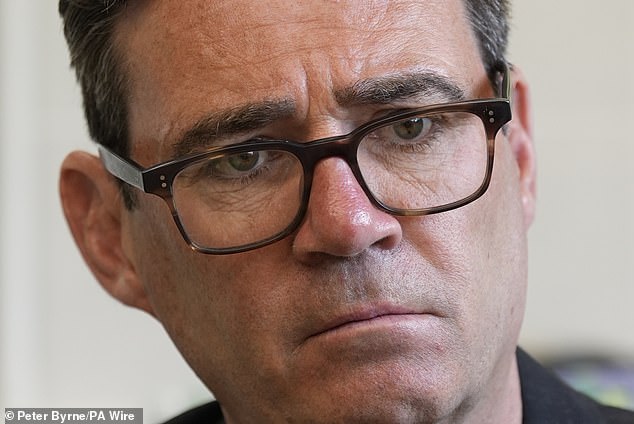
Brace yourself for another round of tax hikes. Keir Starmer’s resignation as Prime Minister has left the door wide open for Andy Burnham to move into Downing Street.
He could be announced as PM as early as July 16 if he is the only candidate.
Mr Burnham has voiced support for a range of radical tax reforms and shake-ups during his years of campaigning for Labour.
And he made a series of commitments during his successful by-election campaign in Makerfield, which included big spending plans that he will need to fund.
So, what will a new prime minister mean for our personal finances and what can you do to fight back today? Here’s everything we know about Andy Burnham’s tax wish list and what he’s promised so far, from pensions and mortgages to inheritance and property taxes.

Mr Burnham has voiced support for a range of radical tax reforms and shake-ups during his years of campaigning for Labour
Property taxes
Mr Burnham has long been in favour of shaking up Britain’s property taxes.
When he ran for Labour leadership in 2010, he proposed a ‘land tax’ that would replace stamp duty with an annual levy paid by homeowners based on the value of the land their property is built on.
A land tax ignores factors such as how big a home is or how many bedrooms it has and instead is essentially a tax based on a property’s location, the size of the land it’s built on and its potential for future development. This type of tax would typically be paid by property owners and not tenants.
More recently, Mr Burnham has supported a proposal by the campaign group Fairer Share, which has called for a similar principle but based on the value of the property rather than the land.
This would replace stamp duty and council tax with a single annual levy set at 0.48 per cent of the property’s value. It would mean that instead of paying stamp duty when you buy a home, you would pay tax each year.
Tenants and homeowners with lower-value properties would save money under these reforms. Fairer Share claims 18million households in England would pay less than they currently do, with an average annual saving of £556.
Someone in a home worth £250,000 would pay £1,200 per year. This is almost half the average council tax currently paid by a band D home in 2026-27, which is £2,392, according to the Ministry of Housing, Communities and Local Government (MHCLG). This household would have the added benefit of no stamp duty when they move.
However, those in more expensive homes could be penalised.
Someone in a home worth £1.2million would pay £5,760 per year. Homes in council tax band H, the highest band, were charged an average of £4,600 per year, according to MHCLG.

Mr Burnham has supported a proposal by the campaign group Fairer Share, which has called for a tax based on the value of the property rather than the land
Footing these higher bills could be a problem for those who are property-rich but cash-poor, which is often the case for pensioners.
Council tax has also been criticised because the rates are set by local authorities, meaning someone in a band D home in Dorset pays much more (£2,765) than someone in Wandsworth (£1,028). A flat 0.48 per cent rate would make things more equal.
Stamp duty has long been a barrier to moving home, so scrapping it could revitalise the housing market. Nicholas Mendes of mortgage broker John Charcol says it ‘could get more people moving and shorten chains’.
Critics point out the new system would be a challenge to introduce and could take years to implement, as it would require re-valuing all homes in Britain. The property values that council tax bills are based on are from 1991.
Prasam Patel, of tax firm Alvarez & Marsal, says: ‘This tax would be extremely complex to introduce while treating current owners fairly.’
It would also hit landlords, as the burden would shift away from tenants who currently pay the council tax.
Tom Bill, head of UK residential research at Knight Frank, said: ‘At a time when many landlords are struggling to make everything stack up financially, any further disincentive is likely to result in less stock available to tenants and higher rents.’
What can you do?
Moving home based on tax changes that might never happen is not advisable. If a land value tax did begin to look likely, those who own modest properties on large plots of land could consider selling some of the land to lower their tax bill – though this is an extreme option, and capital gains tax might be payable depending on the size and whether it has planning permission.
If you don’t know how much your home is worth, have a look at similarly sized homes in your area which are listed for sale with estate agents to compare, or get it professionally valued.
Most of all, don’t panic. If a proportional property tax was put in place, it is likely there would be a deferral scheme for those who could not afford to pay upfront, which would allow them to delay payment until they sold the home. And as with council tax, there could be discounts and exemptions for single people and those on low incomes.
Income tax
While campaigning for the Makerfield seat, Mr Burnham said he would honour Labour’s manifesto tax pledge to not raise income tax, National Insurance (NI) or VAT.
But his allies are already pushing him to break this promise to fund his costly spending plans, or risk being ‘hamstrung’ in office. One minister told this newspaper the ‘manifesto was written at a certain point in time but so much has changed’ and called for an increase in income tax to fund defence spending.
Mr Burnham has previously voiced punchy views on how he would reform income tax, given the chance. Speaking on the BBC’s Question Time on June 4, he said he would raise the threshold at which you start to pay income tax from £12,570, known as the personal income tax allowance.
He said: ‘On the personal allowance, I’ve heard on so many doorsteps, and I’ve said to my team, let’s have a proper look at this and let’s develop a policy.’
This would be good news for millions of workers and pensioners who would get a greater tax-free allowance.

Mr Burnham has previously voiced punchy views on how he would reform income tax, telling the BBC’s Question Time he would raise the threshold at which you start to pay it
The allowance has been frozen until April 2031, as part of Rachel Reeves’ stealth raid on incomes. An increase in the personal allowance would be welcomed by millions of pensioners who, from 2027, are on track to incur an income tax bill on their state pension for the first time. This is because while the allowance has been frozen, the state pension has continued to rise each year and will soon exceed the threshold for the first time.
But Mr Burnham has also said he would fiddle with the headline tax rates. He said last year there was ‘definitely a case’ to bring back the 50 per cent top rate of income tax before the end of the current Parliament. Currently, those earning above £125,140 a year pay the top rate of 45 per cent.
This might go hand in hand with a lower starting rate of income tax for lower earners, at 10 per cent instead of the current 20 per cent. This would be similar to Gordon Brown’s policy which introduced a 10 per cent starting rate in 1999 on the first £1,500 of taxable income to help low-earners. The tax band was abolished by Brown in 2008.
What you can do to keep taxes low
These reforms would be welcome news for those on lower incomes, while those with large salaries may have to take action to mitigate the cost of higher taxes.
Anyone near the additional rate threshold could make sure their taxable income is below the £125,140 a year mark to avoid paying 50 per cent tax on any of their earnings. The easiest way to do this is by paying a larger amount into your workplace pension each year, as they would receive tax relief on this.
If you’re married or in a civil partnership, you can work together to reduce your taxes. Consider sharing assets between you to make full use of your allowances. The personal allowance could become even more valuable for households if Mr Burnham decides to raise it.
Inheritance tax
Inheritance tax could be completely overhauled if Andy Burnham follows through with the vision he has laid out in the past.
Under current rules, everyone can pass on £325,000 tax free (or £500,000 where passing on a family home to direct descendants). Everything above this allowance is taxed at a flat rate of 40 per cent.
Mr Burnham has suggested that inheritance tax could be abolished – but not in isolation. It could be replaced with a new care levy, to help fund the cost of social care.
Another option he mooted at a conference in 2023 was replacing inheritance tax with a flat rate of 10 per cent on all estates on death.
In 2024, he wrote on social media platform X: ‘I would be prepared to accept the abolition of inheritance tax on condition that we tax the wealthy properly while they are alive.’
And earlier this year, he said: ‘I know there’s a great resentment about inheritance tax, so actually just, you know, take that away, perhaps, and look at a care levy.’
Should a 10 per cent flat rate go ahead, millions more families would pay inheritance tax as there would be no tax-free allowance. An estate worth £100,000 would face a £10,000 bill for example, whereas currently there would be nothing to pay.
However, a 10 per cent levy would be far more palatable to many wealthier families than the current 40 per cent rate. An estate worth £1million, for example, would pay £100,000.
Currently, the tax bill on that estate would be £270,000 (40 per cent on the sum above the tax-free allowance of £325,000). If passing on a family home as part of the estate, it would be £200,000.
Such an overhaul would be complicated to map out and implement so would be unlikely to come into force for some time.

Should a flat rate go ahead, millions more families would pay inheritance tax as there would be no tax-free allowance, although it would be far more palatable to many wealthier families
However, there are some measures that could be implemented more quickly.
Andy Burnham said earlier this year that, if made prime minister, he would ‘look again’ at the increase in inheritance tax for farmers.
Changes announced by the Chancellor in the 2024 Autumn Budget and that came into force in April this year mean that tens of thousands of farms could be liable for inheritance tax for the first time when the current owner dies.
Rules around so-called agricultural property relief (APR) and business property relief (BPR) previously meant that most farms could be passed on free of inheritance tax. Now, the first £1million of combined APR and BPR is free of inheritance tax, but anything above that is taxed at 20 per cent.
Andy Burnham has suggested he could ‘revisit’ these rules.
Meanwhile, pensions will no longer be exempt from inheritance tax from April next year under current plans. The change was announced in the Autumn 2024 budget and although Mr Burnham has not indicated he would halt this, doing so could make sense if an inheritance tax overhaul is planned. Adding further complexity to the current system may not make sense ahead of wholesale change.
What you can do now
Make use of the allowances currently available.
You can make unlimited gifts without risking an inheritance tax bill so long as you live for seven years after making them. If you die within three and seven years and your estate exceeds its tax-free allowances, gifts will be taxed on a sliding scale.
You can give away up to £3,000 per tax year without risking a bill and give up to £250 to as many individuals as you like.
You can also give as much as you like so long as you do so out of income rather than capital, the gifts do not affect your own standard of living and you make the gifts regularly. This rule – known as gifts out of surplus income – is one of the most generous allowances and can be a great way to top up grandchildren’s Junior Isas, for example, or help pay towards school fees.
Keep good records when making gifts to make it easier for your executors when sorting out your estate. Don’t give away wealth that you might need yourself – and remember to factor in costs you may encounter in future, for example, if you need care in later life.
Mortgage rates
A shift in mortgage rates is often one of the most immediate impacts when there is a change in prime minister.
This is because gilt yields – which is the return investors receive on Government bonds – determine the cost of borrowing for mortgage holders. If gilt yields climb, the cost of mortgage borrowing tends to follow within days.
If the bond markets perceive that government borrowing will rise and spending will go up under Andy Burnham, gilt yields could increase. That’s because buyers of debt become less confident in the government’s ability to balance the books and need to be coaxed with a higher yield to convince them to buy its bonds.
The average two-year fixed mortgage rate today is 5.58 per cent, while the average five-year fix is 5.56 per cent.
Nicholas Mendes at broker John Charcol says: ‘If the perception is that there will be more borrowing, looser rules and more spending with no credible way to fund it, gilt yields drift up and fixed rates stay higher for longer.’
Mr Burnham said last year that Britain must stop being ‘in hock to bond markets’, which raised fears that he could increase borrowing without sufficient heed to the impact it could have on gilt yields. However, he has since attempted to row back on this and taken steps to prove his economic credibility, for example by bringing in top economists to advise him, including former Bank of England economist Andy Haldane, former Office for Budget Responsibility chairman Richard Hughes and City veteran Lord O’Neill.
A loss in confidence among bond traders can have rapid and disastrous consequences, as illustrated by former prime minister Liz Truss’ mini-Budget, where the announcement of unfunded tax cuts led to a mortgage rate spike.
Average two-year and five-year fixed mortgage rates both went above 6 per cent. In November 2022, two-year fixed reached 6.47 per cent and five-year fixes reached 6.32 per cent, according to data firm Moneyfacts.
Someone with a £200,000 two-year fixed mortgage on a 25-year term would have had an average rate of 2.34 in November 2021, paying £881 per month. If they had to remortgage to the average rate in November 2022, their payment would have soared to £1,347 per month – a £466 rise.
Adam French, head of consumer finance at Moneyfacts, says: ‘The lessons of the 2022 mini-Budget remain fresh. If policies don’t add up, the subsequent loss of confidence can quickly drive up borrowing costs. Once again, it is households which risk picking up the tab if market confidence is undermined.’
What you can do now
Households who need to remortgage can generally secure a new fixed rate six months before their old one ends, retaining the option to switch again if rates fall.
So it’s a good idea to contact a mortgage broker now and lock in a rate to protect yourself against future rises.
State pension and Waspi women
In his campaign for election as an MP, Mr Burnham vowed to keep the state pension triple lock. This is the mechanism that ensures the state pension rises each year by the highest out of inflation, wage growth or 2.5 per cent.
However, pressure has been mounting for the government to scrap this generous guarantee, which has been branded unsustainable and too costly by think-tanks.
Lord O’Neill of Gatley, the former Goldman Sachs economist and adviser who has been in talks with Mr Burnham, is reportedly trying to persuade him to ditch the triple lock.
Steven Cameron, public affairs director at Aegon, said the triple lock must urgently be addressed by the new PM. He said: ‘While remaining popular among pensioner voters, retaining and often boosting their purchasing power, the mathematics just aren’t sustainable in the current form over the decades ahead.

Pressure has been mounting for the government to scrap the triple lock, which has been branded unsustainable and too costly by think-tanks
‘There’s no magic pot of money sitting to pay for state pensions – they’re paid for by today’s workers on a ‘pay as you go’ basis. With an ageing population and fewer workers supporting more pensioners, the current system is already creaking at the seams and without reform the triple lock will place an unprecedented burden on working-age taxpayers, raising serious questions around intergenerational fairness.’
Women who were hit by changes to the state pension age and who have been denied compensation by Starmer’s government are holding out hope for a payout.
‘Waspi’ (Women Against State Pension Inequality) women born in the 1950s, who claim they were not told about changes to their state pension age, have long been calling for compensation.
Mr Burnham previously supported these women’s calls for compensation. However, he has recently rowed back on this and ruled out giving financial compensation after a backlash over the cost. He said he was open to the idea of giving them other benefits, such as subsidised transport.
Sarah Coles, head of personal finance at AJ Bell, said: ‘[Mr Burnham] briefly reopened the debate around compensation for women born in the 1950s who were affected by changes to the state pension age, saying there should be some recompense.
‘However, his team clarified that he hadn’t meant full financial compensation. One suggestion is that they might get earlier access to cheaper travel schemes.’
What you can do to safeguard your retirement
The best way to protect your retirement funds is to make sure you will receive the full state pension and to boost the amount you are saving into a workplace or private pension pot.
Start by figuring out how much you can expect to receive from the state pension and if you are on track to receive less than the maximum, take action.
If you have missing years in your National Insurance record, you can make voluntary contributions to fill those years. This can increase the amount you will receive in the state pension. You can only do this if the missing national insurance contributions are in the past six years.
How much you will pay depends on the rate charged in those years. In 2025/26, the charge is £923 for the year.
If the state pension triple lock is axed, you may need to find other ways of boosting your income in retirement.
You could also consider delaying the date at which you start taking your state pension. Your weekly payout rises by 1 per cent for every nine weeks you defer, adding up to 5.8 per cent for every year you push it back.
If you are saving into a workplace pension, you will be paying at least 5 per cent of your salary into your pot monthly, while your employer will typically pay 3 per cent.
Check if your employer will match your monthly contributions as this could significantly boost your retirement nest egg. If you can afford to, consider increasing the amount you pay in as it is a tax-free way of saving.
Capital gains tax
A renewed push for a capital gains tax (CGT) hike is likely under an Andy Burnham premiership.
Capital gains tax has long been a target for those arguing for more taxes on wealth. Campaigners, such as think-tank the Institute for Public Policy Research, say that tax rates on investment and property profits should be level with income tax.
Currently, income tax rates stand at 20 per cent, 40 per cent and 45 per cent, while CGT rates are 18 per cent for basic rate taxpayers and 24 per cent for higher rate taxpayers. Profits are added to your other income to decide the rate paid.
The rates of CGT were hiked by Rachel Reeves in her October 2024 Budget, from 10 per cent and 20 per cent, respectively. Before this, former chancellor Sir Jeremy Hunt had slashed the annual capital gains tax-free allowance from £12,300 to just £3,000.
Equalising the rates would create a level playing field in how income from employment and profits from investments are treated. It would also prevent business owners and executives from taking some of their income via company shares to benefit from lower tax rates.
But plans to equalise CGT and income tax rates have been criticised as not recognising the investment or entrepreneurial risk being taken on these assets. There is also a strong argument that if CGT rates were raised, a form of indexation should be brought back into the system, which would mean only gains above inflation are taxed.
Last month, think-tank the Resolution Foundation urged Labour to reset its economic policy and called for CGT rates to rise towards dividend and income tax levels. However, it added that inflation indexation should be introduced ‘so that only real returns are taxed, which would substantially reduce the disincentive to invest and amount to a pro-growth reform’.
How to protect against a CGT hike
Investors who have made substantial profits on shares or property could consider crystallising some gains, which is done by selling up or giving assets away. Any unused portions of this tax year’s £3,000 CGT-free allowance could be used, with current capital gains tax rates incurred above that.
Tax experts and financial planners warn that decisions to sell for tax purposes should be carefully considered and professional advice sought. It’s also worth bearing in mind that if indexation were re-introduced, some long-term investors could end up benefitting despite CGT rates rising.
Married couples and civil partners can pass assets to each other free of CGT, which enables them to make use of both their tax-free allowances and can also be beneficial if one partner pays a lower tax rate.
The recent CGT raids on investment profits highlight the importance of using the tax-friendly shelter of a stocks and shares Isa wherever possible. Profits and dividends within an Isa are tax-free. CGT rules prevent investors from selling shares to crystallise a gain and then buying the same stock back within 30 days.
However, there is an exemption that allows assets to be sold and bought back immediately with an Isa. This is known as a Bed and Isa – and most investment platforms will carry it out for customers.
Small businesses
A policy that would be popular with small businesses is reducing the National Insurance Contributions they pay on their employees’ wages.
These were increased by Rachel Reeves in the 2024 Budget. From April 2025, the rate of employer NICs rose from 13.8 per cent to 15 per cent. Employers also started to pay NICs on earnings above £5,000 per year, down from £9,100 previously.
Burnham described Reeves’ move as the ‘wrong decision’ – though it is not clear whether he would try to reverse it.
He has also suggested cutting business rates for some firms, which could be a boost for small businesses that operate out of physical premises.
For example, he proposed increasing the threshold at which they pay rates from £12,000 to £18,000. He has also said he would slash business rates on pubs and music venues by 20 per cent, and that shops, restaurants and cafes that only have one site could pay no rates at all.
Many businesses have seen their rates rocket in recent months due to a revaluation which came into force in April 2026.
Analysis by property firm Colliers showed that even with transitional caps, a typical independent pub could see its annual rates bill rise by 75 per cent in the next three years.
Colliers’ head of business rates, John Webber said: ‘Providing reliefs for pubs and music venues sounds all well and good, but it is short term and does little to address the fundamental flaws in a system that has left large parts of the hospitality sector –and other businesses – facing unsustainable business rates increases.’