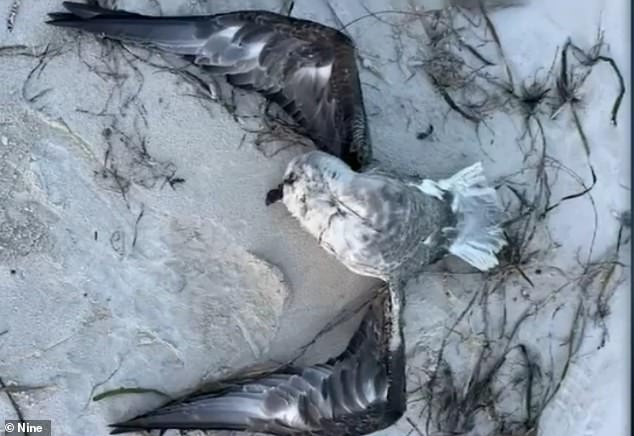
Urgent testing is underway on two seabirds found dead on a remote beach in South Australia, sparking fears that the H5N1 bird flu virus has spread to a second state.
It comes just days after Australia’s first two confirmed cases of the deadly variant were detected in Western Australia, sending several major poultry producers into voluntary lockdown.
Local tourism operator Rod Keogh was on his morning run along the beach at Fowlers Bay on South Australia’s west coast on Monday morning when he discovered the two birds along the shore, 360km from the Western Australian border.
The pair are believed to be different species of petrel.
A dead pelican was also found metres away on the same beach.
Mr Keogh contacted the national emergency hotline, prompting rangers in hazmat gear to arrive within two hours to collect the birds for testing.
‘For me to see the birds on the beach, as close as Western Australia is, it was worth reporting,’ he told Nine News.
They are among 11 birds currently being tested after two tested positive for the virus at Esperance on the Western Australian south coast last week.

Two seabirds found dead on a remote beach on South Australia’s west coast on Monday

The birds have been taken away to be tested for the the H5N1 bird flu virus
Mr Keogh hopes the virus has not spread, amid fears it could impact an important sea lion population at Nuyts Reef, near the town.
‘Nuyts Reef is one of the largest Australian sea lion populations in the country,’ he told the ABC.
‘It is absolutely critical that we maintain vigilance if we’re seeing something on the beaches that is out of the ordinary, especially pelagic birds.’
More than 100 reports of potentially sick birds have been made to the national emergency hotline in recent days.
Authorities have ramped up monitoring and will learn in the coming days whether the virus has spread to SA.
‘If that test indicates it may be bird flu, it’s then sent to the Australian Centre for Disease Preparedness in Geelong, [which is] the national protocol,’ South Australia’s Primary Industries Minister Claire Scriven told ABC Radio.
‘We’re obviously working with our national counterparts and the other states as well to make sure we’re all abiding by the same protocols.
‘We hope this doesn’t get to South Australia, but we know, of course, that it may.’

The seabirds were found washed up at Fowlers Bay, which is 360km from the Western Australian border

Eleven birds are currently being tested after two tested positive for the virus at Esperance
SA Premier Peter Malinauskas added: ‘As a result of this detection [in Australia] there are a range of funding arrangements that kick in.
‘We don’t know if those birds (carrying the H5 variant) transmitted it to other birds that might migrate to South Australia.
‘These are live questions that we just don’t have the answer to.’
Western Australian Agriculture Minister Jackie Jarvis added that there was no confirmed evidence the virus had spread.
‘I’m advised it’s not unusual for these types of migratory birds to be found along the West Australian coast, particularly this time of year when weather events can blow them off course,’ she said.
‘And so it is not a concern that these birds were found. I guess because of the species, the migratory nature of these birds, that’s why it was determined that they should be tested.’
Meanwhile, Aussies have been reassured poultry and egg products are safe to eat.
There has been no evidence indicating the strain has been found in local poultry or agriculture, according to federal Agriculture Minister Julie Collins.
‘We’re not sure yet if it’s established in wildlife in Australia,’ she told ABC News Breakfast on Tuesday.
But the minister warned lessons from overseas indicate the virus cannot be prevented from spreading, and Australia cannot stop it arriving via migratory birds.
‘Experts will decide whether or not it’s eradicable or whether or not we manage the disease,’ she added.