



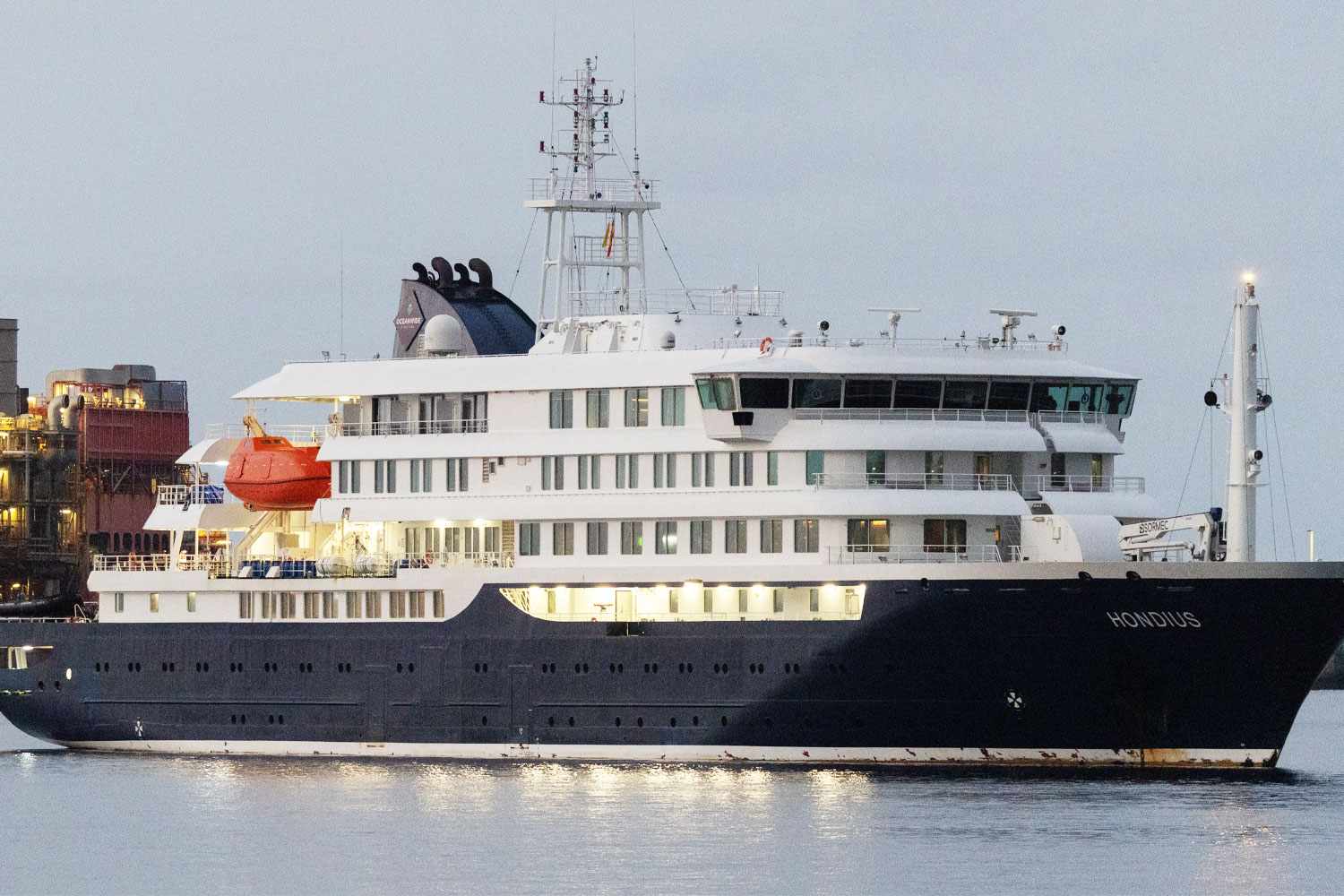
The positive test marks the first case of the disease stemming from the cruise in North America and the 10th overall
:max_bytes(150000):strip_icc():format(jpeg)/MV-Hondius-051726-f4f330751a2f490bb7ef639e79fd16f6.jpg "The MV Hondius")
Credit: Chris McGrath/Getty
NEED TO KNOW
- A Canadian who sailed on the MV Hondius cruise ship has tested positive for hantavirus, health officials confirmed
- One of four Canadians who returned home from the ship last week received a “presumptive positive,” the Public Health Agency of Canada confirmed, adding that further testing was set to be conducted
- The positive test marks the first case of the disease stemming from the cruise in North America and the 10th overall
A Canadian who sailed on the MV Hondius cruise ship has tested positive for hantavirus, health officials confirmed — marking the first case of the disease stemming from the cruise in North America.
On Sunday, May 17, the Public Health Agency of Canada confirmed that one of four Canadians who returned home from the ship last week had received a "presumptive positive," and that further testing was set to be conducted at the country's National Microbiology Lab.
"One individual’s sample was confirmed positive for hantavirus," the agency said in a statement.
A second person who was traveling with the confirmed case has tested negative. Both people are from the Yukon and are in their 70s, and they are now at a hospital in Victoria, officials said.
The other two Canadians aboard the cruise ship are a person in their 70s from Vancouver Island and a British Columbia person in their 50s who lives abroad. All four people are now in isolation.

Credit: Joao Luiz Bulcao / Hans Lucas / AFP via Getty
"I know news like this can be very concerning and can cause us to think about what we went through together over the last number of years, but I want to emphasize that hantavirus is a very different virus than the other respiratory viruses that we've been dealing with — like COVID, like influenza, like measles — and it remains one that we do not consider to have pandemic potential," Dr. Bonnie Henry, the provincial health officer in British Columbia, told the CBC.
Henry said none of the Canadian cruise passengers came into contact with the public after they landed at Victoria International Airport and were taken to the hospital last Sunday, May 10.
Although the four Canadians were initially required to isolate for a minimum of 21 days, Henry said that health officials are currently reassessing their isolation requirements following the positive test.
Three people have died since the hantavirus outbreak began on the MV Hondius last month, and the Canadian patient is the 10th person from the ship to test positive, according to The Washington Post.
The three deceased people are believed to be a Dutch couple and a German national, NBC News reported. One person is still being treated in an intensive care unit in South Africa.
"The overall risk to the general population in Canada from the Andes hantavirus outbreak linked to the MV Hondius cruise ship remains low at this time," the Public Health Agency of Canada added. "All confirmed cases to date have been passengers or crew on the MV Hondius cruise ship."
The MV Hondius originally carried about 150 occupants. The ship left Argentina on April 1 for the Canary Islands, with stops in Antarctica, the Falkland Islands, South Georgia, Nightingale Island, Tristan, St. Helena, Ascension and Cape Verde, The New York Times previously reported.
Never miss a story — sign up for PEOPLE's free daily newsletter to stay up-to-date on the best of what PEOPLE has to offer, from celebrity news to compelling human interest stories.
On May 11, the U.S. Department of Health & Human Services (HHS) announced that 18 American passengers who were on the MV Hondius cruise ship at the center of the hantavirus outbreak had returned to the country.
Health officials said 16 of the passengers were taken into quarantine at the University of Nebraska Medical Center in Omaha and two were sent to Emory University Hospital in Atlanta.
Hantavirus is an infectious disease that's normally spread through contact with rodents. The virus is typically transmitted to humans when they are bitten or come into contact with the urine, droppings and saliva of an infected rodent.
However, with the Andes strain, which has caused the current outbreak, transmission occurs human-to-human following close and prolonged contact during the early phase of the illness, when the virus is more transmissible, according to WHO.