A French hard-right activist is facing prison time for saying on live television that ‘African, Black and Arab’ immigrant men are the ‘main danger to women’ in France.
Anne-Thaïs du Tertre d’Escoeuffant, who uses the pseudonym Thaïs d’Escufon on social media, was sued by a French anti-racism organisation over the remarks and is due to learn the court’s decision on Thursday.
The 26-year-old activist’s case received little attention in French media, but gained international interest after d’Escoeuffant posted a 25-minute video on X about comments she made during a BFM TV broadcast discussing the rape of a French woman by a migrant.
The case struck a personal chord for d’Escoeuffant, who says she herself was the victim of an attack involving a migrant.
Her video quickly went viral and was liked by top figures such as billionaire Elon Musk, reigniting a debate over immigration and freedom of speech.
Speaking to the Daily Mail shortly before learning her fate, d’Escoeuffant insisted that the comments for which she is being prosecuted were rooted in her own experience.
She claims that in late 2022, while returning home from the gym, a Tunisian migrant followed her into her apartment building, entered her flat behind her, locked the door and kept her there for around 20 minutes.
At first, she said, the situation was ‘very confusing’. The man allegedly claimed he was being pursued by authorities and repeatedly told her: ‘Please don’t call the police. I won’t harm you. I just need refuge in your home for 10 minutes.’

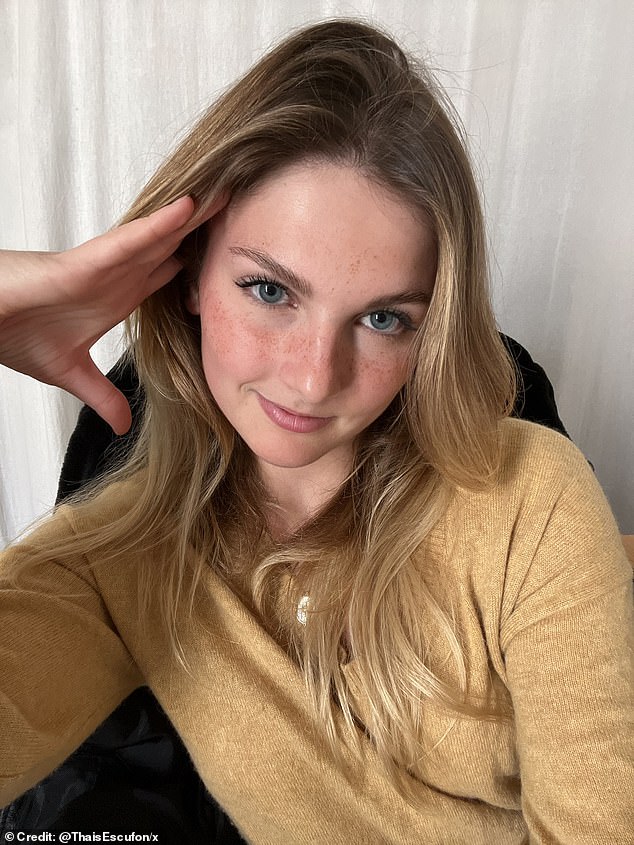
Anne-Thaïs du Tertre d’Escoeuffant is a hard-right French activist who was taken to court over comments she made on live television

D’Escoeuffant argued that many French people are privately frustrated with immigration but are reluctant to express those views publicly
As time passed, however, d’Escoeuffant said she became increasingly frightened as the man began making comments about her body.
She said she tried to remain calm because he had taken her phone and she felt she had no way of calling for help. When he eventually appeared ready to leave, she said he asked: ‘Can you give me a kiss?’
Hoping he would go, d’Escoeuffant said she agreed to kiss him on the cheek. But she alleges that he then grabbed her wrists, forced her onto a footstool and demanded that she perform a sexual act on him.
‘I begged him not to do it,’ she recalled. ‘I said “I was just nice to you. I did everything you wanted. Please just leave”.’
The man eventually left, and d’Escoeuffant said she immediately went to the police.
She claims officers told her that identifying the suspect would be difficult because of a large backlog of 6,000 similar cases they were investigating involving ‘African and Black migrants’.
A few days later, she was invited on French television to discuss the incident after people online accused her of fabricating the story.
She says she broke down in tears during the interview and was challenged on her decision to describe the man as a Tunisian migrant, with panellists asking why she considered his background relevant.
A year later, another channel invited her to comment on the rape of a girl by a migrant.
‘It was pretty similar to my own story,’ d’Escoeuffant said, ‘Because he followed her, and he entered behind her in her courtyard. I said I support her bravery in stating facts.’
When panellists tried to tell her that the problem was men, she replied: ‘Actually, the main danger for women in France are African immigrant and Arab immigrant men.’
Her remarks incited an on-screen uproar, leading producers to confront d’Escoeuffant off-camera. They reportedly shouted that she never would have been invited onto the show had they known she would make such a statement.
Things further spiralled when she received a letter saying she had been summoned to court to be tried on the charge of ‘public insult against a person or a group of persons on account of their origin, ethnicity, race or religion.’
Dilcrah, a French anti-racist organisation was suing her for the comments she had made on BFM TV.
‘I appeared in court on April 8 of this year. I defended myself by saying that I am a woman, and I feel increasingly unsafe on the streets and that it is getting worse. I gave them numbers and statistics to support my statements,’ d’Escoeuffant said.
The prosecutor, however, argued that d’Escoeuffant was portraying herself as a victim and suggested that, as a social media activist, she had used the controversy to raise her profile and generate income.
Referring to the migrant break-in she says she experienced several years earlier, the prosecutor argued that d’Escoeuffant was using a “poor incident to justify hate speech”, adding that such remarks had “no place in our democracy”.’
The prosecution requested a custodial sentence, a move that d’Escoeuffant said left her shocked.
‘France is not a free speech country,’ she said. ‘Anti-white discourse is ok, but the second you say that migration isn’t a blessing, you are intimidated.’
D’Escoeuffant argued that many French people are privately frustrated with immigration but are reluctant to express those views publicly.
‘The majority of the population is fed up with this,’ she said, adding that many voters are deterred from supporting right-wing parties because they fear being labelled racist or extremist.
‘The right-wing is so demonised by the press and the media that say they will be the return of fascism,’ she said.
The activist claimed that immigration has transformed parts of France in a way that many ordinary people no longer recognise.
‘The cities have changed so much,’ she said. ‘Sometimes you take the bus and after a few stations you have the feeling you took a plane to an African or Arab country.’
Asked what Europe might look like in 10 or 20 years if current immigration trends continue, d’Escoeuffant said: ‘France as we knew it will be definitely gone in maybe 20 years,’ she said.

Despite the backlash, d’Escoeuffant insisted she has no intention of abandoning her activism
She argued that women are increasingly avoiding certain areas of major cities because they do not feel safe.
Speaking about parts of Lyon, where she used to live, she said there were neighbourhoods where women feel unwelcome and intimidated, and are not allowed into certain bars.
‘Women don’t go there because they don’t feel safe,’ she said. ‘But many of them are afraid to say it because they don’t want to be called racist.’
The 26-year-old also claimed she has repeatedly faced hostility and violence because of her activism from Antifa and left-wing activists.
Recalling one incident outside a bar, she said a group of men confronted her after recognising her from social media and began calling her racist.
A fight ensued and one of the men allegedly had a weapon. ‘They were waiting for us outside,’ she said. ‘Afterwards we saw that one of my friend’s shirts had been damaged by a knife. We were shocked that he hadn’t been hurt.’
On another occasion, she claimed that a group of anti-fascist activists followed her and her friends through Paris before attacking them.
‘They started to slap us,’ she alleged. ‘We entered a restaurant and they took chairs to throw at us.’
D’Escoeuffant has been banned from Instagram 15 times for her hard-right views and has had numerous bank accounts shut. She said she is even too radical for France’s right-wing parties.
Despite the backlash, d’Escoeuffant insisted she has no intention of abandoning her activism, and believes France must crack down on immigration while encouraging native French people to procreate.
‘The only solution is re-migration. We should shut the borders, and have a policy of natality – French people having more children,’ she said.