



April 14, 2026
3 min read

Colombia will euthanize Pablo Escobar’s invasive ‘cocaine hippos’
After attempts at relocation and sterilization have failed, invasive hippos introduced by the infamous drug lord will be culled, the country announced

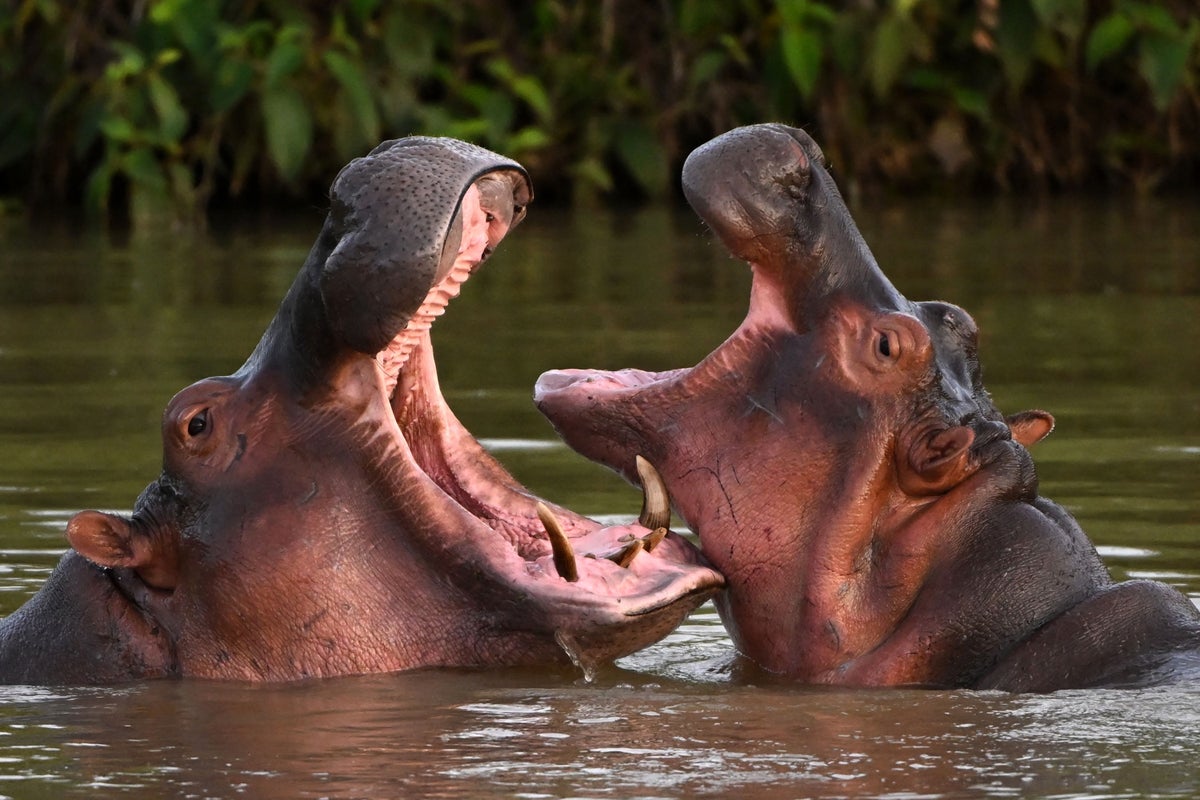
Hippos that are descendants of the ones introduced by drug kingpin Pablo Escobar are seen in the wild in a lake near the Hacienda Napoles theme park, once the private zoo of Escobar, in Doradal, Antioquia Department, Colombia,in 2023.
RAUL ARBOLEDA/AFP via Getty Images
After two years of failed attempts at relocation and sterilization, Colombia’s government has decided it will euthanize 80 of the at least 169 “cocaine hippos” that were once owned by notorious drug trafficker Pablo Escobar. The decision is triggering divided reactions among scientists and activists.
“Without this action it is impossible to control them,” said Colombia’s environment minister Irene Vélez at a press conference on Monday. Citing estimates that the population could reach at least 500 individuals by 2030, “affecting our ecosystems and native species,” she added that “it is our responsibility to take this action.”
Escobar illegally introduced four hippos (Hippopotamus amphibius) to one of his estates in the Antioquia region of Colombia in 1981. After his capture and death in 1993, the animals escaped and began reproducing in the wild, where they became a highly threatening invasive predator to native species. The animals’ large size also alters river systems and pollutes the water with waste, depleting its oxygen and overloading it with nutrients. This can kill fish and plants and affect communities that depend on these waterways. Hippos have also caused traffic accidents and attacked people and boats in recent years.
On supporting science journalism
If you’re enjoying this article, consider supporting our award-winning journalism by subscribing. By purchasing a subscription you are helping to ensure the future of impactful stories about the discoveries and ideas shaping our world today.
In 2022 the government launched a sterilization program to slow reproduction of the hippos, which could number up to 200 individuals. At the same time, officials opened talks with seven countries and two international zoo and aquarium associations to relocate the animals. To date, no country has agreed to take even a single hippo, according to the Colombian government, which ultimately led its Ministry of Environment to opt for euthanasia. The ministry did not reply to a request for comment.
Widespread sterilization is not a viable option because it is a “cumbersome, costly and dangerous procedure that progresses at a very slow pace,” says Jorge Moreno Bernal, a Ph.D. candidate at the University of the North in Barranquilla, Colombia. A single sterilization requires cranes and puts human lives at risk, he says. “It is not like sterilizing a dog or a cat.”
In 2023 a study estimated that sterilization and relocation could cost at least $1 million to $2 million just to slow population growth enough to make long-term eradication feasible. Even then, hippos could remain on the landscape for another 50 to 100 years.
The new plan allocates around $2 million for chemical and physical euthanasia, and the government will implement a monitoring plan to identify which animals should be euthanized based on their size and proximity to human populations. At the same time, officials will continue efforts to sterilize the remaining population and seek relocation options within Colombia.
“The ideal scenario would be that no animals die,” says environmental law professor Luis Domingo Gómez Maldonado of the Cooperative University of Colombia. “But the reality is that, at this point, there is no other option.”
Moreno Bernal says the main reason governments did not act more forcefully in the past was because animal rights groups and activists led political campaigns against euthanizing the animals. “No one wanted to be the politician who ordered the killing of hippos,” he says. “That only caused the problem to worsen over time.” But over the past decade, there has been a major scientific awareness campaign about the risks and effects of hippos in the country, and it has led to broader public acceptance of the new measure.
It’s Time to Stand Up for Science
If you enjoyed this article, I’d like to ask for your support. Scientific American has served as an advocate for science and industry for 180 years, and right now may be the most critical moment in that two-century history.
I’ve been a Scientific American subscriber since I was 12 years old, and it helped shape the way I look at the world. SciAm always educates and delights me, and inspires a sense of awe for our vast, beautiful universe. I hope it does that for you, too.
If you subscribe to Scientific American, you help ensure that our coverage is centered on meaningful research and discovery; that we have the resources to report on the decisions that threaten labs across the U.S.; and that we support both budding and working scientists at a time when the value of science itself too often goes unrecognized.
In return, you get essential news, captivating podcasts, brilliant infographics, can’t-miss newsletters, must-watch videos, challenging games, and the science world’s best writing and reporting. You can even gift someone a subscription.
There has never been a more important time for us to stand up and show why science matters. I hope you’ll support us in that mission.