

Image source: Getty Images
Those wanting to earn a second income from dividend shares are likely to be attracted to a stock with a yield that’s close to 8%. However, experienced investors know that bigger gains could come from reinvesting the income received.
With this in mind, let’s take a closer look at the highest-yielding stock on the FTSE 100. And see how a modest investment could quickly grow without the need to find more cash.
Above average
Based on declared dividends over the past 12 months of 21.79p a share, Legal & General (LSE:LGEN) has a current (14 June) yield of 7.96%. Impressively, this is comfortably more than the Footsie’s 3.1%.
It means 3,650 shares (costing £10,000) could produce income of £796 over the next 12 months.
Indeed, a look back over the past few years shows that it’s always offered an above-average payout:
- 2025 – 8.03%
- 2024 – 8.20%
- 2023 – 8.98%
- 2022 – 7.82%
- 2021 – 7.50%
In cash terms, its 2025 payment was 20.5% higher than in 2021. Although this doesn’t mean its dividend is guaranteed, it can provide some comfort to those looking for steady and reliable income stocks.
Going nowhere?
However, since June 2021, the pension and investment group’s share price has done very little. Like all stocks, there have been plenty of ups and downs but, overall, it’s now pretty much where it was five years ago.
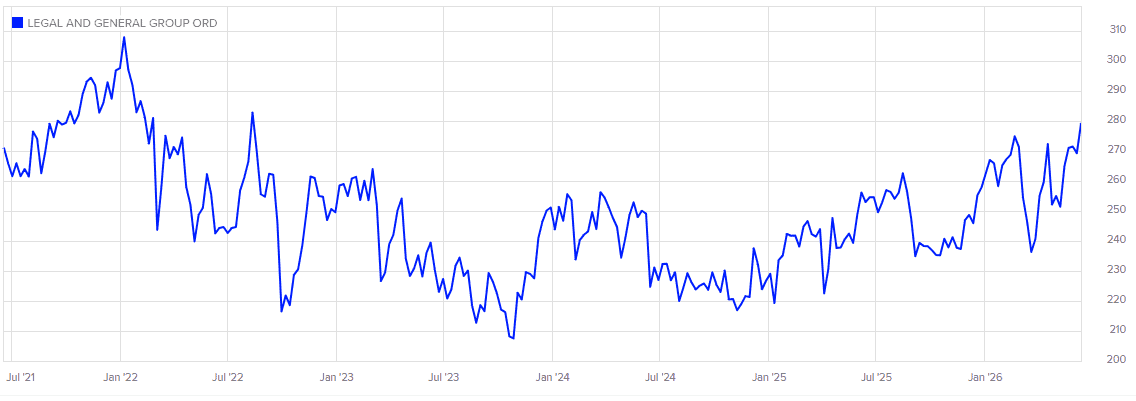
Clearly, this is disappointing to loyal shareholders.
But those who reinvested the generous dividends received (101.31p a share) over this period have done better.
Let’s examine this by considering how an investment of £10,000 (3,597 shares) in June 2021 has been boosted by adopting this approach.
What do the numbers tell us?
The numbers show that the dividends would have bought another 1,746 shares. This means the original investment of £10,000 is now worth £14,640.
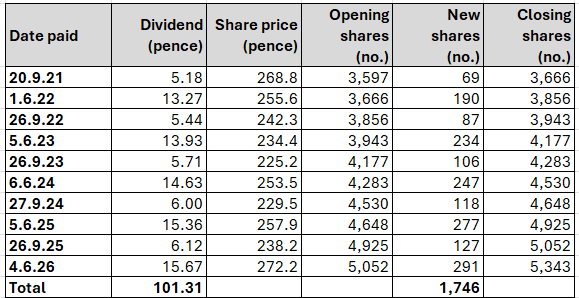
That’s an impressive 46.4% more from doing nothing, other than buying a few more shares twice a year. In contrast, someone who banked the dividends would have seen a 36.4% return.
This dividend reinvestment strategy is known as compounding. And it has plenty of fans. It’s been described as humankind’s greatest invention. Hyperbole? Perhaps. But I still think it’s a great way of seeking to boost long-term wealth. It shows that even if a share price underwhelms, it’s possible to do well from a portfolio of dividend stocks.
Thanks to its strong cash generation, Legal & General has been able to reward its shareholders generously in recent years. Of course, this could come under threat if new entrants were to take market share. And if its huge investment portfolio fails to perform in line with expectations, it might have to trim its dividend to cover its costs and to ensure that it’s able to meet all of its commitments to pensioners and savers.
My view
However, as far as I can tell, there’s no imminent threat to its payout. Its balance sheet looks healthy, the group continues to win lots of new business, and it’s operating in a UK retirement savings and income market that’s forecast to grow by approximately 70% by 2034.
For these reasons, along with its impressive dividend, I have the stock in my own portfolio. Indeed, I think others could consider it too.
Should you invest £5,000 in Legal & General Group Plc right now?
When investing expert Mark Rogers and his team have a stock tip, it can pay to listen. After all, the flagship Twelfth Magpie Share Advisor newsletter he has run for nearly a decade has provided thousands of paying members with top stock recommendations from the UK and US markets.
And right now, Mark thinks there are 6 standout stocks that investors should consider buying. Want to see if Legal & General Group Plc made the list?
James Beard owns shares in Legal & General plc.