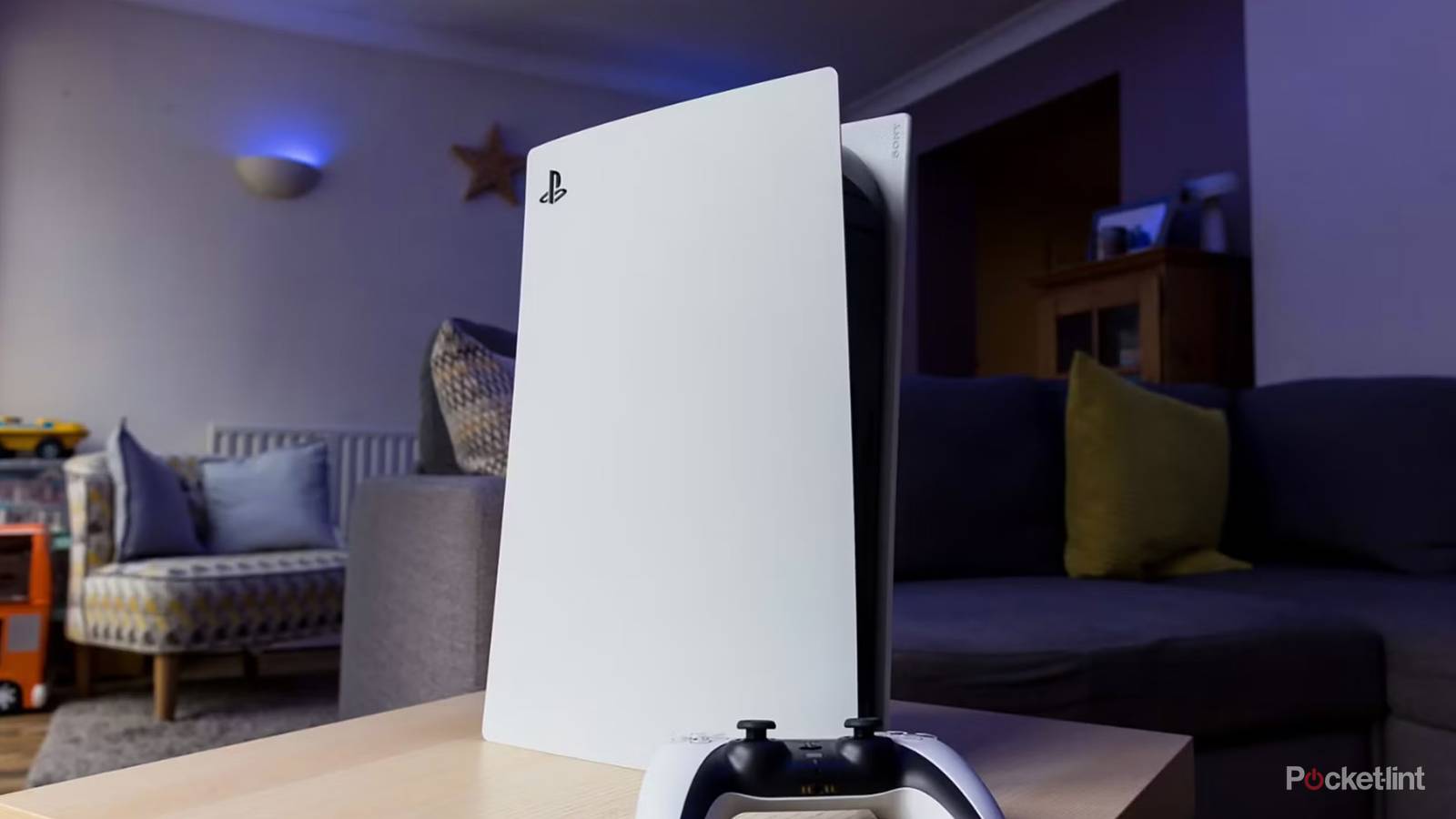
One of the many generational gaps out there is how seriously someone takes gaming on PCs and consoles. Anyone prior to Gen X — and even many of those folks — may still think of games as a hobby for kids, one which adults leave behind…not realizing how far games have evolved since Pac-Man or the original Super Mario. If you’re younger, though, there’s a good chance games are one of your primary forms of entertainment. You might even prefer playing 007: First Light to watching Goldfinger or Casino Royale, since it’s going to engage your reflexes and puzzle-solving skills.
All this is to say is that if you spend many hours gaming each week, it can be tempting to use a console as the centerpiece for all your entertainment, never bothering to switch to another input. Realistically, however, you should probably turn to native TV apps or an add-on media streamer if you want the best possible experience for movies and shows. Here’s why.

Game consoles through the ages
Trivia challenge
From Atari to PlayStation 5 — put your gaming knowledge to the ultimate test.
HardwareHistoryNintendoFirstsGenerations
Which company released the first commercially successful home video game console?
Correct! The Magnavox Odyssey, released in 1972, was the first commercially sold home video game console. It predated Atari’s famous Pong arcade machine and ran entirely without a microprocessor, using simple analogue circuitry.
Not quite. It was actually Magnavox with the Odyssey in 1972. While Atari is often mistakenly credited as the pioneer, Magnavox beat them to market by several years with this remarkably primitive but groundbreaking device.
What was the original name of the Nintendo Entertainment System in Japan?
Correct! The NES was launched in Japan in 1983 under the name Famicom, short for Family Computer. It became a massive cultural phenomenon in Japan before Nintendo adapted and rebranded it for Western markets in 1985.
Not quite. The correct answer is Family Computer, known more commonly as the Famicom. Nintendo launched it in Japan in 1983 and it dominated the Japanese market before being reworked and renamed the NES for its Western release.
Which console was the first to include a built-in hard drive as a standard feature?
Correct! Microsoft’s original Xbox, released in 2001, was the first console to ship with a built-in hard drive as a standard component. The 8GB HDD allowed game saves, downloadable content, and even music ripping, setting a precedent for all future consoles.
Not quite. The answer is the original Xbox from Microsoft, released in 2001. While the PlayStation 2 had an optional hard drive add-on, Xbox was the first console to include one as a standard built-in feature right out of the box.
The Sega Saturn and the original PlayStation were both released in 1994. Which region got them first?
Correct! Both the Sega Saturn and Sony PlayStation launched in Japan in 1994 before reaching Western markets. Japan has historically been the first region to receive major console launches, given that both Sony and Sega are Japanese companies.
Not quite. Japan was the first region to receive both consoles in 1994. North America and Europe had to wait until 1995 for both systems. Japan’s early access reflected the home-country advantage both Sony and Sega naturally prioritised.
Which console introduced the first official motion-sensing controller in a mainstream home gaming system?
Correct! The Nintendo Wii, launched in 2006, revolutionised gaming with its Wiimote controller that used accelerometers and infrared sensing to detect motion. It brought gaming to entirely new audiences, including families and older players who had never picked up a controller before.
Not quite. The Nintendo Wii was the correct answer. Launched in 2006, its iconic Wiimote changed how people interacted with games entirely. Sony did follow with the PlayStation Move, but the Wii was the mainstream motion-gaming pioneer that inspired the entire industry.
How many units did the PlayStation 2 sell worldwide, making it the best-selling console of all time?
Correct! The PlayStation 2 sold over 155 million units worldwide during its lifespan, cementing its place as the best-selling home console ever made. Its success was partly driven by its built-in DVD player, which made it an attractive multimedia device as well as a gaming machine.
Not quite. The PlayStation 2 sold over 155 million units, making it the best-selling console in history. A big part of its appeal beyond gaming was its built-in DVD player, which was a genuinely affordable way to watch DVDs at the time of its launch in 2000.
Which Nintendo handheld console was the first to feature a clamshell folding design?
Correct! The Game Boy Advance SP, released in 2003, introduced Nintendo’s first clamshell flip design for a handheld console. It also added a front-lit screen and a rechargeable lithium-ion battery, fixing two of the biggest complaints fans had about the original Game Boy Advance.
Not quite. It was the Game Boy Advance SP in 2003 that first used Nintendo’s clamshell design. While the Nintendo DS also used a clam shell form factor, the SP came first. The SP also added a rechargeable battery and a built-in screen light, which were long overdue improvements.
What was the name of Sega’s last home console before the company exited the hardware market?
Correct! The Sega Dreamcast, discontinued in 2001, was Sega’s final home console. Despite being innovative — it was the first console with a built-in modem for online play — it could not recover from the Saturn’s poor reputation and the looming launch of the PlayStation 2.
Not quite. The Sega Dreamcast was Sega’s last console before it exited the hardware business in 2001. It was actually ahead of its time, featuring online gaming via a built-in modem, but fierce competition from Sony and poor public perception ultimately ended Sega’s run as a console manufacturer.
Your Score
/ 8
Thanks for playing!
What’s so wrong with using a console for streaming?
Formats, interfaces, and more

In many respects, nothing. On a PlayStation 5 or Xbox Series X/S, you’re liable to have access to the most important streaming services, and the interface should be perfectly usable. Moreover, you can turn to a phone app or a dedicated remote if you don’t want to navigate with a gamepad, and those systems are far more powerful than any TV or media streamer on the market, despite having first shipped in 2020. If a machine can handle a game like Ghost of Yotei in real-time, streaming The Seven Samurai is going to be trivial, no matter if it’s in 4K.
The first area where things break down is HDR support. The PS5 lacks any support for dynamic formats, and the only one an Xbox can provide is Dolby Vision. HDR10+ is completely absent, even on 2024’s PS5 Pro. This matters because dynamic tech can adjust on a scene-by-scene or even frame-by frame basis, allowing it to squeeze out optimal detail. The static version of HDR10 on consoles will often be just fine — yet if you’re a diehard film lover, you’re missing out. Even Vision has its limitations. It’s not an option on Samsung TVs, since that company is HDR10+’s main backer, and it refuses to pay the Vision licensing fee. You can buy a MicroLED TV that costs as much as a Porsche, you still won’t get Vision support.
Another potential hurdle is casting from a phone or tablet. Neither console truly supports Apple AirPlay or Google Cast, which offer standardized ways to control music and videos from mobile apps. There are workarounds in some cases, but they’re just not worth the effort when you can probably cast straight to your TV. Perhaps this is why console makers haven’t made it a focus. From a practical perspective, there wouldn’t be any huge advantage beyond keeping you on the same input.
A PS5 may consume between 55 and 80W playing online video, and just lingering on the homescreen will consume over 40W.
A factor you might not have thought much about is power consumption. While streaming isn’t nearly as demanding on a console as 3D gaming, it’s still wildly inefficient next to streaming with your TV or a dedicated add-on. SolarTech estimates that a PS5 can consume between 55 and 80W playing online video, which is believable, given that Sony says lingering on the homescreen will consume over 40W. Conversely, a 2022 Apple TV 4K probably isn’t going to surpass 6W, and that difference is going to translate into a real impact on your power bill. Running a 40W device for four hours a day, every day could add $10 or more to your annual costs, and 80W would obviously double the amount.
Why are things so inefficient? To put it simply, any modern console is effectively a multipurpose PC, just equipped with gaming-oriented specs and software. It’s prepared to tackle anything at a moment’s notice, and that horsepower doesn’t come cheap. Indeed when you actually do play a 3D game, consumption on a PS5 or Xbox will sometimes top 200W.
I haven’t talked about the Switch 2 yet, but that’s for a good reason: Nintendo has given up on media streaming apps. At best you’ll have to deal with web workarounds, and regardless, the console’s HDR support is limited to HDR10. There isn’t even Dolby Atmos if you want spatial audio — you’re limited to 5.1-channel surround. That’s plent for the average person, yet a weird omission when Atmos is increasingly ubiquitous.
Speaking of app support, it isn’t always that great on Sony or Microsoft consoles. They don’t seem to be that high a priority for streaming companies, which is unfortunately logical, with the majority of viewers being on mobile or smart TV platforms. The consequence is that if a service does have a console app, it may not be as polished as it should be. It may not be critically broken, but that’s hardly a ringing endorsement.
Will next-gen consoles come to the rescue?
Some informed speculation on the future

Possibly. I should caution that few rumors have emerged about Sony or Microsoft’s next consoles, let alone concrete data, and Nintendo is probably many years away from a Switch 2 sequel. With that said, Sony and Microsoft’s machines are widely expected to become even more PC-like, one reason being price. With memory and GPU prices being in the stratosphere and unlikely to fall that quickly, it may be hard to justify a device that costs close to $1,000 (or more) without it being able to completely replace a desktop. Really, the only thing stopping you from treating an Xbox Series X like a Dell is its software compatibility.
At the same time, PC gaming is enjoying surprising popularity, and encroaching on formerly console-only territory. Yes, a mid-range or high-end rig could cost you between $2,000 and $3,000, but the benefit is a do-it-all device with access to a decades-old app catalog, with many older games costing less than $10 each. And if you don’t need the most photorealistic graphics, you can have a blast with a cheaper handheld PC like a Steam Deck or ROG Ally X, connecting it to a TV or monitor when you want a better view. I’d honestly rather play on my Steam Deck than any of the major consoles.
Sony and Microsoft’s machines are widely expected to become even more PC-like, one reason being price.
With a PC-like philosophy, we can probably assume better format support out of the box, including Dolby Vision 2 and/or HDR10+ Advanced. Microsoft may even push for more cross-compatibility with Windows, in which case streaming services would be able to kill two birds with one stone when it comes to app development.
Don’t expect any miracles in the energy department. Although smaller die sizes should make future consoles more efficient, that’s going to be offset by increased performance ambitions. It hardly matters if you make an EV or PEVmore efficient if you turn that upgrade towards speed or acceleration instead of range.

- 4K Capability
-
Yes
- Brand
-
PlayStation
- Storage
-
2TB
- Screen Resolution
-
VRR and 8K