This article is from Proof Positive, our friendly math newsletter that’s delivered to your inbox every Tuesday afternoon. Sign up today and read it first.
We all have some past events that we’d like to undo. These can be minor moments, such as a failed exam or an argument with friends, or world-changing incidents, such as the 2019 outbreak that led to the COVID pandemic.
On supporting science journalism
If you’re enjoying this article, consider supporting our award-winning journalism by subscribing. By purchasing a subscription you are helping to ensure the future of impactful stories about the discoveries and ideas shaping our world today.
Outside of science-fiction stories we have yet to encounter time travelers (so much for changing the past). But various scientific disciplines, from physics and mathematics to philosophy, have been exploring the topic for decades.
The basis for most ideas around potential time travel lies in Albert Einstein’s special and general theories of relativity, which he published in 1905 and 1915, respectively. With these theories, he turned our understanding of the world upside down. According to Einstein, time and space are not static quantities but can be stretched or compressed depending on the situation. In other words, a steel rod is not the same length everywhere and at all times, and a second can sometimes pass very quickly and sometimes very slowly.
The latter may sound familiar—an hour of school or work can drag on, while an hour with friends flies by. But Einstein wasn’t concerned with the perception of time; he was talking about its actual duration. For example, according to relativity, a second on the Earth’s surface differs from a second on a satellite orbiting it.
Travel into the Future thanks to Rapid Movement
Einstein’s special theory of relativity makes time travel possible—but only into the future. As the physicist discovered, clocks run slower for moving observers. So if you board a spaceship for a five-year-long round trip through space, and the craft travels at 97 percent of the speed of light, a good 20 years will have passed on Earth when you return. That’s why, after 11 months on the International Space Station, NASA astronaut Scott Kelly is now an additional 13 milliseconds younger than his twin, who remained on Earth.
It’s not only motion that can make time pass more slowly or quickly, however; gravity or acceleration can also do so. This is because of Einstein’s insight that gravity is a geometric effect: mass and energy (which are equivalent, according to E = mc²) curve spacetime, which in turn controls the direction of motion of massive objects. You can imagine that heavy objects such as stars leave a depression in spacetime, which is why other massive objects such as planets are attracted to them.

Einstein’s general theory of relativity develops a geometric picture of gravity: mass curves spacetime, thus providing the known forces.
And because massive objects warp spacetime so dramatically, time passes more slowly in their vicinity. This idea is explored in Christopher Nolan’s film Interstellar. In the movie, one of the protagonists travels to the vicinity of a black hole in search of a habitable planet for humanity. While only a few months pass for him as he explores the area, his daughter, who is still on Earth, ages by several decades.
Journeys into the Past
Technically, the equations of general relativity also allow for backward time travel through the existence of so-called closed timelike curves. Traveling along these curves, one starts at a point in spacetime, moves backward into the past and ultimately returns to their starting point in place and time. Dutch mathematician Willem Jacob van Stockum was the first to discover this possibility in 1937.
Why did more than 20 years pass between the development of general relativity and this insight? Einstein’s theory allows for numerous solutions, and each one describes a different universe.
When Einstein published his results in 1915, researchers rushed to find the solution that would correspond as closely as possible to our cosmos. But this is no easy task. The calculations are often extremely complex, and many properties of our universe remain uncertain. What shape does it have, for example? And how is mass distributed within it?
The Einstein field equations that underly general relativity are differential equations. This means they describe how certain functions change depending on several quantities: for example, how the curvature of space varies over time and space. Summarized, the equations can be expressed in an almost innocuous-sounding form: Gμν + Λgμν = 8πG/c4× Tμν.
The lefthand side of that equation deals with the geometry of space, where Λ represents the cosmological constant (which accounts for the accelerating expansion of the universe). The righthand side, meanwhile, encompasses the matter-containing part and explains how massive objects move in space and, in turn, influence it. Behind all these variables lie complex expressions, including differential operators such as derivatives.
An Equation with Many Solutions
The goal is to find a certain geometry (in the form of a metric such as gμν, a tensor that defines spacetime geometry) and mass distribution (Tμν) that will satisfy the equation above. Astronomer Karl Schwarzschild was one of the first to find a solution in 1916. He used it to describe the empty spacetime around a stationary, round, massive object. This allows, for example, the calculation of gravity near a planet, a star or even a black hole.
In 1963 mathematician Roy Kerr pursued the same approach as Schwarzschild but for rotating masses. His solution, however, has astonishing properties: this solution makes it possible to trace a path along a closed, timelike curve. This means that, theoretically, travel into the past is allowed in this system. It can only occur in a region of Kerr spacetime that is unstable, however, and the slightest changes cause the region to collapse.
Thus, even though the Kerr solution likely describes spacetime outside of rotating black holes quite well, it fails in their vicinity—and it is precisely in that region that timelike curves would be possible.
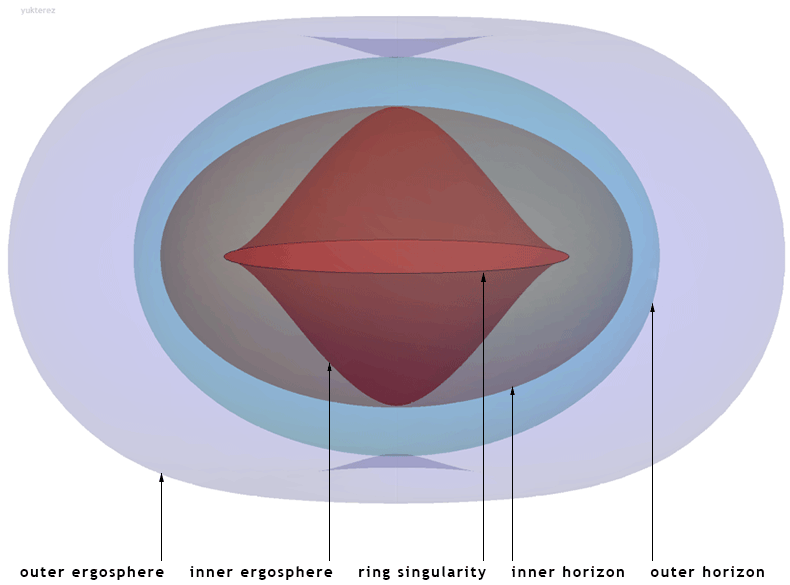
Within the “inner horizon,” travel into the past could at least theoretically be possible.
© Yukterez / Kerr Universe / CC BY-SA 4.0 (excerpt)
But as it turns out, the Kerr universe is not the only solution to Einstein’s equations that allows for travel into the past. Next week, we’ll dig into other solutions to the special and general theory of relativity and discuss how they offer distinct visions of the universe, time and space.
This article originally appeared in Spektrum der Wissenschaft and was reproduced with permission. It was translated from the original German version with the assistance of artificial intelligence and reviewed by our editors.