



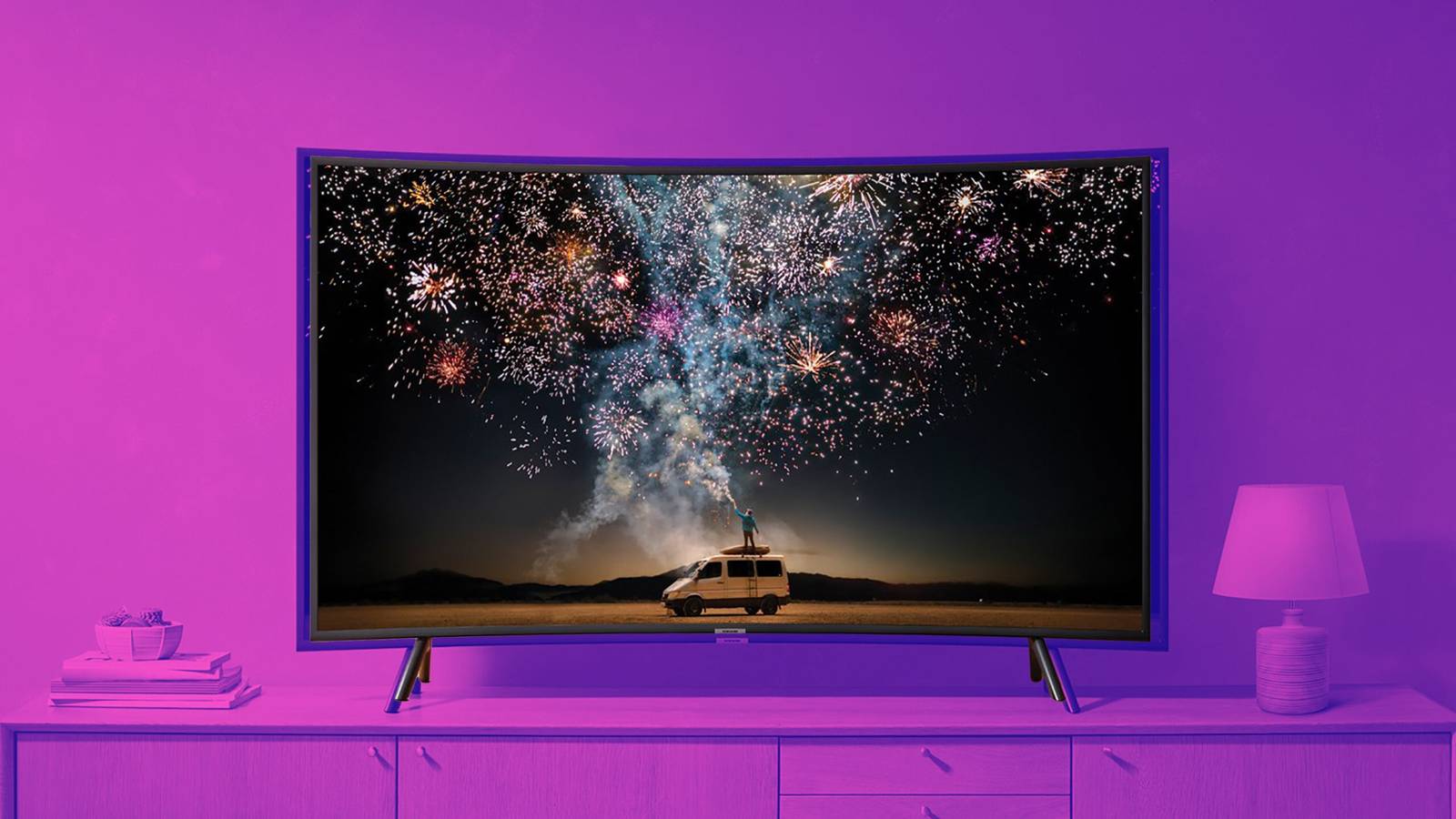
TV makers are fond of gimmicks, which makes sense if you take a step back and look at the industry. It’s hard to grab your attention when most TVs look the same from the outside, and differences otherwise boil down to things like refresh rates and HDMI ports. Hence we’ve had things like 8K TVs — when there’s almost no 8K content to watch — and even 3D, which tried to ride off the popularity of James Cameron’s Avatar.
Some gimmicks do end up transforming into permanent features, but curved screens weren’t one of them. So what happened? Why would curved TVs vanish around the same time that curved monitors were actually growing in popularity? Those two trends are more connected than you might realize.
The long march of curved screens
A brief history in every sense

The notion of curved screens has been around for ages. In the 1950s, the movie industry experimented with curved theater screens and matching formats, the best known example being Cinerama. Many classic films were projected in Cinerama at some point, such as 2001: A Space Odyssey. In every case, though, the goal was the same: immersion. It was a way of increasing the spectacle of movies, giving you a reason to go to the theater instead of sitting at home watching The Twilight Zone.
The more direct inspiration for curved TVs was probably IMAX. While Cinerama has been dead for decades (excluding Quentin Tarantino’s The Hateful Eight, released in 2015), the IMAX format is alive and well, no matter that few theaters project it on a curved screen. When shown in its ideal form, IMAX is extremely immersive — it completely fills your field of view, and its curve mimics the way your eyes perceive reality. There used to be an even more immersive format called OMNIMAX/IMAX Dome, but that required complex technology to work as intended. If you’ve seen something on an IMAX Dome screen recently, it was probably just projected in the regular IMAX ratio.
folding smartphones are the exception rather than the norm. Back in the early 2010s, it was more practical to curve something on the scale of a TV.
For a brief while, brands like Sony, Philips, and Panasonic joined the fray, and you could actually buy curved soundbars if the visual mismatch bothered you. But sales of curved products never really went far, and one by one, brands began dropping out of the game. The last brand standing was Samsung. While it was still selling curved TVs as recently as 2025, it was probably just unloading unsold inventory, considering that its lineup included a model dating back to 2019.
So why did curved TVs die out?
You can’t win against the laws of physics

While curves may be perfect for IMAX, they’re a terrible idea for a screen in your living room. It’s a question of viewing angles. There are plenty of reasonable angles in a theater, since the screen is going to be as wide or wider than the seating. At home, however, all but the largest TVs are liable to be smaller than your seating area, or at least relatively small at the distance they’re sitting. Curving a TV leaves you with a narrower “sweet spot” where you can see every corner as intended. If you’re sitting outside that spot, images may appear distorted, and at the extremes, partially obscured. That’s not exactly conducive to a Super Bowl party with friends.
It gets worse. Brightness and color representation can suffer at off angles, too. The result is that curved TVs are best viewed from a single spot on the couch by one or two people. Historically, that was probably a tough sell when no one really had any complaints about flatscreen TVs.
Curving a TV leaves you with a narrower sweet spot where you can see every corner as intended. If you’re sitting outside that spot, images may appear distorted.
Merely owning a curved TV can be problematic, depending on your situation. It won’t necessarily fit well in an entertainment center, and mounting one sometimes involves extra considerations, like choosing a swiveling mount so you can redirect the sweet spot as needed. If nothing else, curved panels are tougher to pack, given that moving boxes aren’t designed with them in mind. That’s speaking as someone who’s had enough trouble sliding conventional TVs into U-Haul boxes.
All this might have been acceptable from the business side except that curved panels were harder to produce, and came with a price premium for a feature few people were clamoring for. Participating companies seem to have given the concept a few years’ worth of runway — but when it didn’t take off, it was time to bail out and spend resources on something more profitable.
Why are curved monitors so popular, then?
From weakness to strength

Simply put, angle issues disappear with a computer monitor. Most users are sitting solo in a seat just 2 or 3 feet away. Although a larger panel may improve immersion, even smaller screens are typically going to provide a bright, clear, and colorful image no matter which way you look. In fact, a curved screen is preferable to a flat one when you’re sitting at a desk, since it brings corners closer to your eye and reduces effects like vignetting.
Some monitor brands take things a step further with curved ultra-wides. These allow buyers to replace multiple monitors for maximum efficiency, or in some cases, deliver a level of immersion impossible with curved TVs. When you know exactly where a viewer will be sitting, you can wrap a screen tightly enough to fill their peripheral version, getting about as close to VR as possible without a headset.
In fact, a curved screen is preferable to a flat one when you’re sitting at a desk, since it brings corners closer to your eye and reduces effects like vignetting.
There are a few drawbacks to curved monitors, as you might expect. They have the same packing and space problems as TVs, just on a smaller scale. And while many curved monitors are affordable, they can still command a premium sometimes, especially if you want an ultra-wide both large and curved enough to fill your view. The best ultra-wides may demand a beefy graphics card to with them — more pixels translates into more rendering work. For gaming, you shouldn’t bother with a 4K ultra-wide unless you’ve got a card with at least 16GB of VRAM, and 24GB or more is preferable. Requirements tend to be a little more sane at resolutions closer to 1440p.
Will curved TVs ever make a comeback? I can’t rule it out, but I doubt it. There might be some chance if TVs with adjustable curves become easy to manufacture. Short of that, I’d expect flat panels to reign supreme, with curves being relegated to monitors, VR headsets, and AR glasses.