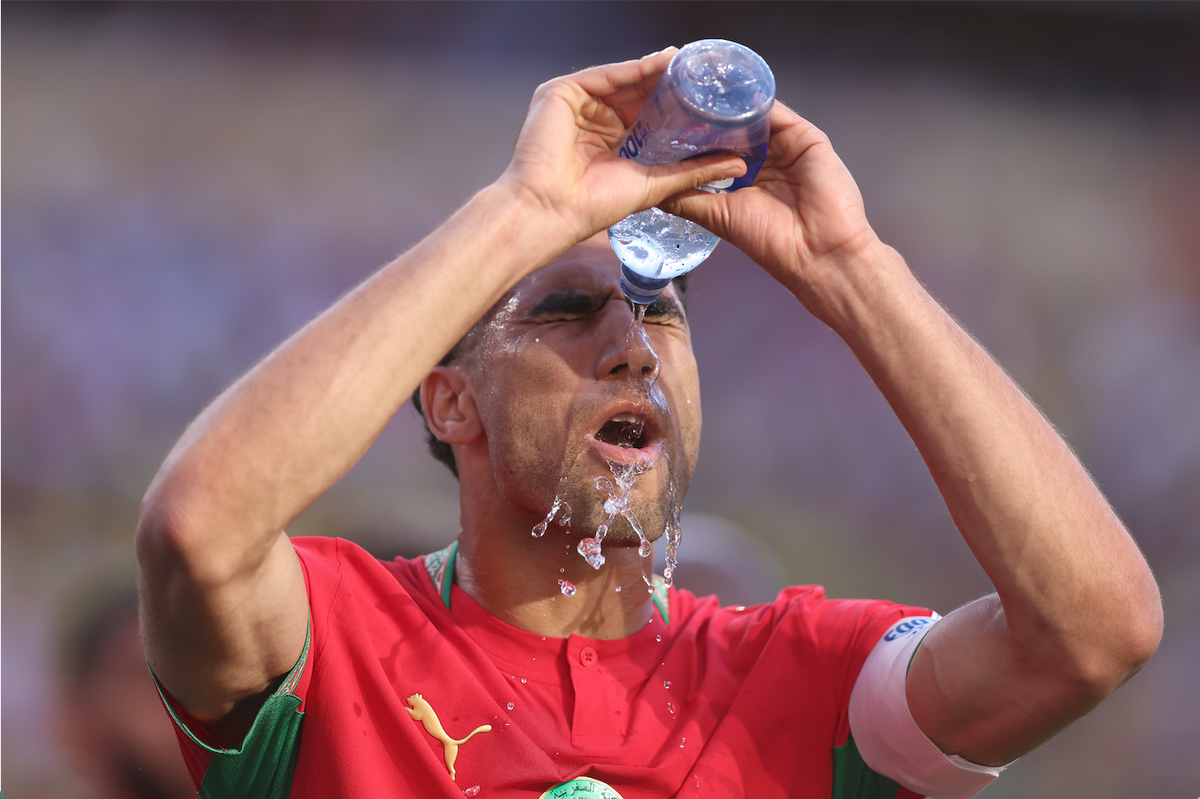
Every match at the 2026 FIFA World Cup this summer stops at the 22-minute mark of each half. In Dallas on June 17, England’s and Croatia’s teams paused because FIFA, soccer’s international governing body, said they had to, not because the moment obviously demanded it. Fans booed.
Three-minute hydration breaks are mandatory regardless of the weather. That splits the game into four chunks—and has split opinion. Critics say the pauses interrupt the rhythm of a sport that is less regimented than most American team sports.
But the grumbling sidesteps a sharp question. When players risk overheating, which tools best keep them cool?
On supporting science journalism
If you’re enjoying this article, consider supporting our award-winning journalism by subscribing. By purchasing a subscription you are helping to ensure the future of impactful stories about the discoveries and ideas shaping our world today.
Around a quarter of the games at this year’s competition are expected to be played above 26 degrees Celsius, or nearly 79 degrees Fahrenheit, on the wet-bulb globe temperature (WBGT) scale, according to an analysis by the climate science group World Weather Attribution. WBGT is a measure of heat stress that accounts for humidity, sunlight, wind and air temperature—not just the number on the thermometer.
Ollie Jay, a professor of heat and health at the University of Sydney in Australia, says the evidence is now clear. “Things that we term heat waves are more frequent, they’re more intense, they last longer, and they happen early in the season,” he says. His work with the Lancet Countdown has tracked the rising risk of heat stress for people exercising and playing sports using data from the past three decades.
Heat reshapes the game itself, and it can be dangerous. In soccer, the effect may be subtle, says Julien Périard, director of the University of Canberra Research Institute for Sport and Exercise in Australia: players ration their effort, running less in the second half and passing more rather than carrying the ball.
That’s the logic behind the hydration breaks. Whether they do much good is a separate question.
“What’s been odd this year is the fact that they’re having them in every game, irrespective of the conditions, and that’s a little bit concerning,” says Jay, who worries that unnecessary breaks could turn people against the idea when conditions mean such pauses are genuinely needed.
Three minutes is also not long to cool a body under strain. “They’re taking these breaks in the sun,” Jay points out. Périard says the pause can slow a dangerous rise in body temperature, but a 15-minute halftime break in an air-conditioned room is far better. Lee Taylor, a sports performance expert at Loughborough University in England, is blunter: “It’s proven to be more of a commercial opportunity,” he says.
“Should [the hydration breaks] be longer?” asks Jonas Werner, team physician for the Swedish national team, which will face the Netherlands in Houston on June 20. “Maybe, but that would severely affect the game.”
Werner says Sweden has cold showers, ice baths, cold drinks, sprays, cold towels, ice bags and ice vests available to players. Ice bags and cold towels may make players feel cooler, but experts say briefly chilling a small patch of skin does not necessarily pull much heat from the body’s core. They are “mostly for comfort,” Werner says. “The scientific evidence for both tools is scarce.”
Adidas has provided its 14 World Cup partner teams with a setup it calls the CLIMACOOL system—vests, jackets and overshoes filled with a cooling gel that the company claims can lower core body temperature by nearly one degree F. But Werner says the system requires 12 to 15 minutes of use—“something no one does”—and is “troublesome” to deploy because the gear must be kept frozen and transported to the stadium in heavy, battery-powered coolers. Adidas did not respond to a request for comment.
Scientists are cautious about judging specific products without published evidence. But they agree on the most important intervention: acclimatization. The Swedish team began acclimatizing at home, with players training in a climate-controlled room at Bosön, the Swedish Sports Confederation’s development center, and using a sauna afterward. More broadly, training and living in hot conditions can increase blood plasma volume, improve sweating and help athletes work closer to their normal limits.
That’s closer—not all the way. “What acclimation does is, it brings you closer to that ceiling,” Taylor says. “We’re never going to get back to our true performance capacity [in extreme heat]. We’re just going to get closer to that.”
It’s Time to Stand Up for Science
If you enjoyed this article, I’d like to ask for your support. Scientific American has served as an advocate for science and industry for 180 years, and right now may be the most critical moment in that two-century history.
I’ve been a Scientific American subscriber since I was 12 years old, and it helped shape the way I look at the world. SciAm always educates and delights me, and inspires a sense of awe for our vast, beautiful universe. I hope it does that for you, too.
If you subscribe to Scientific American, you help ensure that our coverage is centered on meaningful research and discovery; that we have the resources to report on the decisions that threaten labs across the U.S.; and that we support both budding and working scientists at a time when the value of science itself too often goes unrecognized.
In return, you get essential news, captivating podcasts, brilliant infographics, can’t-miss newsletters, must-watch videos, challenging games, and the science world’s best writing and reporting. You can even gift someone a subscription.
There has never been a more important time for us to stand up and show why science matters. I hope you’ll support us in that mission.