It’s enough to leave long-suffering football fans as sick as a parrot – the post-match press conference in which a manager reels off a string of cliches rather than an honest appraisal of their team’s performance.
Now a new study has revealed the worst offenders among World Cup coaches.
And it’s bad news for England boss Thomas Tuchel, who was ranked fourth worst of the 48 managers at the tournament with a staggering 51 cliches per press conference or interview.
Phrases such as ‘we focus on what we can control’, ‘we must adapt to the conditions’ and ‘we know our qualities’ often leave fans rolling their eyes. And with the help of an AI-powered tracker courtesy of the communication infrastructure giants Sinch, we’ve identified which bosses maintain clarity and honesty in their interviews and who simply relies on platitudes to deflect the hot topics.
We identified which of the 48 managers at the World Cup used the most and least cliches, indicating the best communicators and the more typical, less descriptive gaffers.
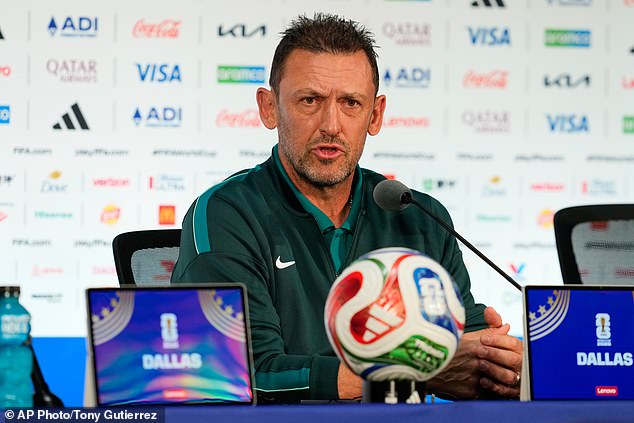
Heading up the list of the worst communicators is Tony Popovic of Australia who averaged an incredible 60 cliches per press conference, including the use of the phrases such as ‘a special group’, ‘the first step is done’ and ‘we still have a lot of work to do’. The use of these demonstrates a clear desire to be vague and uninformative, something that left Aussie fans frustrated and desiring more insight.

Heading up the list of the worst communicators is Tony Popovic of Australia who averaged an incredible 60 cliches per press conference

Marcelo Bielsa’s blunt terminology would have been appreciated by Uruguayan fans despite their early exit
At the other end of the spectrum is former Uruguay boss Marcelo Bielsa, who rarely minces his words in front of the press. He averaged only six cliches per press conference and regularly used more blunt terminology – something that would have been appreciated by Uruguayan fans despite their early exit.
England’s boss, however, cannot boast the same record. Throughout England’s turbulent campaign, Tuchel commonly employed the cliches ‘it’s always a team effort’, ‘we believe and trust in this group’ and ‘that just what it is’. Perhaps if the German had been more descriptive and candid on his decisions and thought process, fans may not have been so critical of his calls in the semi-final defeat to Argentina.
Another of the managers that the study identified as particularly cliché heavy was Luis De La Fuente. Despite eventually lifting the coveted trophy, he produced rather typical and uninformative press conferences, using an average of 45 cliches in each one on his way to glory.
One interesting stat that the tracker revealed was that we saw a 9% increase in his average cliché use post the semi-final. Implying that when under more pressure or with more at stake managers shirk more questions and shy away from candour.

Throughout England’s turbulent campaign, Thomas Tuchel commonly employed the cliches ‘it’s always a team effort’, ‘we believe and trust in this group’ and ‘that just what it is’
This was evident not just with De La Fuente, but also with his French opposite number Didier Deschamps. Deschamps throughout the tournament was one of the more articulate managers, only averaging 24 cliches. However, when he got to the semi-final he ultimately lost, we saw an incredible 29.2% jump from 24 to 31. Again, implying that common use of cliches can imply either a fear or a desire to not divulge more descript information.
Robert Gertsmann, co – founder of Sinch, said: ‘The pressures facing international football managers are unique, but the communication challenge isn’t. Whether leading a national team, a global business or a political party, pressure regularly shapes how we communicate. While the likes of Bielsa make original communication look easy, when the stakes are highest, many leaders naturally gravitate towards familiar phrases that feel safe and hard to scrutinise.
‘The coaches who have stood out throughout this tournament aren’t necessarily the funniest or most charismatic, they are the ones who have explained their decisions with clarity, no matter the outcome.’