As a long-time lover of science fiction, I’m very familiar with the old trope of a galaxy-spanning human civilization, thousands or even millions of planets strong. Watching Star Trek, Star Wars and Stargate made such a dizzying future seem almost inevitable. Humans are destined for the stars—right?
We’ve certainly made our first steps in that direction, having already sent robotic probes all across and even out of our solar system. But getting people into space has been trickier. We’re gooey globs of meat that need a lot of TLC to survive beyond Mother Earth. Still, we’ve managed to get to the moon (and a wee bit farther), which is amazing all in itself.
But space is vast and deep, and there’s a very, very long way to go to visit even the other planets orbiting our sun, let alone those around other stars.
On supporting science journalism
If you’re enjoying this article, consider supporting our award-winning journalism by subscribing. By purchasing a subscription you are helping to ensure the future of impactful stories about the discoveries and ideas shaping our world today.
Still, some consider humanity’s future in space to be so bright that they’ll bet the bank on it. China and the U.S. are both proceeding with separate plans for moon bases, and U.S. billionaires are trying very hard to provide the hardware for NASA’s lunar push. Jeff Bezos’s Blue Origin is in the running to develop a lunar lander, as is Elon Musk’s SpaceX, with an approach using its Starship rocket—though both still have a long way to go.
Musk seems confident. Of course he does: with SpaceX, he’s truly revolutionized rocketry—and become the world’s wealthiest person. History shows, however, that his predictions for when his companies’ breakthroughs will occur tend to be several years off the mark—if the breakthroughs happen at all. But outside of quibbles over timing, there’s something more fundamentally questionable in his vision: he has said on multiple occasions that he wants humans to become (at least) a Kardashev Type II civilization—and the concept has caught on, becoming trendy among “tech bros.”
To any deeply nerdy sci-fi fans (guilty!), this is already a familiar idea. In the 1960s, as the U.S. and the Soviet Union engaged in a breakneck-pace space race, many scientists seriously pondered the near and more distant future, including what it would mean for humanity to become a permanently spacefaring race.
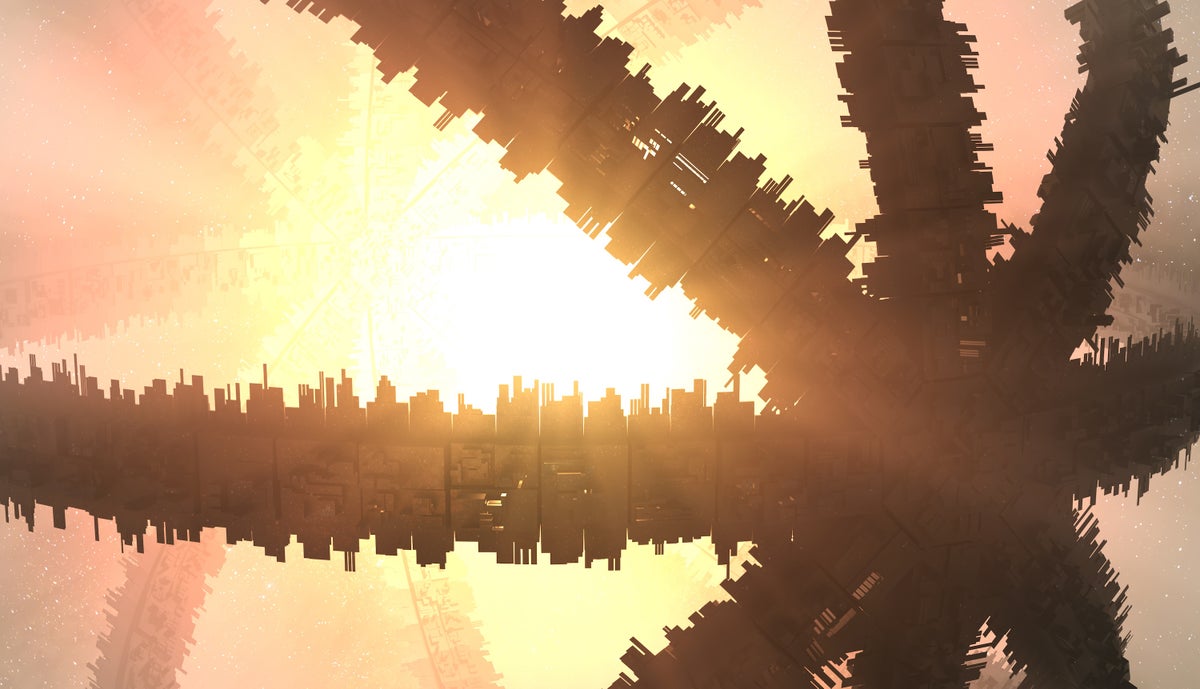
One of them was Nikolai Kardashev, a Russian astrophysicist. In 1964 he proposed what is now known as the Kardashev scale, a way of categorizing a civilization’s technological advancement using energy production as a proxy; the idea was that as a society’s tech scaled up, so, too, would its need for power. The scale has three broad categories: A Type I civilization can capture and utilize all the energy it is possible to generate on a planet—usually simplified as all the light that reaches the planet from its star. Type II could capture all the radiant energy from a star. And Type III could do so for an entire galaxy—presumably using humongous armadas of solar panels to trap all that ambient energy radiated into space.
While oversimplified, in some ways, it makes sense. After all, interstellar travel and communication require absurd amounts of energy—simply staying home does so as well as our technological capabilities grow, whether you consider “home” to just be our Earth or the entire solar system. And the most obvious and accessible energy source would be light from any nearby star.
Most estimates put humanity around Type 0.7 currently but with plenty of room for further growth, which sounds about right to me. We haven’t come terribly close to tapping into all the solar energy we can use; ditto for things like nuclear power (including the dream of fusion power, which is always seemingly 20 years away).
But for all the growing we might do, I’m not at all sure how we’ll actually do it. It’s tricky to extrapolate our current progress even into the next few decades, let alone centuries or millennia from now, especially when using Musk’s favorite civilization-measuring scale.
That’s because ascending the Kardashev scale isn’t really a realistic goal—the scale is more a crude guide for thinking about how a technological civilization could grow and what its ultimate limits could be. Sure, if you encase an entire star with solar panels, you can power an enormous energy-hungry society (one that uses many millions of times the energy we do now). But that’s all in electricity, which has limited use in situ. You’d have to store it somehow or transmit it to where it’s needed. If you want to, say, explore the galaxy via fleets of starships, you need to power them locally, too.
Still, you don’t need to enclose a whole star for that. Fusion drives (assuming they’re possible, though we’re taking a series of big leaps in technological faith here anyway) could do this more easily. And fusion could probably scale to allow us to meet practically any (currently) conceivable energy needs without having to harness all the power of the sun.
Enveloping a galaxy makes even less sense; you can generate a lot of energy by dumping matter into a black hole, say—we know some galaxies have supermassive black holes that are consuming matter and blasting out enough energy to outshine all the stars in the rest of the galaxy combined. So there’s simply no need to Bubble Wrap the entire Milky Way.
All this extrapolation about the distant future is relevant because, as Musk’s prognostications show, it’s already influencing the way we’re exploring space right now. We’re scrambling to swarm Earth orbit with millions of satellites, we’re creating space stations and moon bases with an eye toward sending humans to Mars, and the engineering to support all this is coming along. But while we’re building all this tech, it makes sense to question whether we’re even doing this the right way.
Broadly speaking, there’s no such thing as a “free lunch,” even if solar power is as close to it as we’ll ever get. Similar to the 20th-century U.S.-Soviet space race that flashed and then fizzled, climbing the Kardashev scale with a rampant ramp-up in orbital infrastructure is unlikely to be sustainable in light of possible associated disruptive effects such as the Kessler syndrome: a catastrophic cascade of collisions that could render low-Earth orbit unusable. And sustainability—persistence—is the real coin of the realm when you’re talking about civilizational goals and timescales.
The problems don’t stop even for more limited cases, such as ascending the scale to chase that notional bright future for humans in space. Musk, for example, has claimed SpaceX’s Starship will carry 100 humans to orbit at a time—something that he has said could eventually allow a million people to voyage to Mars. We may very well be able to stuff that many people into a rocket and blast them away to points extraterrestrial, but he seems less eager to engage with other important questions: Can we keep them healthy and, just as importantly, happy?
That involves much more than simply feeding space passengers, giving them air and recycling their waste into water and food—things that NASA and other space agencies already have some experience with. These matters only scratch the surface of the problems any interplanetary spacefarers will face. My friends and colleagues Zach and Kelly Weinersmith wrote a whole book on this topic—A City on Mars—and they are very skeptical that we’re going about all this the right way. I agree with them.
Musk and his fellow travelers seem to ignore the depths of these problems entirely (he does tend to grossly oversimplify complex issues). Instead they’re just gung ho to go.
But if something’s worth doing, it’s worth doing right, which demands questioning all the core assumptions and showing we’ve got good answers. And when it comes to Musk’s desire to climb the Kardashev ladder—and the question of whether the Kardashev scale is even valid at all—the answers have yet to add up. The scale doesn’t cover such things as advancing our understanding of ourselves, society, art, and so much more of what makes us human. Using it as a glib catchphrase for space exploration just promotes exponential expansion seemingly for its own sake—something, I might add, that usually isn’t durable or desirable when it occurs in nature: think “plagues of locusts” and “metastasizing cancer.” Those are harsh analogies but not wholly inapt ones.
To be clear, I’m all for exploring space and spreading out humanity, but we need to make sure we’re doing it properly, with the right goals in mind. In the end, the Kardashev scale is one way to measure a civilization but not a compelling way and certainly not the way. Beware of tech bros who use it as the be-all and end-all. That view of the universe, and of humanity, is profoundly limited and limiting.