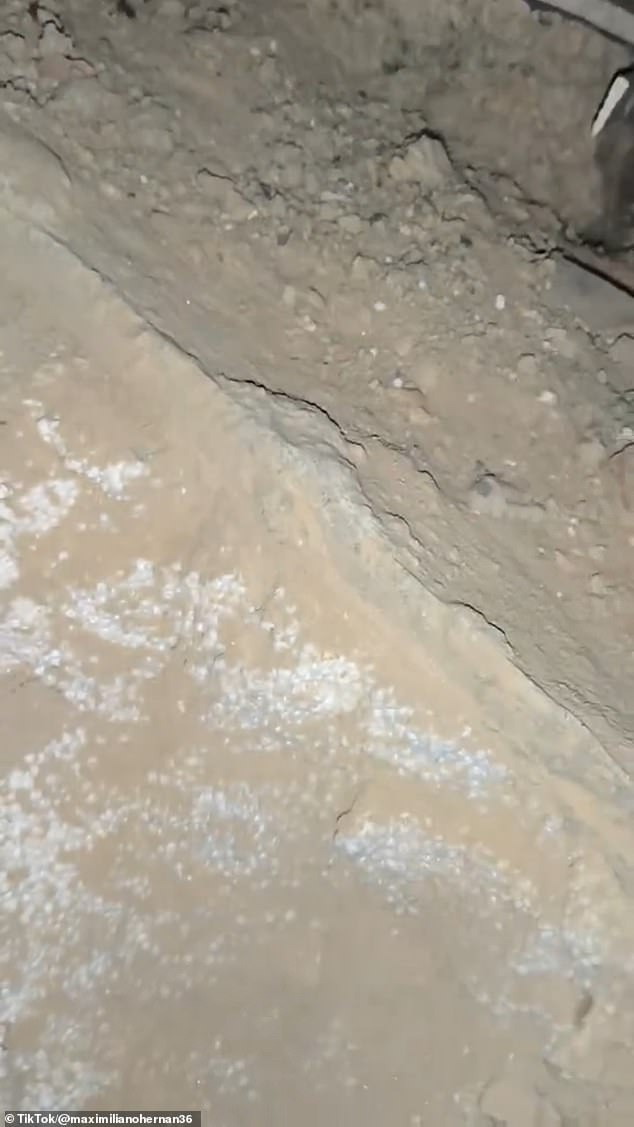
Rescuers sifting through rubble left by collapsed buildings in Venezuela recorded a video showing that the structures were built with what appears to be Styrofoam.
The country was rocked by a devastating 7.2 and 7.5 double-earthquake on Wednesday. The official death toll has risen to 1,430 despite foreign and domestic rescue teams pouring into coastal La Guaira, near the capital Caracas, the hardest-hit state.
Top lawmaker Jorge Rodríguez has called it ‘the most disastrous event’ the country has suffered in the last 123 years, with whole swathes of towns and cities across the country reduced to rubble.
The government has said more than 3,000 people were injured and a similar number were living in shelters, but just under 50,000 people were listed as unaccounted for on a website promoted by the country’s political opposition on Sunday.
A video posted to TikTok on Saturday by a Venezuelan rescuer with the handle @maximilianohernan36 indicates that buildings in the country were not built to withstand natural disasters.
In the video, a man can be seen recording himself pulling away pieces of what appears to be collapsed walls with just his hand. The outside of the wall has a thin layer of concrete, while the inside is clearly Styrofoam or a similar material.
‘Look at this sh**,’ the man recording can be heard saying in Spanish as he pulls away chunks of Styrofoam and digs his finger into the material without resistance.
‘No wonder everything crumbled like cardboard,’ he later said before he and a fellow rescuer could be heard criticizing the government for the shoddy construction.

A TikTok video posted by a Venezuelan rescuer shows collapsed walls that appear to have been built with Styrofoam covered by a thin layer of concrete

The rescuer is pictured easily pulling off chunks of the wall’s internal material with nothing but his hands

Workers remove debris from a collapsed building in the San Bernardino neighborhood of Caracas
Wednesday’s double-earthquake leveled entire neighborhoods and blocks of buildings, many of which were constructed as part of socialist revolutionary president Hugo Chavez’s ‘grand housing mission.’
The program came in response to previous natural disasters that killed and displaced tens of thousands of people in 1999, the first year of Chavez’s tenure.
The government built apartment complexes for thousands of families to move into, but it only loosely followed its own laws and codes meant to prepare the buildings for future natural disasters, an earthquake risk-reduction specialist who worked for Chavez’s government, Alejandro Linayo, told the Washington Post.
After Chavez died and Nicolas Maduro took power in 2013, the project was accelerated, and construction was rushed to meet a political deadline.
At a four-building apartment complex in La Guaira that was constructed as part of the ‘grand housing mission,’ three of the buildings were leveled by the earthquakes, destroying at least 960 apartments and burying countless people.
Although it is unclear where the TikTok video of the alleged Styrofoam walls was recorded, it offers insight into the cheap construction methods that the Venezuelan government appears to have used for its socialist housing program.
That cheap construction has come with a high cost of life. The US Geological Survey estimated more than 10,000 deaths were possible from the magnitude 7.2 and 7.5 quakes, which would place them among Latin America’s deadliest of the last century.
Families and volunteers spent days pulling survivors and bodies from the rubble before more than 1,600 foreign rescue workers arrived.

A drone view shows buildings destroyed by earthquakes in La Guaira, Venezuela

Families and volunteers spent days pulling survivors and bodies from the rubble before the arrival of the more than 1,600 foreign rescue workers

Picture of a building destroyed during twin earthquakes in Caraballeda
Additional teams from Europe have been trying to make it to Venezuela to provide assistance, but Simon Bolivar International Airport, the only international airport that serves Caracas, was also ravaged by the earthquakes, so travel into the country is ‘severely affected.’
Rescuers complained of scant heavy equipment and a limited official presence as hundreds of aftershocks deepened damage and kept residents on edge.
Years of socialist mismanagement under Chavez and Maduro, as well as US sanctions, gutted Venezuela’s private construction sector, which has left the country ill-equipped to respond.
The government – headed by interim president Delcy Rodriguez since her predecessor was removed by the US in a January raid – thanked civilian volunteers ferrying aid to La Guaira soon after the earthquakes.
But since then, the port city has been declared a disaster zone, and Rodriguez has heavily tightened access to the road, saying traffic was preventing efficient movement of emergency vehicles.
Officials said anyone who wants to enter would now have to seek official permits, but provided few details of who would be allowed in.
Meanwhile, the clock is ticking for rescuing people still living amid the rubble.
‘There exists a window of roughly three days, 72 hours, where the probability afterwards decreases that you can save people alive,’ Sebastian Eugster, the leader of a Swiss rescue team in the country, said on Saturday.

The government has said more than 3,000 people were injured, and a similar number were living in shelters. A woman is pictured sitting atop rubble next to her destroyed home

Footage shared by interim president Delcy Rodríguez showed a huge team of emergency workers coming down from a pile of rubble
In Caraballeda on Saturday, US rescuers worked alongside remaining civilian volunteers, some of whom were searching for their own family members.
Rescuers had originally spray-painted the rubble with the name of the apartment building that used to stand there. By Saturday evening, they had marked debris with coding indicating they believed no living person remained in the ruins.
Pope Leo on Sunday told worshippers gathered for the Angelus prayer in Rome that he wanted ‘to express my closeness to the Venezuelan sisters and brothers affected by the recent earthquakes’ and expressed gratitude to rescue workers.
European Union foreign policy chief Kaja Kallas said on X that the EU had mobilized 5 million euros ($5.7 million) in emergency assistance and that its Copernicus satellite system is helping map the damage and direct assistance to the areas most in need.
A senior U.S. official said on Saturday that a funding package worth hundreds of millions of dollars is expected to be announced within the next day or so, in addition to $150 million that the Trump administration had already committed.
The disaster could have political consequences for Rodriguez, who has portrayed herself as an agent of change even though she served as vice president under predecessor Nicolas Maduro.

People go through donated clothes at a temporary refugee camp after earthquakes hit the country in La Guaira

A view of damaged buildings at Catia La Mar after a magnitude 7.2 earthquake struck Venezuela
During a visit Rodriguez made to a Caracas neighborhood that was all but razed to the ground, residents voiced their anger.
Many screamed at her: ‘The government isn’t doing anything for the people.’
Others said: ‘Get out! Get out!’