Jan Bartek – AncientPages.com – About a hundred years ago, archaeologists unearthing pottery sherds in Tampa Bay found something unexpected. Some of the fragments they recovered had designs nearly identical to decorated pottery found hundreds of miles to the north.
At least on the surface, the pottery appeared Mississippian, a culture that emerged over a thousand years ago and brought social, economic, and political transformation across southeastern North America. For years, archaeologists excluded peninsular Florida from maps of its range, but the artifacts suggested a different story.

How Did Mississippian-Style Pottery End Up In Tampa Bay?
“It’s been this open debate for a century,” said Neill Wallis, curator of Florida archaeology, bioarchaeology and the Ceramic Technology Laboratory at the Florida Museum of Natural History. “Tampa Bay sites had some Mississippian-like traits such as platform mound-village complexes and iconography, but lacked others, like maize agriculture and shell-tempered pottery. The Mississippian-looking pottery has always begged the question: How did this stuff wind up in Tampa Bay?”
Mississippian pottery offers strong evidence of the region’s cultural connections, but surface designs alone could not confirm the pottery’s origin. Lacking the necessary tools and expertise, curators set aside the pottery sherds, leaving several theories unproven. Recently, researchers at the Florida Museum conducted a study to resolve this question.
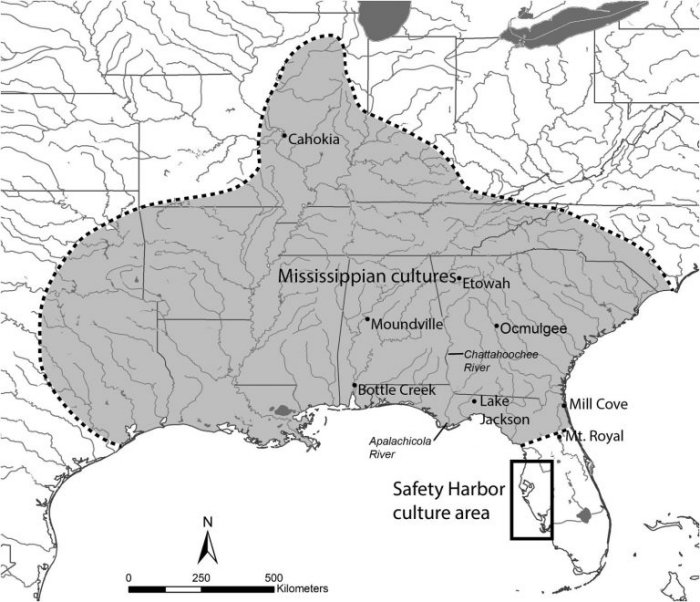
Only some of the classic Mississippian traditions were adopted in the Tampa Bay region. Archaeologists have never fully understood the extent of the connection between these coastal communities and the Mississippian heartland.Image from “Sourcing Mississippian pottery among the complex maritime cultures of Florida s peninsular Gulf coast” (2023) by Wallis et al., CC BY
Archaeologist Trevor Duke analyzed the pottery’s composition and chemistry for his doctoral dissertation at the Florida Museum of Natural History. The research later expanded as scientists gathered more evidence from the region.
“We were curious to find out if these vessels were imported from the heartland by trade, if they were local imitations of Mississippian motifs, or, as we ultimately found, if they were made by migrants who had made their way into communities in Tampa Bay to take up shop and residency there,” said Trevor Duke, who began conducting the research for his doctoral dissertation at the University of Florida. Since then, Duke and his colleagues have expanded the initial scope of his dissertation to compile more evidence from a larger set of samples.
The researchers examined subtle production details beyond surface designs, tracing the decorated pottery to a community of artisans who likely migrated from the Mississippian heartland to Tampa Bay. Unlike the region’s common plain wares, the decorated pottery’s high-quality clay, temper, and production methods suggest these migrants possessed specialized knowledge and resources unavailable to local residents.
A Cultural Revolution Spans The Southeast
Around 1000 A.D., a new culture emerged in the Mississippi River Valley and expanded across much of the Midwest and eastern United States. Indigenous communities formed regional hierarchies, with large chiefdoms exerting political control over nearby villages. They cultivated maize extensively and constructed large mounds topped with temples and residences for chiefs.
Safety Harbor, the regional culture in and around Tampa Bay during this period, was located on the periphery, hundreds of miles south of Mississippian tribes. Like their northern counterparts, Safety Harbor communities formed small chiefdoms and built flat-topped mounds. The largest village was home to the Tocobaga, while smaller Mocoso, Pohoy, and Uzita chiefdoms occupied the surrounding area. However, no single group achieved the political dominance seen in the northern centers. These coastal communities also relied on fishing and marine resources rather than adopting maize agriculture.
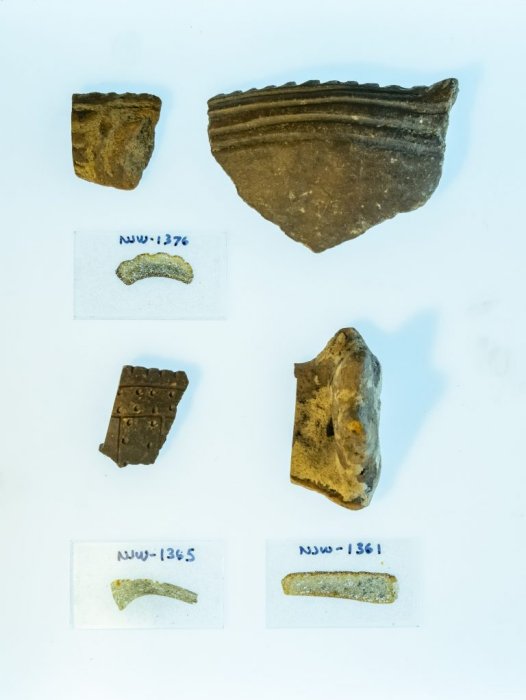
At least on the surface, the decorated pottery appeared to be Mississippian, but scientists needed to look at the chemical and material makeup of the pottery to determine where it originated from. Credit: Florida Museum Photo by Jeff Gage
Due to these mixed indicators, archaeologists have not fully determined the relationship between the coastal communities and the Mississippian heartland. The discovery of pottery with Mississippian designs in Tampa Bay has intensified this debate.
To investigate further, Duke and colleagues at the Florida Museum collected 58 plain and decorated pottery sherds from Tampa Bay for analysis. Both types were used for cooking and serving, though decorated pottery was likely reserved for special occasions.
At this time, Mississippian potters began tempering clay with crushed freshwater shell or grog, and shaped vessels by stacking coils of clay rather than molding. If the decorated pottery in Tampa Bay was authentically Mississippian, either traded or made by Mississippian-trained artisans, archaeologists would expect to find these techniques. If the vessels were local imitations, researchers would instead find regional methods, such as sand tempering, beneath the decorative designs.
Combining Local Assets And Remote Capabilities
The authors first used neutron activation analysis to measure the chemical composition of the artifacts and determine if the clay was locally sourced. They compared the pottery sherds to raw clay from the region and found matching chemical profiles, indicating all pottery was produced on-site. This finding ruled out the theory that the artifacts were made in the Mississippian heartland and traded to the site, though scientists could not yet exclude the possibility that the vessels were imitations.
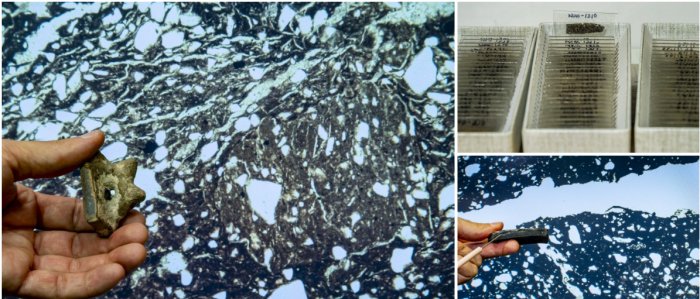
Petrography allows scientists a closer look at what potters were mixing into the clay during the production process. Credit: Florida Museum Photo by Jeff Gage
Researchers then used microscopy to examine what materials potters mixed into the clay during production. In petrographic analysis, scientists cut a thin section from a pottery sherd and polish it to about half the width of a human hair. Using a polarizing microscope, archaeologists analyze the voids, cracks, and grains to understand how the clay was processed.
“Looking at the section under a microscope, you can identify the minerals in it based on their color and shape. From that, we can figure out what was added to it. It’s a sort of fingerprint of the people who made it,” Wallis said.
This was where the Tampa Bay pottery really turned interesting.
Several of the decorated fragments were tempered with grog, a characteristic of some Mississippian pottery. Mixing crushed pottery into the clay improves the vessel’s quality by helping it withstand the high temperatures of firing and cooking.
“This grog tempering is not something that we saw previously or in the plain samples in Tampa Bay,” Duke said. “But up in the Tallahassee Hills, where the nearest massive Mississippian mound center is located, it’s common in all vessels. It’s the plain-Jane tempering technique there.”
The connection between this pottery and the Tallahassee Hills, about 200 miles north of Tampa Bay, extended beyond technique. Scientists identified mica within the grog temper, a silicate mineral common in the Panhandle but rare in peninsular Florida. While the clay may have been sourced locally, the mixed particles likely originated from the Mississippian heartland.
While 80% of the decorated pottery in the sample contained grog, not a single piece of plain pottery did. Most plain vessels contained chunks of dry clay or sand, a temper used for both plain and decorated pottery for the previous 3,000 years.
This was not the only difference between the two styles. The decorated pottery used the Mississippian coiling method and more consistent paste recipes, indicating advanced knowledge of clay processing. In contrast, the plain wares were molded, a simpler technique that became more common as the population grew and could be easily adopted by those without prior pottery experience.
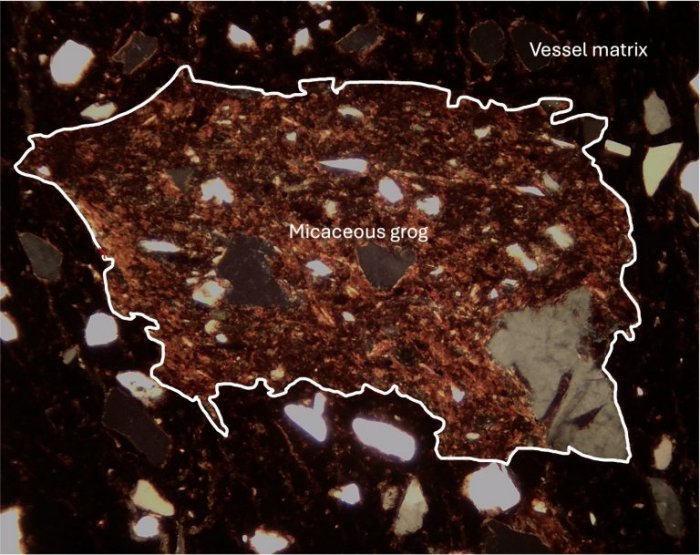
When the scientists observed mica, which is not found within the Florida peninsula, in the grog temper of the Tampa Bay pottery, they knew the local-made vessels contained material from the Mississippian heartland. Image from “Secret Recipes: Potting Knowledge and Migration in Mississippian (ca. AD 1000–1600) Tampa Bay, Florida, USA” (2026) by Duke et al.
As the analysis progressed, more evidence supported the idea that potters from the Mississippian heartland brought both expertise and resources with them. Migrants traveling from northern Florida likely carried old pottery made from their homeland’s clay. Upon arrival in Tampa Bay, they crushed and incorporated this decorated pottery into the local clay.
Beyond its functional use, this grog likely held symbolic significance for the migrants. They specifically reserved decorated pottery from their homeland for this purpose. Each grog-tempered vessel contained multi-generational grog, where a piece of grog is embedded within a larger one. These fragments represented tangible connections to their homeland, incorporated into every vessel made in Tampa Bay.
“It’s sort of like Russian nesting dolls because you have grog within grog within grog. You can trace this back several generations of pots,” Wallis said. “And they’re not using vessels from just anywhere. They’re crushing up the same decorated vessels that include pieces of decorated pottery from before.”
Their advanced pottery skills and ties to Mississippian culture likely helped the migrants establish themselves in a new environment, transforming familiar traditions into valued expertise within their new community.
“Migrant communities often had to figure out their own niche in a new place,” said Andrea Torvinen, collections manager of the Ceramic Technology Lab and Florida Archaeology at the Florida Museum. “What would have made these migrants stand out? How would they have established a role in this new area? Bringing a specialized knowledge of pottery production seems to have been one way they could do so.”
These skills were highly valued, and resources were limited. As a result, archaeologists find evidence of advanced techniques only in decorated pottery, while novices continued to make plain vessels using basic methods. The decorated vessels also used higher-quality clay, suggesting migrants had access to a restricted supply of superior materials.
Maintaining The Secret
The distinction between decorated and plain pottery persisted for centuries. Local residents did not adopt these new skills, likely because the techniques remained within a small community of crafters.
“The group of potters making the decorated vessels likely had some kind of special status that they maintained through this secretive practice, even if it wasn’t a secret in the sense that no one knew about it,” Wallis said. “In fact, for secrets like this, you do have to broadcast some of the details so that people know there is a secret.”
See also: More Archaeology News
High-quality decorated pots circulated and were valued in the community, but key techniques such as tempering, coiling, and consistency were not visible in the final product. As a result, these methods were difficult to replicate. Without close access to this group of migrant potters, Tampa Bay residents could not adopt these specialized practices.
“People with specialized skills have direct relationships with the people learning from them. That’s how we see knowledge passed down. When it’s the way your mentor has always done it, that’s how you’re going to do it,” Torvinen said. “And in this case, there could have been a more meaningful reason behind it. By tying the homeland pottery into this enchainment, they’re bringing those pots with them into the next generation.”
The study was published in American Antiquity.
Written by Jan Bartek – AncientPages.com Staff Writer