
A former education minister who urged Labour to U-turn on a social media ban for under-16s is now backing curfews on children ‘doomscrolling’ at night.
Conservative peer Lord John Nash said tech firms should prevent under-18s from ‘addictive’ features after 9pm, including so-called ‘infinite scrolls’, ‘streaks’ and video autoplay, amid fears their sleep patterns are being affected.
His plea comes just days after Sir Keir Starmer announced the Government will stop children from using ten of the biggest social media platforms including TikTok, Instagram, YouTube and X.
Sir Keir’s approach will go further than that introduced in Australia by stopping strangers contacting children in gaming apps and banning under-18s from using sexual chatbots.
There are also provisions within the new ban for a curfew on 16- and 17-year-olds to stop addictive late-night scrolling.
The proposal is one Lord Nash strongly supports, given that it was his amendment to the Children’s Wellbeing and Schools Bill that triggered the Government’s change of heart over a ban.
Sir Keir had previously opposed a crackdown on apps, believing it would be difficult to enforce.
But the Prime Minister changed tack after dozens of Labour MPs called for urgent action to protect the young, sparking fears he could lose a Commons vote.

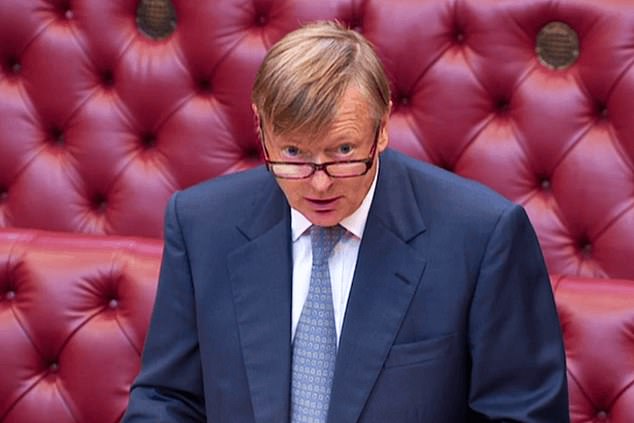
Conservative peer Lord John Nash, who urged the Government to adopt a social media ban, said tech firms should prevent under-18s from ‘addictive’ features after 9pm

Lord Nash, who is chairman of a multi-academy trust, said he had seen for himself the impact on young people who spent their evenings ‘doomscrolling’ (file pic)
For his part, Lord Nash believes a ban is the right way forward given that a public consultation on the issue showed nine in 10 parents back the measure.
Now he wants to see further limits placed on teenagers, who he believes are being harmed by their late night exposure to social media.
Lord Nash, who is chairman of a multi-academy trust, said he had seen for himself the impact on young people who spent their evenings ‘doomscrolling’.
Speaking to The Telegraph, he said: ‘They’re turning up clearly knackered [to school] and some of them aren’t even turning up.
‘They can’t operate if they’re getting half as much sleep as they need.’
He added: ‘It’s always been obvious to me that this kind of technology can be very distracting if you let it control you, and you’ve got to actually control it.’
Lord Nash’s comments come as campaigners for stronger protection against harmful online content – such as Ian Russell, whose daughter Molly, 14, took her own life in 2017 – have said ‘sledgehammer techniques like bans’ would only cause more problems.
Downing Street said 90 per cent of the more than 116,000 questioned in a recent Government consultation backed a minimum age of 16 for going on social media.
The crackdown comes hot on the heels of Sir Keir warning tech giants he will act unless they ban children from being able to take, view or share nude photos on mobile phones.
Critics have accused Sir Keir, who could face a leadership challenge within days after Andy Burnham became an MP following his win at the Makerfield by-election, of only acting to secure his legacy.

Critics have accused Sir Keir of only announcing a social media ban to secure his legacy
Andy Burrows, chief executive of the Molly Rose Foundation, set up in memory of Molly Russell, said: ‘A social media ban leaves parents with a false sense of safety. A majority of children will continue to use high-risk sites that will have no incentive to implement robust protections.’
Mr Russell said Sir Keir should be enforcing laws already on the books more robustly, rather than imposing a ban rushed through for ‘deplorable’ political reasons.
There are also concerns the ban will create a digital ID system by the back door, if it means adults will also have to prove their age when using social media.
‘This will be remembered as the beginning of ID checkpoints for the internet,’ said Silkie Carlo, of the group Big Brother Watch.