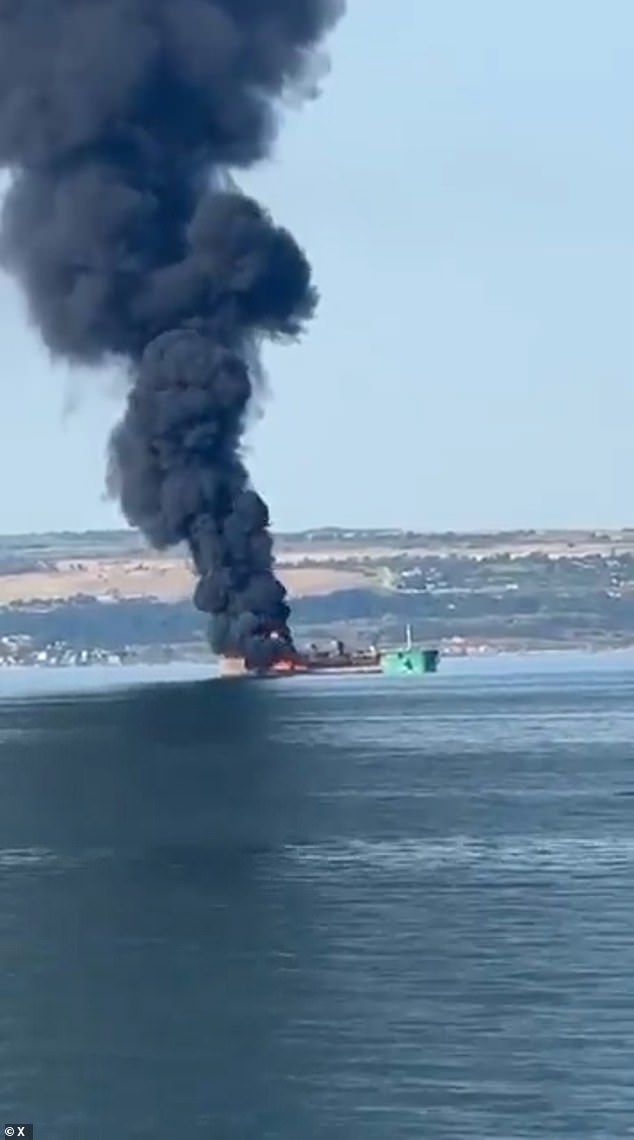
Ukraine attacked another 19 Russian tankers last night, as the nation steps up its war against Putin’s shadow fleet.
For the past ten days, Vladimir Putin’s fuel carriers have been obliterated in the Azov Sea.
The change of tack caught Russian forces by surprise, using sea drones to strike 17 oil tankers and two gas tankers among the toll of 19.
The latest strikes came as the country marked Ukrainian Statehood Day, honouring the country’s more than 1,000-year state tradition, countering Putin’s claims that Ukraine is part of Russia.
It means the Ukrainians have hit up to 136 vessels since the start of last week causing massive damage to Putin’s ability to supply the annexed tourist region Crimea.
A tanker hit earlier in the Sea of Azov was seen burning, and damage was revealed on dry cargo vessel Chelsea-6.
A day earlier, Ukraine destroyed 205ft-long Izumrud – an FSB security service patrol ship in the Black Sea.
Putin’s forces responded to the humiliating decimation of his fleet with massive strikes on port facilities in Ukraine.

Ukraine attacked another 19 Russian tankers last night, as the nation steps up its war against Putin’s shadow fleet

Ukraine has been targeting Russia’s shadow fleet in an attempt to hit the Kremlin’s coffers
At least three were killed in Odesa in missile and drone attacks.
The Russian defence ministry said it had targeted the ports of Odesa and Chornomorsk, striking fuel storage tanks and drone production facilities.
‘In addition, four naval vessels delivering cargo for the Ukrainian Armed Forces were hit.’
A huge fire was blazing from a Russian strike at Pivdennyi port in the Odesa region.
Ukraine said Russia had hit two civilian vessels under the flags of Tanzania and Liberia, with one captain killed.
A vessel flying the flag of the Marshall Islands was hit with two killed.
Two dry cargo ships were hit in the Dnipro-Bug port in the Mykolaiv region said Russian sources.
It comes as Lithuania has intelligence that Russia is planning attacks on infrastructure, and security around energy and transport sites will be tightened as a precaution, President Gitanas Nauseda said in an interview published on Wednesday.
Nauseda said he had no information on when or where the attacks were planned, and did not say that his country was the target, in his interview with BNS news agency.
‘We have such signals, which we receive from our (intelligence) services. They do not clearly identify place or time … because the opponent is not at the end of its planning, and we only know about the planning or the goal,’ he said.
‘It could be various means aimed at physically damaging critical infrastructure. … Anything that halts the functioning of these sites,’ he added.

Firefighters work at the site of residential houses damaged by a Russian air strike, amid Russia’s attack on Ukraine, in Zaporizhzhia, Ukraine, July 13, 2026

A residential building burns after it was damaged by a Russian air strike, amid Russia’s attack on Ukraine, in Zaporizhzhia, Ukraine, July 13, 2026
Lithuania — a NATO member which shares land borders with the Russian exclave of Kaliningrad and with Moscow’s ally Belarus — has tripled its defence spending since Russia’s invasion of Ukraine in 2022.
Neighbouring Poland said earlier this month that Western intelligence agencies were concerned about the risk of Russian attacks against its territory and the Baltic states.
Moscow has regularly denied accusations of planning or carrying out sabotage and other attacks on countries outside Ukraine, saying such reports are part of an anti-Russian propaganda campaign.