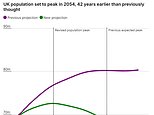

The UK’s population will peak more than 40 years earlier than previously thought, new official projections show.
The Office for National Statistics (ONS) calculated the number of people living in the country will peak at 72.5million in 2054, and then begin to fall.
Its previous estimates suggested the UK peak would not come until 2096.
Changes in the ONS’s calculations mean it now expects the first ever peak – and decline – in England’s population.
Previous sets of data compiled by the official statistics body had forecast that the number of people living in England would continue to increase for at least the next century.
But now it is forecasting it will hit its highest point in 2056, before beginning to fall.
For other nations in the UK their predicted population peaks have been brought forward.
The ONS expects Wales’ population to peak in 2035, rather than in 2077.
Scotland’s population will reach its highest level just seven years from now, in 2033, rather than in 2051, as previously estimated.
And Northern Ireland’s population will peak two years earlier, in 2031.
The changes are due to a combination of slowing net migration and the number of births being overtaken by the number of deaths.
ONS data, published today, set out how the UK population is set to grow more slowly than previously thought over the next few years.
It is forecast to climb from 69.3million in 2024 to an estimated 71million by 2034 – 1.2million lower than in previous predictions.
Net migration will remain the only source of population growth, the ONS said, adding 2.2million to the population over the decade.
At the same time ‘natural change’ – the number of births minus deaths – is projected to be minus 450,000.
‘The population of England is projected to peak at 62.1million in mid‑2056, while Wales is projected to peak at 3.2million in mid‑2035, Scotland at 5.6million in mid‑2033, and Northern Ireland at 1.9million in mid‑2031,’ the ONS said.
‘Over the 10 years to mid-2034, England’s population is projected to grow more quickly than other UK nations, at 2.9 per cent.
‘The projected population growth for Wales (1.0 per cent), Northern Ireland (0.6 per cent), and Scotland (0.3 per cent) is slower in this period.’
The decline in the overall projection is due to a significant dip in net migration.
The Conservative government introduced a number of changes to visa rules which began to be implemented in spring 2024, leading to a sharp fall in net migration.
The ONS said it was assuming net migration would continue at 230,000 a year, down from the 340,000 a year figure used in its previous calculations.
According to the most recent data, asylum seekers – including small boat migrants – now make up 44 per cent of net migration to Britain.
If asylum claims continue at a similar or higher rate it would see it playing an ever-growing role in Britain’s starkly changing demographics.
Conservatives said the 2.2million increase in the population up to 2034, driven solely by migration, was ‘catastrophic’.
Shadow Home Secretary Chris Philp said: ‘This is a catastrophic projection. Mass immigration undermines our society and low wage immigration is bad for the economy.
‘British people feel this in lower wages, longer waiting lists for public services and housing shortages.
‘Labour have opened the door without any plan to deal with the consequences, and the ONS shows this will continue to impact us into the 2030s.’
He added: ‘These 2.2 million will mostly arrive with legal visas that Parliament could stop.
‘That is why the next Conservative Government will introduce a binding annual immigration cap at a very low level, close the loopholes that let temporary visa holders stay indefinitely and tighten and extend the conditions for indefinite leave to remain.
‘We only want a small number of very high skilled migrants and no low skill migrants at all. But sadly, Labour do not have the backbone to deliver this.’
Home Secretary Shabana Mahmood has set out plans to double to 10 years the time most migrants have to wait to qualify for ‘indefinite leave to remain’ in Britain, with separate measures making refugee status temporary rather than permanent.
However, it remains unclear whether opposition from within the Labour Party will lead to the proposals being watered down.
A Home Office spokesman said: ‘Net migration is down by nearly 70 per cent under this government, with visa numbers continuing to fall as we restore control to our borders.
‘While these projections do not directly take into account recent policy changes, we must go further to reduce the levels of migration.
‘That’s why we are introducing sweeping reforms to our immigration system, ending over-reliance on cheap labour whilst attracting the brightest and the best to the UK.’