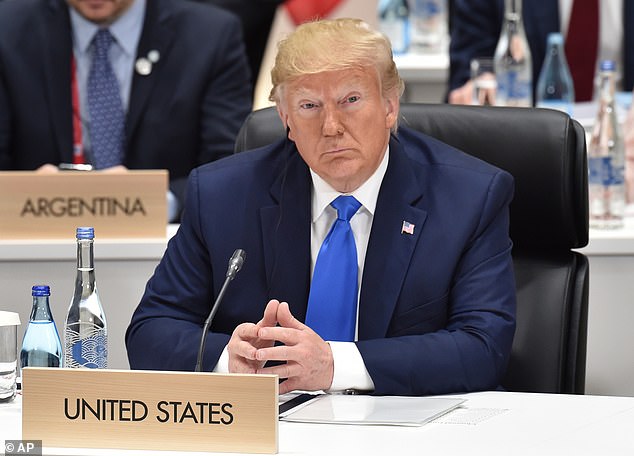
President Trump has implored Iranian leaders to release eight female prisoners, including one who is set to hang for her involvement in anti-regime protests.
He added that the move would be considered a ‘great start to our negotiations’, which are due to start today in Islamabad.
He posted on his Truth Social account: ‘To the Iranian leaders, who will soon be in negotiations with my representatives: I would greatly appreciate the release of these women.
‘I am sure that they will respect the fact that you did so. Please do them no harm! Would be a great start to our negotiations!!!
‘Thank you for your attention to this matter. President DONALD J. TRUMP’.
He then included a screenshot of American pro-Israeli activist Eyal Yakoby, which featured pictures of the women who are reportedly set to hang.
He wrote alongside it ‘not a word from the international community or so-called human rights organisations’.
The majority of the women have not been widely identified but did include and picture of Bita Hemmati, who was arrested alongside her husband, Mohammadreza Majidi-Asl, in the crackdown against protests in January.
Iran has already hanged seven people in connection with the protests, which were ruthlessly stamped out in a crackdown that left thousands dead and tens of thousands arrested.


Alongside the sentencing of Ms Hemmati and Mr Majidi-Asl, Behrouz Zamaninejad and Kourosh Zamaninejad, who lived in the same Tehran building as the married couple were also sentenced to death earlier this month.
Hemmati is believed to be the first woman to be sentenced to death over the protests.
The four were convicted of carrying out actions on behalf of the United States, the US-based Human Rights Activists News Agency (HRANA), and the Abdorrahman Boroumand Center said in separate statements.
They had been accused of throwing concrete blocks from a residential building onto security forces in the capital. It was not immediately clear when the verdict was issued.
The Abdorrahman Boroumand Center said it also believed that Hemmati was the woman who appeared in a video broadcast on state television in January, being personally interrogated by judiciary chief Gholamhossein Mohseni Ejei.
‘The recording and broadcasting of forced confessions from defendants in an opaque process… constitutes a blatant violation of the defendant’s rights,’ it said.
Rights groups accuse the Islamic Republic of using the death penalty as a tool of repression to instil fear in society, and fear it will ramp up capital punishment in the wake of the war against Israel and the United States.
Norway-based Iran Human Rights (IHR) and Paris-based Together Against the Death Penalty (ECPM) said on Monday in their joint annual report on the death penalty in Iran that at least 1,639 people have been executed in 2025, including 48 women.
Of these, 21 women were executed for the murder of their husbands or fiancés, the report said. Rights groups have said women executed for killing spouses or relatives were often in abusive relationships.