


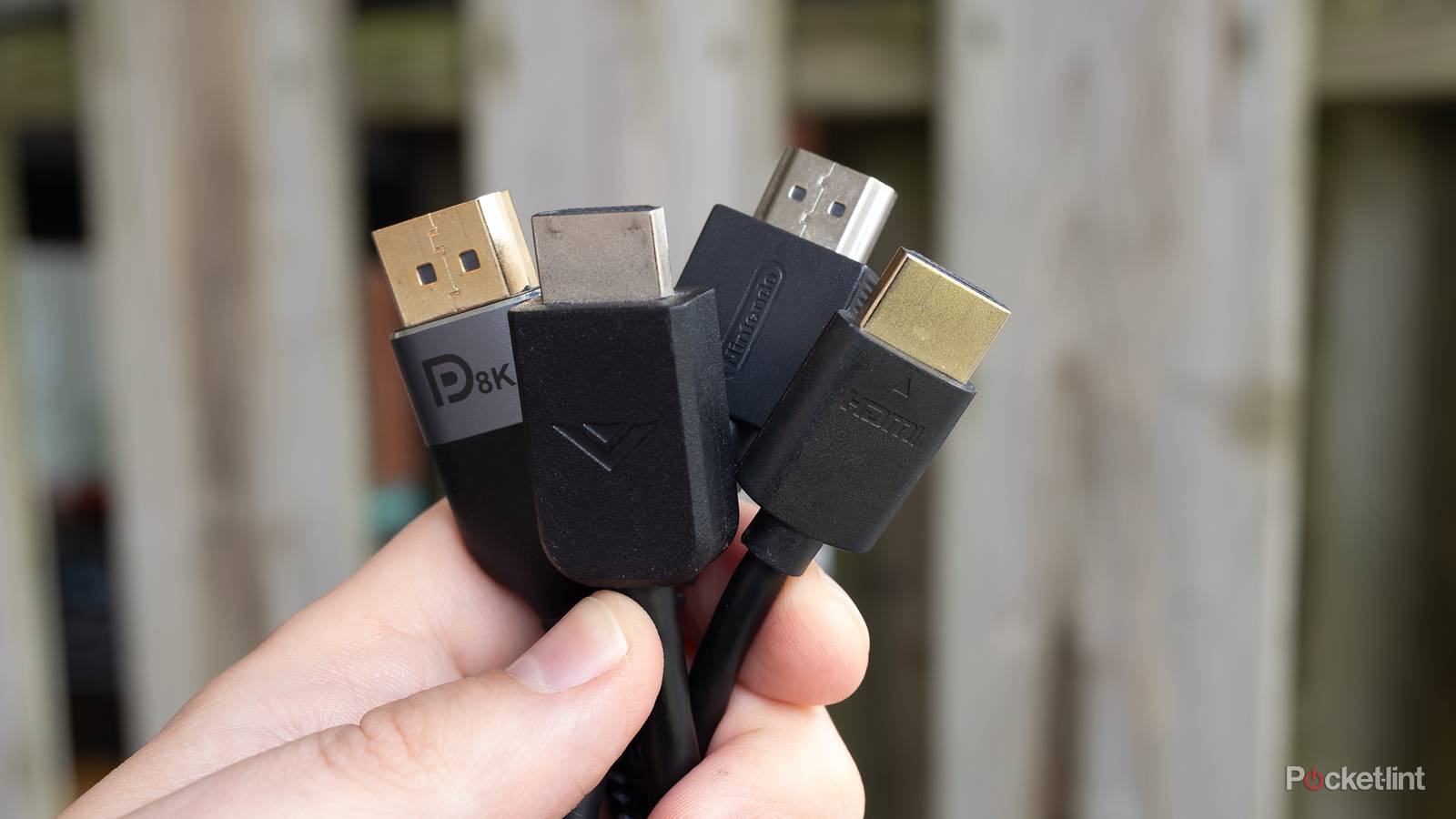
The HDMI cable was a simple yet revolutionary entertainment invention, streamlining and eventually supercharging the transfer of audio and video from a source to a screen near you. The powerful cable quickly established itself as the new operating standard. Decades later, it is still currently the common and effective means of connecting various devices to your TV screen, whether it’s a gaming console, laptop, streaming stick, physical media player, or soundbar.
While the HDMI cable is vital for home entertainment, there was a moment some time ago when its ambition outreached its grasp. The HDMI cable was almost even more versatile and useful than it is now. Here’s what happened.
How the HDMI cable evolved over time
The innovative connection changed home entertainment

HDMI stands for high-definition multimedia interface. It’s a cable that consolidates the transfer of audio and video, taking it from a source and getting it to a screen, with the first iteration debuting all the way back in 2002. That first cable had limited bandwidth, but it was a huge improvement on a previous system that used separate cables for audio and video and had a low ceiling on quality. Long gone are those colored component cables, unless you’re feeling nostalgic.
In the time since, there have been several updated versions of HDMI as bandwidth limitations increased, allowing for more detailed video at higher refresh rates. The current preferred HDMI of choice is version 2.1, which features 48 Gbps bandwidth to support up to 4K resolution at 120Hz. HDMI 2.1 supports the top gaming consoles from Sony and Microsoft while also allowing high-fidelity audio transfer to soundbars and stereos. The HDMI 2.1 connection is often referred to as an Ultra High Speed cable.
The previous iteration, HDMI 2.0, uses a Premium High Speed cable and is still available on some recent TVs. You may still have some 2.0 slots if you have an older model, or you may find one or two ports present on a budget-friendly TV as well. HDMI 2.0 tops out at 18 Gbps and allows for only 4K resolution at 60Hz, which is still sufficient for many consumers who don’t use the latest gaming consoles or prefer movies in high fidelity.
You may still have some HDMI 1.4 cables around if you have held onto your PlayStation 3 or Xbox One. While those cables have been around for over 15 years now and are mostly obsolete, they did herald in a new era of HDMI with lofty ideas.
An Ethernet connection idea
HDMI wanted to be more ambitious

It took less than a decade for HDMI to take over the cable market, all but replacing old AV hookups. The HDMI 1.4 iteration released in 2009 was a big jump in quality, allowing for 4K resolution to pass through, albeit only at 30Hz. That was plenty for the latest gaming consoles at the time as well as all those consumers who were newly embracing 4K TV.
HDMI 1.4 also upgraded audio fidelity with an Audio Return Channel (ARC), which sought to prevent lag and sync issues. Instead of a separate optical cable to return to your output device, the HDMI cable handled audio transfer in both directions. Without ARC, you need a cable to connect your TV to your speakers; or you simply have to use your TV speakers. ARC could offer a simple surround sound setup.
HDMI 1.4 wanted to do more, however. The company behind HDMI cables wanted to include the ability to run Ethernet through the cable. This innovative idea, dubbed HDMI Ethernet Channel (HEC) would further consolidate your cable management, allowing the internet to pass through along with audio and video. It made a lot of sense as the next step in an entertainment world that wanted to make everything faster and more convenient. You would have your TV connected to your router, and all your devices would connect to your TV with this cable, enabling them to use the internet. But it didn’t work.
Why HDMI Ethernet Channel was doomed
Technology was ahead of its time

Successful home entertainment operations involve three different components interacting on equal grounds: your source material, your screen, and the connection between them. All three of these parts need to be on the same page with equal compatibility. For example, if your source material offers 4K resolution and HDR, but your TV isn’t equipped to showcase those features, then you’re not going to get that 4K HDR quality image. And if both your source material and screen offer 4K resolution, but you don’t have a cable between them that supports 4K, you’re also not going to get what you’re looking for.
HDMI 1.4 also included a feature to standardize 3D video files. At the time, 3D home entertainment was gaining some momentum, but ultimately the user experience proved too tedious and unpopular for the feature to really ever be used.
This is part of the reason HEC failed. The cable wanted to allow for Ethernet pass-through, and it did, but TVs were not willing or able to accommodate it. Without the backing of TV, it was just a feature that had nowhere to be used. TV manufacturers would have needed to build a compatible port on their units and in 2009, there didn’t seem to be any reason to do so. Streaming wasn’t popular yet, and smart TV were in their infancy. TVs weren’t connected to the internet, so there was no internet to share. The other device, whether it’s a media player or gaming console, would have needed to be compatible as well.
The timing was off with HEC. When devices needed to connect to the internet, they used a Wi-Fi connection or their own Ethernet port. Routers are lightning fast and an HEC cable isn’t going to make anything faster or more convenient.
HDMI still has compelling features
Convenient control and audio fidelity

Still, other popular HDMI features caught on and are embraced to this day. The introduction of the Audio Return Channel in 2009, and later the enhanced Audio Return Channel (eARC) in 2017 improved audio fidelity and consistency. This was a feature that was embraced because TVs always had an audio output and there was a need to make this connection more convenient and stable. Still, you need a compatible port with the right cable. You’re likely only to have one eARC or ARC port available among several HDMI ports on your unit. And if you want to use the eARC feature, then you need an HDMI 2.1 cable.
Another convenience the cable has brought us is HDMI-CEC, which allows you to control all the devices connected to your TV via an HDMI cable with a single TV remote. Your PlayStation 5, soundbar, and Google TV streamer can all be wielded using a single remote. It makes for a world of convenience and maybe one or two problems. With HDMI-CEC enabled, you can turn on your TV, and your soundbar will turn on automatically as well. It can also activate your streaming device if you use one too. Sometimes, though, it may turn on devices you aren’t intended on using. If a gaming console or media player was the last thing you used before you turned off your TV, they may turn back on when you power up your TV.
A new HDMI iteration is on its way. HDMI 2.2, which features 96 Gbps bandwidth, has already debuted, although it too is ahead of its time. The doubled allowance, fostering 8K resolution at 240Hz, is most impressive. However, as has been the case before, just because the cable offers some quality features doesn’t mean it’s viable just yet. TV screens and source material at 8K aren’t quite popular yet, so that HDMI 2.2 cable won’t do you a lot of good. At least, for now.