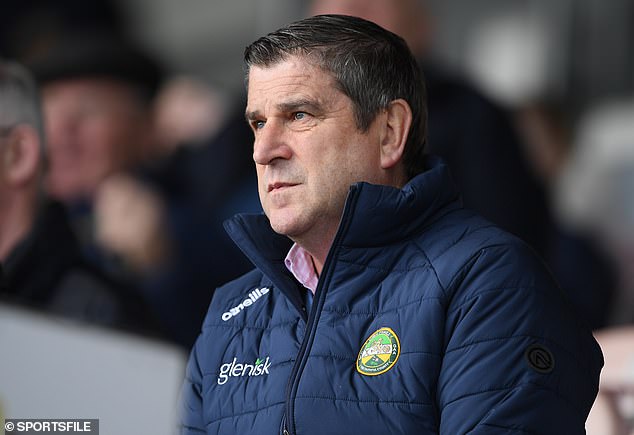
In one kitchen chair sits Michael. Double All-Ireland winner with Offaly in 1994 and 1998. An All-Star. RTÉ analyst and co-commentator and a long-time columnist for Mail Sport.
Outspoken, driven, he took on the position of Offaly chairman in 2019 and became a figurehead in the county’s resurgence – in both codes.
He snagged Shane Lowry as an ambassador and helped lay the ground for a new army of fans who became swept up in the underage revolution and the Under-20 All-Irelands in both codes, not to mention the senior hurling team’s re-emergence.
Beside him in the other chair sits Brian. At 25, he’s the younger of Michael’s two sons. A teacher at Coláiste Colm in Tullamore, religion and history are his two subjects.
Brian made his senior debut just as his dad took over the chair in 2019 when things were at such a low ebb – he missed a penalty in the shoot-out as Offaly lost a semi-final to Down in hurling’s third tier competition, the Christy Ring Cup.
Yet here they are now. Brian, one of the leaders in attack as Offaly take on Cork this afternoon in Thurles in an All-Ireland quarter-final.
Michael, the Offaly county board’s Central Council delegate and player liaison officer.
Brian’s older brother Seán is living in working in Canada. He’s not in the room but Seán is there in spirit.

Michael Duignan has been highly successful as an administrator with the Offaly GAA board
And so is Edel, Michael’s late wife and mother to the two boys.
‘Life, death & hurling’ was the title of Michael’s memoir which bravely went beyond the whitewash to describe his wife’s long battle with cancer, and the impact of her passing in 2009.
In the week when Offaly take on Cork in an All-Ireland quarter-final, father and son talk about a county’s journey, and one family’s journey, their family dynamic and everything in between.
Michael’s wife Aisling – they married in 2022 – is now the warm female presence in the house just a minute from the Gaelic field in Durrow outside Tullamore and she is responsible for the chocolate buns left out. [The inter-county hurler in the room, passes on them].
PHILIP LANIGAN: You were born in 2000, Brian, the year of Offaly’s last All-Ireland final appearance, so where did the county’s success story feature growing up?
BRIAN: Growing up, we would have heard a lot about the team of the 1990s. We would have watched back matches when we were younger, but it was never, like, too big of a thing.
Obviously from Mick we would have met, say, Joe and Johnny Dooley, we’d know them well just from being around town. You’d meet Jim Troy up the road, Pat Cleary, because they’re all part of the club and things like that. We knew an awful lot of them.

Michael Duignan salutes the crowd as part of the Offaly 1998 All-Ireland winning Jubilee team when the team was honoured in 2023 during the All-Ireland final at Croke Park
Joachim Kelly, even from further back before that into the 80s. And it was nearly just, like, kind of part of life, you know what I mean?
It was never really anything… I wouldn’t say anything special, but we never really thought anything of it. And I say we, as in the other lads around here that came through with me as well, we all kind of came up with the same thing, and all we wanted to do was just hurl.
The medals used to be on the wall here beside us. The medals were there, and there was a picture, and there was an All-Star thing and all that. And you’d be looking at it, and it’d be class to get one, but you wouldn’t be thinking about it. It wouldn’t be deep.
You’d just go down to the pitch and have the craic.
PL: There’s such a love for Offaly hurling because of those old teams still – but you weren’t sitting around the Christmas table, and Michael saying, ‘come here, let’s throw this All-Ireland on again…’?
BRIAN: No, that only started happening the last couple of years. I’d say the last three years we watched a match around Christmas, because it would only be us here. We’d be up in our aunties’ or Michael’s sister’s up in Dublin at Christmas, and Seán’s in Canada, so we’d come home, watch a match.
MICHAEL: We watched the 1999 semi-final [Cork-Offaly], I’d never seen that. And we watched the two Kilkenny and Tipp finals, 2009 and 2010, remember?
He’s laughing at the hurling… [gestures at Brian grinning away].
BRIAN: I just look at it, it’s a completely different game to now. It was different skills back then, it was pulling on the ball in the air, or pulling on someone! But it was just way more physical, and aggressive.
It’s physical now but it’s a different type of physical, it’s all coached, it’s more tactics, but back then it was just raw, and just trying to hurt people. Chaotic.
And there’s no harm in a bit of chaos as well; sometimes hurling is too structured. The freer it is, the better it is for people to watch and to play.

‘There is an Offaly way’ – Brian Duignan in action for Offaly against Kildare earlier this year
PL: Do you get a sense, though, of being a current Offaly hurler, that you need to play in the traditions of Offaly hurling or is that too naive?
BRIAN: I wouldn’t say so. I think naturally the way we play, it all is very similar. Like there definitely is an Offaly style. Do we think that we need to play the way, say the successful team of the 1990s did? No.
Obviously the teams of the past were there, and fair play to them, but we did go down to Christy Ring level, where we deserved to be. We had to build up our own identify.
We figured it out ourselves from rock bottom back up. It’s similar to the lads, the way they played, but it’s definitely a new brand of Offaly hurling.
PL: So the father and son dynamic. How does it work. Are you a chip off the old block, or would you say ‘no, I got the brains and the good looks’?
BRIAN: I got the hurling anyways! Seán got a certain amount of the brain. I don’t really know where Seán came from, to be completely honest; I don’t know if you do either [looking at Michael]. Seán is his own man, he’s a bit of a character, who wouldn’t be too concerned about anything I’d say, I’d be a little bit more serious.
MICHAEL: Seán was actually a very good athlete, natural athlete, but didn’t have that mad interest, didn’t have the drive, but he’s a great character.
I wouldn’t have done much socialising with ye over the years, just an odd time with the lads, but I think there’s a bit in both of them, but they might not have fully seen it yet.
PL: The father and son thing isn’t anyway unique to Gaelic games but the dynamic of having your dad as county chairman for five years is. Like you say, Offaly were relegated to the Christy Ring but now things have been turned around, would you be in this position if he didn’t take over as chair?
BRIAN: I would say no. Not being biased, I’d say we wouldn’t be.
I’ve often had to explain it to the lads, I see things from both sides, all the time, so from the player side and from the county board side.
Which is good sometimes but not others because you don’t want to be part of the politics when you’re playing.

Brian Duignan celebrates after the win over Kildare in Newbridge in the Leinster Championship
But the work that went in here from 2019 through to now… it just never stops. It’s always ringing someone, always on the phone, always organising things, trying to fix problems – it’s non-stop.
If we didn’t have the likes of Michael as chairman and Dervill Dolan, Colm Cummins and all the rest who came in, it’s very straightforward: we wouldn’t be where we are now.
Because we got treated like a Liam MacCarthy team when we were in the Christy Ring in terms of whatever we needed we got – our gear, our equipment, our management.
Look at the management team we have now in the Liam MacCarthy, we have two All-Ireland winning captains in our backroom team [Brendan Maher and Seamus Callanan], and four years ago we were Christy Ring or just coming out of it.
So we got treated fierce well and I think that added to us becoming more professional as a group and putting in that extra bit of work. Which, together with the younger lads coming through, got us over the line.
PL: But that day against Down, losing on penalties Brian, in your first year on the senior panel – that must have been tough? In November too, in a surreal Covid winter championship….
BRIAN: It was the worst. I was after missing the penalty in the penalty shoot-out. It was a long, long, journey home.
PL: Did he mention the penalty?
MICHAEL: Ah Jesus, there wasn’t many words spoken. We didn’t say much did we?
PL: So Michael being chair, and maybe doing a public broadcast about the wrongs of the GAA paywalling big championship games on Sky, going viral on social media, having strong opinions in print or on TV, how was that for you, Brian, if people were having a go?
BRIAN: I’d say, the easiest answer is, I have a very similar personality. So I don’t really care too much, and anyone who’s ever said anything to me, on the field or off the field – I’m fairly well able to handle myself, no more than he would do.
There’s two or three times over the years… I remember a schools match, an All-Ireland schools final years ago. I remember a league match, four or five years ago, against Kerry, and some other time.
A lad had specifically said something to me about Michael, and I’d just be like, “Go and say it to him. I don’t care. See how you get on if you go up and say it to him – he’s on the terrace, right over there!”
PL: Same for you Michael, you’ve been around long enough, but it still doesn’t make it easy to hear it?
MICHAEL: Look, most people wouldn’t say anything to your face. There would be the odd gobshite. But, it’s part of it, and you make allowances for certain people, you know what I mean. They’re at a match, you go in.
I have a much bigger problem with people that aren’t at the match and are commenting. I think that is the most cowardly, carry-on of all time. Some of the stuff that’s being said about people is shocking altogether.
But no, one of Brian’s things is that you’ve always been mentally strong.
We’ve built up from the club here, and the school, the underage stuff, and the lads, they’ve a great old bond.
PL: So, it was a tough first year, then won Christy Ring, then won Joe McDonagh final in 2024 and there was that lovely photo after of you embracing after the whistle on the pitch at Croke Park. I think the previous final, you didn’t score Brian, you felt you were a bit under pressure. So, what was that day like – you hit a top corner screamer in the opening minutes to set the tone?
BRIAN: I think from a playing perspective, in terms of the group, and our progression, it was pure relief. You’d even see, if you watch back that final, the last 15 minutes we were all gassed, and that was nothing to do with our strength and condition, our fitness, it was the occasion that had just drained us, because we wanted to get back up so bad. We knew we needed to be in Liam MacCarthy, we needed to give the younger lads the platform to play.
MICHAEL: So it was a real journey, and there’s a picture over there of all the lads from the club here, on that Joe McDonagh squad. There was Mark Troy, the two Ravenhills [Ross and Dan], Ciarán Bourke, Sam Bourke, Dan Bourke, they’re all living here. I suppose for me, having been involved with them for so long, and it’s such a huge part of our lives, of course it was.
We wouldn’t be big into that sort of embracing on the field – normally it would be a quick handshake – but it was good.

Brian Duignan has developed into one of the most influential players on the Offaly team
PL: From there to surviving a relegation play-off in Leinster in 2025 and setting the tone for what was to come with a thrilling draw against Dublin in the game of the Leinster championship. And then, on the Monday, on Morning Ireland, Michael spoke of Offaly’s progress – coming from a place where they were the 17th ranked team in Ireland?
BRIAN: Yeah, look, I think first thing just on what Michael said about being 17th ranked team. It’s mad to think there, I think about four years ago we sat down and started and had a meeting and our goal was just to try and break into the top 10. This time we were a Joe McDonagh team. So that’s where that group was at that time, that if we got into the top 10, we’d be doing unbelievable.
Are we inside the top 10 now? Obviously we’re in the last six. People would do their rankings differently. They might have us in or out. We think that we’re fairly firmly in there and we have more to go.
Then coming into the Leinster Championship, that Dublin game was huge. Same as last year, I think we lost by two points and Ronan Hayes got a goal at the very end and we felt we were unlucky.
We targeted it from a long, long, long way out and the whole way through the League, the whole country had us written off.
PL: A draw against Kilkenny – the first time since the 1998 All-Ireland final that Michael featured in that Offaly hadn’t lost to the same opposition. That helped propel you to a place where they needed to beat Kildare in the last round to qualify for the All-Ireland quarter-final – but only if Dublin beat Kilkenny at Parnell Park. So, how was that day?
BRIAN: I’m on the field in the second half against Kildare. Someone brought on water to me. Told me that Dublin were winning by six I think at the time. And whatever way I got it twisted – you’re so wrapped in your own game – I thought it was the other way around! One of the lads, David Nally came on and he’s after getting a great point but there was an overlap for a goal. I ate him for not going for a goal.
And I was like, ‘We could need to go to score difference… blah blah blah’. And then I came off with about 10 minutes to go and I was sitting there, I was in an awful mood. There was a few lads around me and a couple of them were watching it on phones because it’s on GAA+ and they were like, ‘What’s wrong with you?’ And I was like, ‘I’m mad, we’re not going to get through.’
And they were like, ‘Dublin are winning by seven points” and I was like, “Oh ****!’
Just a relief then. And it was unbelievable. That 10 minutes on the pitch was class. Just the amount of people coming up to you. I’m used to kids in school coming out to me and all that sort of stuff but it was everyone.
There’s people that you’re going like, you don’t even know who they are. I’ve never seen them at a match before and they’re all buzzing. And it’s just the whole vibe around Tullamore here, around everywhere, wherever you go, everyone is just buzzing for Offaly hurling, so it’s class.
PL: I know, Michael, you’ve been very honest about losing Edel and you detailed your own personal story in your book. For you Brian, do you think that’s really shaped your dynamic as father and son? That your mam wasn’t around, and the bond, I guess, would probably be different than a lot?
BRIAN: I would say so. A lot of the time, obviously now I’m nearly 26 this year, so I’m a bit older, but even when we were younger, we would have always had, and Sean would be the very same, it would be more of a kind of friendship dynamic, if that makes sense. But by the time we got to about 16 or 17, it was kind of more so, “Right, I’m after giving you the tools now, and lessons. Go out and do them, and make mistakes, and whatnot.”
And you’d be there to give out to us, if you really had to, but it was rare enough at that stage. I think that that probably did stem from that, that you probably felt you couldn’t be as strict with us when it was just the three of us here for a long time.
But that being said, I think we were both raised fairly well, considering.

After losing wife Edel in 2009, Michael Duignan was raising two young boys through his grief
PL: For moments like that Joe McDonagh Cup win, it must hit. Obviously, there’s milestones that you must think, obviously, about Edel and not being around to witness?
MICHAEL: Yeah, yeah, yeah. Yeah…. [takes a moment to gather himself]…. I suppose we just tried to move on with life, didn’t we?
BRIAN: You have to.
MICHAEL: So that was 2009. The lads probably don’t even realise, like, Brian was only eight, but even before that, when Edel got sick first, that was 2002. I think it was about your second birthday when she was diagnosed. And we probably wouldn’t be here in Offaly if that hadn’t happened. Because we were living in Naas. And Edel was very successful in her job at the bank. I had just gone out on my own, in business.
That’s where all my contacts were. So it was never on the agenda at that particular time to move back.
Edel had surgery, she had treatment, and it went on for about 12 months, and during that period, we sort of reflected on life and where we were at. And we were very young to be doing that – I was 34 or 35 at that time, and so was Edel.
And you’re sort of saying, look, ‘let’s take our foot off the pedal a little bit here, work-wise and everything else, and see what’s important in life.’
At that stage, hoping Edel was going to come out of it and be right, but her family, she had a sister in Galway, a sister in Glasson, who are still there, a sister in Portlaoise, her mom and dad were in Portlaoise, God rest their souls, and now have passed.
My mother and father, who were a huge influence on us, a huge help to us, were in Banagher, so we said, look, ‘we’d have more support, we’d move down the country’. We were very friendly with Joe and Marie Dooley, a few other people here.
Edel was great friends with Marie, best friends, and so that was the decision we made. And then we fell upon the house there by complete accident.

Michael Duignan with his late wife Edel, and Brian, left, and younger brother Sean
PL: You’ve always been so open Michael about it all. When you published the book, your personal story resonated with so many people. But did you read the book Brian? Do you read the book or find out a lot of stuff about your family life story? Where did you go with it all?
BRIAN: No, I never read it. I wouldn’t say that I had no interest in reading it, but probably when I was younger, when I first, say, could have read it, there’s probably stuff in it that I don’t want to really know. That I don’t want to have to read that and learn about that and see that.
Will I read it at some stage of my life? Yeah, I will, but I don’t really want to read it now. There’s just different things that I just don’t want to kind of put myself through.
PL: Michael getting remarried then, that was obviously a change?
MICHAEL: Someone else coming into the house?
BRIAN: I’m fairly easy going about the majority of things, so, like, I don’t really think deeply about anything, because I don’t… look, things are in the past. I suppose, like, there was what, four or five years, it was just three of us here, was it?
It was probably a raw enough situation, I suppose, to put it that way.
And there’s no harm in just having more of a feminine touch around the place, just to keep us all kind of at bay.
PL: And that’s something huge for you as well, you know, to have Aisling around, isn’t it?
MICHAEL: Yeah, well, look, especially as lads got older, and Seán’s gone to college, Brian went on to college, yeah, absolutely. She’d be very good to the two lads, and never tried to be anything else. She was my partner, was very good.
BRIAN: You can imagine, Mike probably wasn’t the best for doing the housework and stuff like that as well, so there was a bit of a help there too. He wasn’t bad cooking, but after that…
PL: But you mentioned that idea of, like, this, not sliding door, but just the change, that you could be, you could be a Kildare hurler, would you?
BRIAN: I could still have a job, a Joe Mac medal, who knows?
MICHAEL: And me and is met by a complete accident as well. All these things that happen… it happens for a reason, doesn’t it?

Michael Duignan, Offaly in action Semple Stadium against Cork in April 1995
PL: You’re very good friends Brian with Charlie Mitchell [the Offaly captain was diagnosed with myocarditis earlier in the year and suffered a cardiac issue after the Kilkenny game which required surgery]. How do you kind of process that while you’re trying to qualify from Leinster, how do you keep going?
BRIAN: First of all, he’s ok. As well as he can be. He’s healthy and everything. We would have talked about when it happened – like thank God he was okay. And everything he’s been through was tough on the group.
The first time when he was out for a few months it was kind of different because he was knocking around the place and everything like that but then after the Kilkenny match it was a little bit more serious so it was tough for the group to process.
To be fair to Johnny [Kelly] he was very good with the way he dealt with it. He got us all together he gave us full run through of what was going on and how everything was. Like you’d hear a lot of rumours going around the place and you’d hear them in different places but we knew exactly what was going on so we had full transparency of what the story was.
I had been up to visit him in hospital as well so we all knew he was grand – he was in his usual good sneery form, anyone that knows him knows that he’s a gas character. So he was grand.
And then as a group look how do you deal with it? Like your captain, probably your best player you’re missing him all of a sudden, like how do you deal with that as a group?
First of all from a hurling point of view there is no other player in Offaly like Charlie Mitchell. In my opinion he’s head and shoulders above us, the way he plays and his work rate and he kind of inspires everyone so it’s hard to deal with that.
And to be fair Eoghan Cahill came in for him and has probably been our best player, arguably one of the best players in the country in the last three games. Has been incredible and that’s credit to Eoghan, the work he’s put in. Like he’s been there since 2016 as well so he really took his chance probably after not playing that much the last few years.
And then, what else do you do? Do you sit around and worry about Charlie? That’s not what he wants us to do either. So you kind of have to get on with it.
Charlie wouldn’t want us to be sitting around worrying about him; he’d want us to go out and try to win matches. And the last thing he’d want to do is us to not do ourselves justice.
Again we didn’t even say we’re doing this for Charlie because he wouldn’t want that either – “What do you mean you’re doing this for me? Like I’ll be back there.”
So it was about playing the way Charlie would play. Doing ourselves justice and everyone justice so just kind of keep going the way we’re going.
On the AI and social media thing, this is a funny one. As a player, you try to stay away from it. Your social media, or your algorithm all this, you try and keep it to stuff that’s nothing to do with you. You don’t want to see articles go “Offaly, blah blah…”
Then last week a lot of lads were onto the group chat. Different lads sent it into the group. A TikTok. I thought, What’s this? So I went into it.
So there was an AI picture of me, sitting there holding a book, that said “How to be as good as Charlie Mitchell”! Some young lads is after making it and putting it up!
PL: So what about Cork and the quarter-final. You’re playing one of the favourites for the All-Ireland. How do you approach this one?
BRIAN: Same as any other game this year. You ask anyone who plays at this level, if you don’t think you can win a match there’s no point going out.
No more than the Cork lads would be thinking the same thing but us we think that we can go out and win – but we have to play to our best. We have to work hard we’ve to do all the things we’ve been doing all year and then we definitely have a chance.
And no matter who you’re playing in the country you have to have that mindset or else you’re not going to survive to this level
PL: What would it be like if you could see him walk up the steps of the Hogan Stand to lift the Liam MacCarthy Cup?
MICHAEL: Ah Jesus, would you stop. [Pauses to take a deep breath. Takes a moment]. Sure look, that’s what you dream about.
You know from the column over the years, one of the things that would have inspired me to go for chairman. When we were in the Christy Ring and we’d hit rock bottom, I’d heard a comment made before that from a previous chairman that we probably overachieved over the years, that we couldn’t get back there again. I was at a function one night and Sean Lowry, great footballer, was beside me, and I said to Sean, “I don’t agree with that.”
And I want to stress was a huge team effort, it wasn’t me, I was leading the team, but had great people around me and they’re still in there today. It’s all about having that ambition.
We’re not saying we’re a Kilkenny or a Cork or a Tipp but we have our own tradition.
I love quoting first county to have an All-Star in hurling and football, only three counties have won minor, under-20 and senior in football and hurling – Cork and Galway the other two along with Offaly. We never feared anybody.
I keep saying of the older lads, they, to me, stand out for keeping the show on the road for Offaly hurling. It would have been so easy to throw in the towel in the Christy Ring.
But a hardcore of them stuck together and said “we’re going to get this team back into the Liam MacCarthy before these other lads come”. And that was a huge effort.
BRIAN: I think there’s eight of us left now who’ve gone from Christy Ring through to now, and then there was Jason Sampson and David King who retired last year, but we’d always kind of include them when you have the discussion because they were there the whole way as well.
Grand, we did our bit to get up there and the younger lads were coming and they were going to be good, but it’s not that easy to kind of gel.
I think something that people don’t realise is if you walk into our dressing room, say you come in tomorrow to do a piece with all of us at training, and you’ll be looking at the craic that’s going on here between Ben Conneely who’s married and has three kids and say, who’s the youngest on the panel? Shane Rigney or Rory Kelly or these boys who have no clue what they’re going to do tomorrow, who can hardly get out of bed, you know what I mean?
You know how often you hear people quote the New Zealand ‘no dickhead’ policy in the dressing room? It’s a great way of describing it.
I think the atmosphere in the dressing room is kind of what contributes to the whole thing. Like it doesn’t matter if you’re 20 or 21 or if you’re 29 or if you’ve played 80 games or 10 games, you’re as important to the group as anyone else.
So I think that’s really important.
MICHAEL: Look, to answer your question, it would mean the world. Like what we did, we did. And I’ve got so much out of that, having those All-Ireland medals. And there’s loads of great players who didn’t win All-Ireland medals; we’ve always said that as well. So you’re not defined by it either.
Ken McGrath, John Mullane… you can go through all the Waterford team. There’s loads more: Ciaran Carey, Gary Kirby, all these lads.
But look, it’d be special. It’d be special for the county and it’d be great. And you know, I think it can happen…