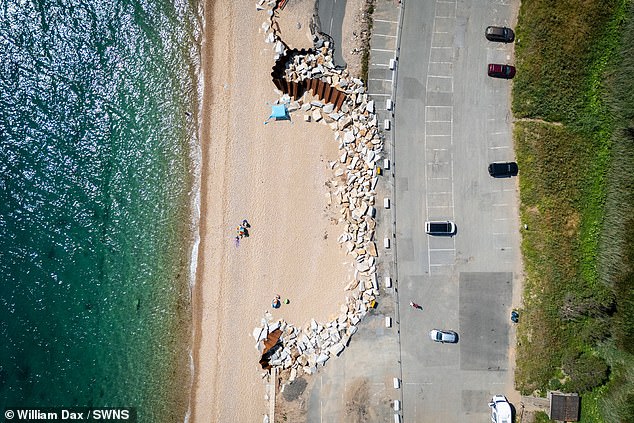
A coastal village faces an ‘existential’ threat from the sea next winter if the £20million ‘rock armour’ defence scheme isn’t built in time.
Residents in Torcross, south Devon, are still recovering from the brutal storms that damaged homes, pubs and washed away the coastal road linking the village to the outside world.
The A379 between Torcross and Slapton remains closed after waves from the winter storm caused the road collapse.
The closure has cut the town off from nearby Dartmouth and detours can add 45 minutes or longer to drive.
And while the Environment Agency (EA) has promised £20million to build a new sea defence for the town, the construction faces a race against time as villagers brace themselves for next winter.
Locals said that it is now vital the work is carried out as a matter of urgency as they fear even more homes, or even the whole village, could be lost to the elements.
Hannah Miller, 36, general manager at Start Bay Inn, said: ‘We’ve come through a pretty wild winter here in Torcross.
‘It was terrifying. There were waves coming over the building, the buildings shaking, waves crashing against everything, paving slabs flying around everywhere. It was quite scary to be around.

Residents in Torcross, south Devon, suffered brutal storms last winter that damaged homes, pubs and washed away the coastal road that connects them to the outside world

Gail Stubbs, Landlady of The Start Bay Inn in Torcross, worries the work may not be done in time for next winter

The A379 between Torcross and Slapton remains closed after waves from the winter storm made the road collapse
‘The village literally wouldn’t survive another winter if we hadn’t got that grant for the rock armour so we are really pleased about that.
‘It’s a bit of a race against time to get it done. But if the storms are anything like they were this year and we don’t have that in place, then it’s going to be a pretty bleak future.
‘The amount of damage that’s already been done, it would just be absolute chaos if it was to happen again. There wouldn’t be much left.’
Last winter, huge waves smashed into the sea defences which protected the coastal community around Start Bay, leaving the village suffering an ‘existential’ threat, according to the Environment Agency.
The A379 into Torcross was swept into the sea after being pummelled by 12ft waves and 60mph winds when Storm Imogen hit south Devon in February this year.
It was not the only casualty in the storm. Landlady Gail Stubbs’ pub, the Start Bay Inn, was smashed up by the deluge along with several neighbouring houses.
Later this summer, work will begin to position 55,000 tonnes of rock in front of the existing sea defences as part of a £19.8million improvement scheme that the EA said would ‘buy the community some time’.
Alison Willcock, 63, owner of The Billy Can said of the storm: ‘It was horrendous, it was terrifying, it was constant. We live above our business, so we lived through every single night, every single wave that hit us, every single bang that hit the sea wall, vibrated through our house. It was terrifying, it was awful.

The promised £20million however, is not targeted at repairing the road, with cash for that being sought from a different government fund

New photos show coastal houses still in disrepair after storms hit in January and February this year

Locals said that it is now vital the work is carried out as a matter of urgency as they fear even more homes, or even the whole village, could be lost to the elements
‘I didn’t go to bed because it just felt very frightening, very unsafe. Despite having the Coast Guard outside, the storms just kept going on, kept hitting us.
‘The following morning when it became light, it was obvious that there was so much damage here and it was a series of three storms. So the first storm came in and damaged some of the properties and then the next two storms really topped it all off and damaged every single property along the line. So it was scary.
‘The road is a lifeline to the village and has cut off our transport links, not just for Torcross but also for the surrounding villages, the surrounding businesses and it’s making travel transport very very difficult.
‘I was absolutely full of anxiety. We’ve put our life and soul into living in Torcross, and we’ve got a couple of businesses here and it just felt as though all was lost. It felt that we’d potentially got to start again.’
She said that there was ‘total jubilation’ when they found out about the grant as funding had been shrouded in uncertainty.
Alison added: ‘I wouldn’t say we were out celebrating because we’re a long way from actually having the repairs done until it all starts. But it was the most fantastic news that could ever happen to the village.
‘We just hope it is done in time because we really cannot face another winter of storms as we have experienced this year.

Residents in Torcross suffered brutal storms last winter that damaged mulitple properties

Storms last year left the village suffering an ‘existential’ threat, according to the Environment Agency
‘I’d be very nervous if the sea defences are not done. I’d consider moving out, although it might be that the storms we got were potentially a once-in-a-lifetime situation.’
The promised £20million however, is not targeted at repairing the road, with cash for that being sought from a different government fund.
Rocks will be dropped off near the shoreline from the barges at high tide between September and November, and collected by an excavator at low tide.
The smaller one to three tonne rocks will be stockpiled, while the larger ones will be strung out, creating a temporary protective line of rock armour parallel to the works.
Rock revetment work will take place in October with five-metre panels installed per tide, while piling works at the slipway and car park defences, including repairing the car park storm breach, will happen in March next year.
Completion of all the works is predicted to happen by June 2027.
Gail Stubbs, 48, landlady of The Start Bay Inn, said: ‘The only thing that the money is doing is actually protecting the village. It doesn’t include the road at all.
‘We have to protect the buildings themselves and then hope that something can be done about the road if possible.
‘The thought that it might not be here in a few years was really frightening. We are going to get some protection for the village which should start in September but we’re still waiting to hear the final bit of permissions so there’s still a little bit of fear that the work might not be done quick enough for the next storms.
‘I don’t think I’ll breathe out until the boulders are in place all along the front of the village and the later it gets in the year the more there is a possibility the storms might start hitting and the works might have to pause.
‘I’ll feel a lot better when the works are finished in front of the village. I’ll definitely breathe out. We’ll have a boulder party.’

Damage to this coast can still be seen today after storms last winter
She said last winter was the worst she had ever seen.
‘My family have been here since 1977. We’ve lived through a lot of storms, but I think this one, the village sustained the worst damage in our time here,’ Gail said.
‘There was so much damage along here, along the front, we had water in the pub. We tried to open as much as we could but we were closed a little bit. We are very concerned about public safety, staff safety and actually our existence as a business and a community.’
Her inn dates back to the 1400s, but Gail fears storms like this could wipe out that 600-year history.
George Arnison, the Environment Agency’s coastal engineer, said: ‘It was a disaster that happened overnight.
‘Torcross was a real wake up call. This is what climate change can look like.
‘Torcross was very unlucky on this occasion, another day, another year, it would be somewhere else.
‘But we’ve got to start having the conversations and work out what we do. Not just for places like Torcross but for other places around our coastline that are similarly at risk.’
He added that while the scheme was ‘value for money’ that it was not a permanent solution and that there were ‘no easy answers’.