Brits have lost millions of pounds trying to sell retirement properties over the last decade as their values plunge due to high service charges and restrictive leases.
Many of the UK’s 190,000 privately owned retirement flats are now worth far less than when they were built with an extreme example having fallen by 95 per cent.
Frustrated pensioners have watched service charges soar by more than half in just seven years on their homes, making them difficult to sell and leaving some empty.
While anyone in the UK can buy a retirement property, rules dictate the occupant’s minimum age – which is usually 55, 60 or 70 depending on the specific development.
This means families who have inherited empty retirement properties are having to pay thousands of pounds a year in ongoing service charges while waiting for a buyer.
Upmarket properties for the elderly are found in ‘retirement villages’ with restaurants, health clubs and golf courses – in a sector now worth more than £10billion annually.
These communities first began springing up in Britain in the 1990s with the idea of giving older people independent living but with help available whenever needed.
They are located on accessible estates serviced by a management company who charge a fee – but the amount can rise significantly in the years after a purchase.
Those trying to sell a retirement property also only have a limited pool of buyers, meaning demand can be low and some estate agents face trouble shifting them.

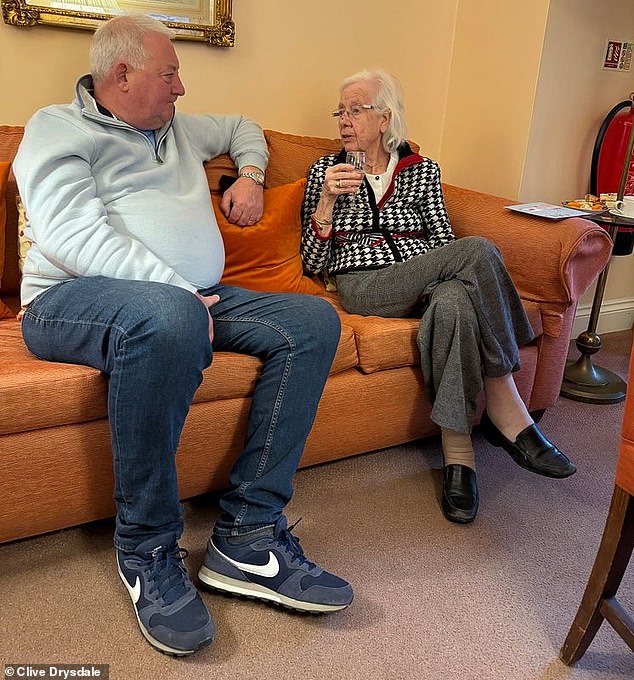
Clive Drysdale, 63, with his elderly mother Lilian, whose retirement property in Maidenhead has plunged in value from the £533,930 purchase price in 2019 to as little as £200,000 now

The property at Swift House, a retirement home for over-70s in Maidenhead, has lost value
Obtaining a mortgage to purchase a retirement home can also be troublesome and expensive because lenders are aware how difficult a future sale could become.
Retirement flats normally do not retain their value as well as other properties – highlighted by a case involving a chartered accountant who bought a property for his elderly mother in Maidenhead, Berkshire.
Clive Drysdale, 63, decided in 2019 that the health and cognitive skills of his mother Lilian, aged 84 at the time, were failing her and she should relocate closer to his home.
Mr Drysdale made several visits to Swift House, a retirement home for over-70s operated by McCarthy & Stone, the UK’s biggest supplier of private retirement developments, and decided to buy it.
He was encouraged by the company’s website indicating that service charges were generally increased below the level of inflation – and the fees for the two-bedroom flat he was looking at were £8,401 a year at the time.
Mr Drysdale was also impressed by the firm’s claim that it had secured an average 4 per cent net price increase per sale resale launching McCarthy Stone Resales in 2017.
It also offered to cover the stamp duty and moving costs and give a £20,000 discount on the £553,950 list price – giving a final price of £533,930. The property was purchased in August 2019 and Lilian moved in soon after.
But annual service charges soared over the following years – hitting £13,497 for the coming year which is 7 per cent up on 2025 and a 61 per cent rise since she moved in.
In 2024 Lilian’s health deteriorated further and so she made a permanent move to a nursing home in Maidenhead – but Mr Drysdale had to continue paying the service charge.
At this stage he spoke to seven estate agents who all said they would lose a significant amount on the apartment, with price estimates of between £200,000 and £350,000.
Mr Drysdale said: ‘I had not realised the scale of capital loss being incurred.
‘On the basis that losses on individual apartments at that time could amount to £200,000 to £250,000 and there were 60 apartments in Swift House, the estimated combined losses could be £12million to £15million, which astounded me.
‘To make it worse I have just been told of a two-bedroom apartment being sold for £200,000, likely to be around a 60 per cent loss for the original purchaser. A far cry from 4 per cent growth. This may mean a combined capital loss well in excess of my £15million estimate.’
Mr Drysdale said the company did not accept any link between service charge rises and the extended time to sell as well as the large drop in market value – suggesting that the overall property market had slipped and his flat was following general trends.
By May 2025 he found a new rental tenant paying a monthly rate which just covers the service charge – and Mr Drysdale now knows he will likely suffer a significant loss on the original price if he is ever able to sell.
Sebastian O’Kelly from the charity Leasehold Knowledge Partnership believes families have lost millions of pounds overall when trying to sell retirement homes over the past decade.
He told the Daily Mail: ‘Retirement housing has been a repeated, costly failure for years with truly appalling resale values as evidenced on the Land Registry. Rather than acknowledge this, the sector attempts to deny it using highly selective and misleading data.’
Mr O’Kelly added: ‘There are success stories in retirement housing but not in the offer from the house builders, who make their money selling out new schemes after considerable marketing effort and then on to the next site.’

A flat at Goodes Court in Royston, Hertfordshire, first sold for £189,950 but is now up for auction with a guide price of only £9,000 – an astonishing drop in value of about 95 per cent

The property at the Goodes Court complex, a block of 52 flats for people aged over 70

Land Registry data shows 24 out of 27 flats sold at Goodes Court since 2014 had fallen in value
He said that only 2 per cent of British people aged over 65 live in designated retirement sites – compared with 16 to 18 per cent in North America and Australasia, adding that UK pensioners were ‘absolutely right to be wary’.
Meanwhile a BBC News investigation this week highlighted an extreme example of retirement homes losing value in Royston, Hertfordshire.
The Goodes Court complex is a block of 52 flats for people aged over 70 also run by McCarthy & Stone.
The assisted living site, which was constructed in 2012 with facilities such as a dining room, has a typical service charge of £10,000 per year for a one-bedroom flat.
But Land Registry records showed 24 out of 27 flats sold since 2014 had fallen in value – losing a total of more than £1million.
The starkest example was a flat which first sold for £189,950 but is now up for auction with a guide price of £9,000.
This means the annual service charge is even higher than the property’s value.
A McCarthy & Stone spokesman insisted many of its properties gain value but noted that this was not the case at Goodes Court, adding that it had invested in ‘significant refurbishments’ to help owners who can freely rent out flats while trying to sell.
Buyers also have the risk of the freehold on a development being sold off to an independent company who can also then increase the service charge.
If the owner fails to make service charges payments, they could end up forfeiting the lease which would then revert to the freeholder.
McCarthy & Stone began retaining ‘headleases’ in 2010, meaning the service charge can only rise by a set amount – but this is not the case at some other developments.
Owners may also have to pay an annual ‘ground rent’ charge to the freeholder, although since April 2023 only a ‘peppercorn’ amount can be charged on new retirement flats or houses.
Other pitfalls can arise from charges known as ‘assignment fees’ or ‘transfer fees’ which can make it expensive to resell or sublet a property.
Council tax is payable on retirement properties too, with unoccupied homes facing an ’empty property’ fee charged at a higher rate.
Leaseholders – who own the building but not its land, which is owned by the freeholder – also sometimes have to pay an exit fee from the lease when the resident leaves or dies. This can be as much as 30 per cent of the open market price.
When someone comes to shifting a retirement flat, some will decide to pay the property management company to sell it for them – which is sometimes the only option under the contract – while others consider putting it up for auction.
But the difficulties of selling have left England and Wales with an estimated 10,000 long-term, empty properties in privately-owned retirement complexes.
Retirement flats take an average of 78 days to sell compared with 50 days on average for all types of flats, according to estate agents Hamptons – while one in ten retirement flats take more than a year to sell.
Nicola Fury, conveyancing director at Staffordshire-based solicitors’ firm ORJ, said: ‘When age restriction is included in the terms of a lease, it can make a property extremely difficult to sell.
‘It is simply a very restrictive market and we have heard of people struggling to sell flats, even after reducing the price by £100,000 or more.
‘When annual charges are considered, the property can become a millstone for the beneficiaries rather than the gift it was intended to be.’
Writing on the company’s blog, she suggested that sellers could consider renting out the property temporarily to cover the costs and maintenance until a buyer can be found.
Ms Fury also pointed out that HMRC values property at the date of death – so using a current lower valuation, means a potential reduction in immediate inheritance tax liability.
She added: ‘For those who can cover the annual running costs, it could be worth holding onto the asset until the market improves and ground rent policies change at the end of 2028, which will make these properties more saleable.’
Claims management company European Consumer Claims is now taking action against some UK retirement community developers over what is claims is large scale mis-selling and corporate greed.
The group’s chief executive Greg Wilson compared the situation to the problems experienced by consumers who have invested in timeshares or holiday park homes.
He cited the common themes across all three sector as ‘misleading sales practices’; ‘important information allegedly withheld at the point of sale’; ‘significant and unexpected depreciation’; and ‘spiralling and often excessive annual fees’.
Mr Wilson told the Daily Mail: ‘In many cases, consumers are actually happy with the lifestyle aspect, the community, and the original idea behind the purchase. The real issue becomes the feeling of entrapment and the long-term financial burden that develops over time.
‘The concerns often begin at the point of sale, where purchasers are commonly led to believe that the property is a strong appreciating asset, potentially capable of outperforming traditional residential property.
‘Consumers are also frequently reassured that resale opportunities are straightforward and that annual service charges operate on a cost-only basis, meaning increases would broadly track inflation. However, from what we have experienced, the reality can be very different.
‘Many owners face immediate and substantial depreciation, combined with rapidly increasing annual service charges. As a result, families often find themselves trapped in situations they never anticipated. In numerous cases, the contractual terms appear heavily weighted in favour of the developer or operator, including restrictions around resale or letting of the property.
‘This can leave residents and their families in extremely difficult positions, where mounting fees continue to accumulate and options become increasingly limited.’
Campaign group Better Retirement Housing has also been pushing for better practice in the sector, particularly relating to what it has described as ‘sneaky and dishonest fees’.
However it believes that the culture is starting to improve thanks to new overseas companies entering the market and care providers coming up with housing solutions.
Another organisation, Action on Empty Homes, has launched a national research project called ‘Retired Homes’ to investigate the industry with the end goal of demanding changes to bring empty retirement properties back into meaningful use.
Chris Bailey, director of policy and campaigns at the group, said it was responding ‘to what the public was telling us’.
He told the Daily Mail: ‘Families paying huge service charges for the flats of long-dead relatives, residents trapped in homes they feared would be a burden on their families; and local government officers and community leaders telling us that half empty retirement developments were an increasing problem.
‘But despite this, in some areas of the country new retirement developments were springing up like mushrooms, when many locals were saying that what was really needed was affordable housing for young families.
‘At the heart of our campaign was the stories coming from families trapped with huge and increasing service charge bills for flats they had inherited, which they couldn’t sell and which had dropped in value in many cases.’
Mr Bailey said Action on Empty Homes believed ‘developers were exaggerating the need for new developments, as these make the greatest profits, while the operating companies made little effort to ensure that existing retirement flats were re-occupied after the first residents moved out to receive more care, or sadly died’.
He added: ‘We feel that this is just another example of where the development industry’s obsession with ‘build, build, build’ is out of kilter with actual housing needs.’
But a spokesman for the Retirement Housing Group, which represents the industry, told the Daily Mail: ‘Retirement housing is a lifeline for hundreds of thousands of older people who want to remain in a home of their own safely, independently and with support on hand should they need it.
‘As such retirement living should not be viewed in the same way as other property – it is both a home and a set of support services that together facilitate a better lifestyle as people’s needs change.
‘Service charges can be higher than in mainstream flats as they fund significantly more facilities and services. Resale values will vary, much as they do with mainstream flats, but unlike a residential care home, there remains a property which can be sold or rented out.
‘Anyone thinking about retirement housing should ask about ongoing costs, if there are any other fees payable, and what support is in place if they want to resell or rent out the property so they can take a balanced decision when the time comes to move.’
And a McCarthy & Stone spokesman said: ‘McCarthy & Stone is committed to providing best-in-class apartments and services for over 22,500 people living in our 560 developments.
‘The overwhelming majority of residents and their families are delighted with their experience, giving us our industry-leading five-star Trustpilot score.
‘Many McCarthy & Stone properties retain or go up in value, but we recognise that this hasn’t been the experience at Goodes Court. Since it was built in 2014, we have invested in significant refurbishments to support owners and, if they wish, they can rent their property while they are selling.
‘The mainstream and later living markets have evolved significantly since 2014, and we have been evolving in response.
‘This includes looking at how we can do more to support existing owners that are looking to sell, as well as offering new customers greater choice – buying outright, shared ownership, or renting from us – meaning that they have far greater flexibility in making the best choice for themselves and their families as their needs change.’
The industry also argues that service charges are governed by legislation and heavily regulated, and cover the current and future costs of running developments.
It adds that increases in service charges in recent years have largely resulted from rises in energy and utility costs, building insurance and staff costs through higher minimum wage rates.