The U.S. military is hungry for a domestic supply of tungsten, a critical mineral used to make weapons—but a NASA facility effectively blocks mining of a vast deposit of the heavy metal in Nevada, according to a Financial Times report.
The deposit is located in an area of the Great Basin Desert in eastern Nevada and could contain almost two million metric tons of tungsten. Mining company 3 Proton Lithium (3PL) wants to develop the site, but around a third of it is located in lands reserved for NASA to use for calibrating Earth-observing satellites. The pristine wilderness allows the space agency to fine-tune instruments onboard these spacecraft to ensure they make accurate measurements.
NASA has used the area, known as Railroad Valley, for this purpose for at least 33 years. And in 2023 the Bureau of Land Management formally granted NASA exclusive use of the about 92 square kilometers (22,634 acres)—blocking any other public or private use.
On supporting science journalism
If you’re enjoying this article, consider supporting our award-winning journalism by subscribing. By purchasing a subscription you are helping to ensure the future of impactful stories about the discoveries and ideas shaping our world today.
At the time NASA described Railroad Valley as “uniquely suited” for its purposes because of a dry lake bed that was “large, flat, free of vegetation, of a consistent surface color, undisturbed, easy to access, and with good visibility from space.”
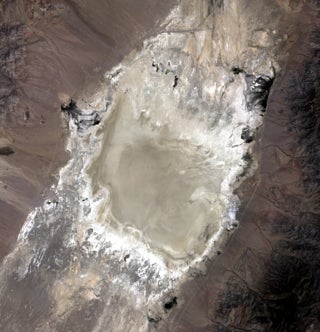
The dry lake bed of Railroad Valley in Nevada.
The largely featureless landscape is crucial because NASA technicians know exactly how much reflected light satellites’ optical instruments should see in the area. Among the missions that use the land are Landsat, which monitors Earth’s land and water resources; Suomi NPP, a weather and climate observation platform; and the Earth Surface Mineral Dust Source Investigation (EMIT), which maps the composition of arid dust that blows around the planet.
This is not the first time 3PL has tried to exploit this land: a previously found lithium deposit set up a possible conflict with the space agency in 2023—and NASA won. In a statement about the new deposit that was released on Monday, 3PL said it has estimated that its claim contains 31 million tons of lithium carbonate equivalent; if confirmed, that would make it among the largest lithium resources in North America. The site also includes large amounts of boron and potash, 3PL said. The latter is a salt that is often used to make fertilizer, which the U.S. almost exclusively imports.
“We now have a measured, world-class deposit of multiple critical minerals in one basin, and the one discovery that surprised even us is tungsten,” said 3PL chairman and chief financial officer Kevin Moore in the statement. “This is a metal the United States stopped mining a decade ago and now imports while China controls and manipulates the global market. To find more of it here than anywhere, alongside large, measured lithium, potash, and boron at world-class grade, is not a mining story. It is a national security story.”
Tungsten’s usefulness stems from its resilience to heat: it has the highest melting and boiling point under typical conditions of any element, which made it perfect for use in older generations of light bulbs. It also has the highest tensile strength of any metal and is denser than lead; these qualities make it ideal an ideal material for making weapons. The need for tungsten has become even more pressing because of the ongoing war with Iran, which has seen the U.S. fire off large amounts of munitions that contain the metal, such as Tomahawk missiles.
Despite its importance to the military, the U.S. has long lagged in production of the material. A February report from the U.S. Geological Survey showed that the country produced a negligible amount of the material in 2024 and 2025. By contrast, China’s mines produced 67,000 metric tons of tungsten in each of those years, accounting for almost 80 percent of global production.
A NASA spokesperson did not immediately respond to a request for comment.
It’s Time to Stand Up for Science
If you enjoyed this article, I’d like to ask for your support. Scientific American has served as an advocate for science and industry for 180 years, and right now may be the most critical moment in that two-century history.
I’ve been a Scientific American subscriber since I was 12 years old, and it helped shape the way I look at the world. SciAm always educates and delights me, and inspires a sense of awe for our vast, beautiful universe. I hope it does that for you, too.
If you subscribe to Scientific American, you help ensure that our coverage is centered on meaningful research and discovery; that we have the resources to report on the decisions that threaten labs across the U.S.; and that we support both budding and working scientists at a time when the value of science itself too often goes unrecognized.
In return, you get essential news, captivating podcasts, brilliant infographics, can’t-miss newsletters, must-watch videos, challenging games, and the science world’s best writing and reporting. You can even gift someone a subscription.
There has never been a more important time for us to stand up and show why science matters. I hope you’ll support us in that mission.