

In brief:
- Scientists expect dramatic swings between active and inactive hurricane seasons in the future.
- The risk of back-to-back hurricanes is growing.
- Hurricanes are expected to get more damaging and deadly.
Wild year-to-year swings — from punishing hyperactive seasons to quiet years with little activity — could well become the norm for future Atlantic hurricane seasons, according to recent climate change research.
The latest science paints a complex but alarming future, as the unprecedented amount of heat that humans are supplying to the climate system disrupts the fundamental atmospheric circulation pattern in which we designed our civilization.
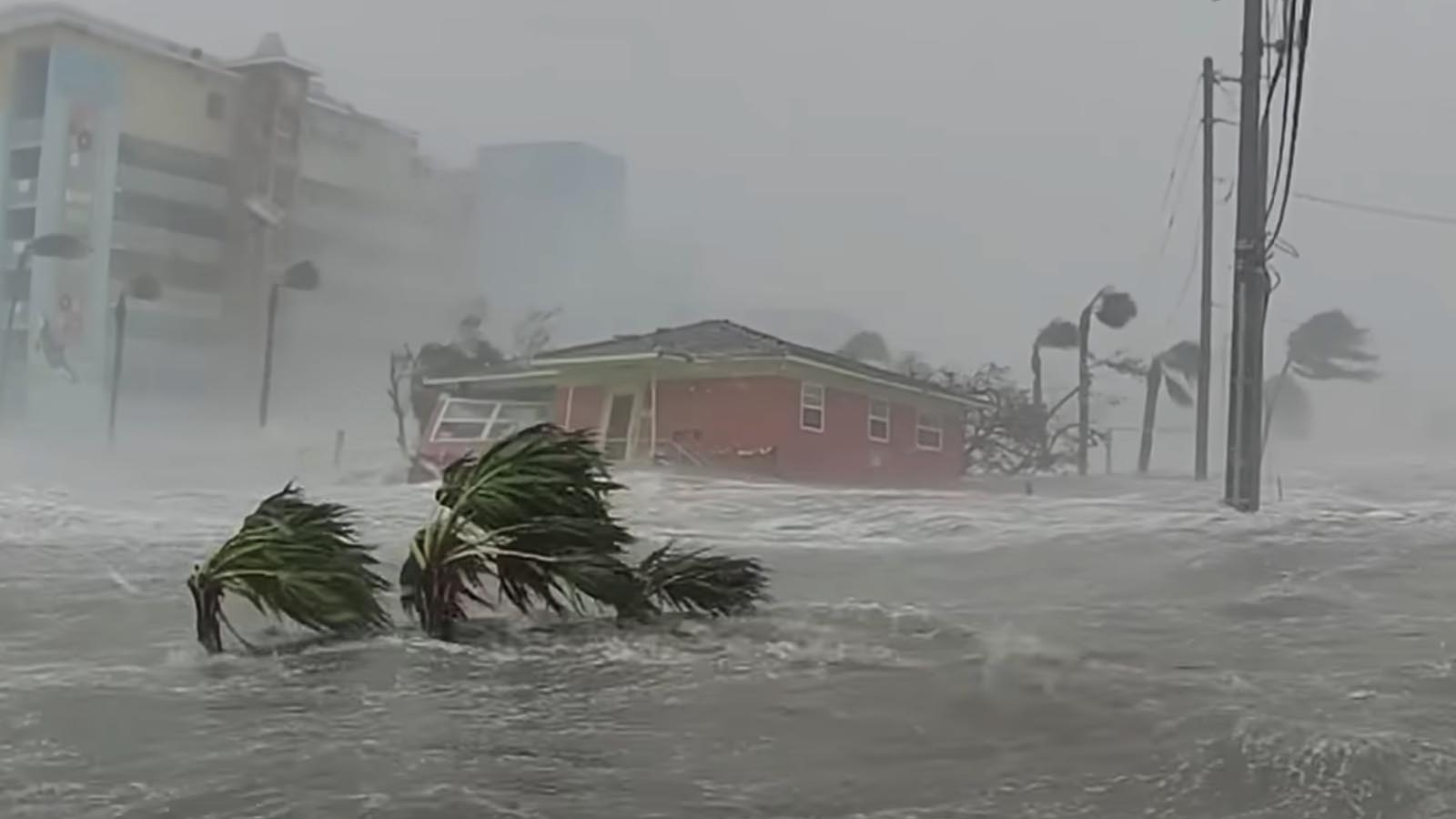
During the coming busy seasons, death and destruction from unprecedented hurricane catastrophes will probably grow much more commonplace, because even as risks grow, people have continued to build in risky flood-prone regions. But eventually, the coming hurricane catastrophes will pose an increasing threat to the viability of living in many coastal areas, particularly in the Caribbean.
Hurricane seasons will likely grow more erratic
The year-to-year variability of Atlantic basin hurricane activity already is the largest of any of the globe’s tropical cyclone basins. And climate change will make extreme swings between active and inactive hurricane seasons the norm, according to a 2024 paper, Projected increase in the frequency of extremely active Atlantic hurricane seasons.
The high-resolution climate models used in the study projected a 36% increase by 2050 in the variance of Atlantic tropical cyclone activity. The main causes: an increase in the variability of wind shear (strong upper-level winds that tend to tear a storm apart), and major swings in how stable the atmosphere is in the tropical Atlantic. One good thing is that the study found that the increased activity during hyperactive seasons would be focused farther from land over the eastern and central Atlantic, with less activity over the Caribbean.
A 2022 study, Extreme Atlantic hurricane seasons made twice as likely by ocean warming, found that ocean warming from 1982 to 2020 doubled the probability of extremely active hurricane seasons over that time period. However, the authors did not clearly separate out how much of that change resulted from increased heat-trapping greenhouse gases and how much was caused by a reduction in planet-cooling air pollution particles called aerosols. These particles are not likely to change much in the future, while greenhouse gases will be increasing, so it is important to know their relative impacts on ocean warming.
More double whammies: back-to-back hurricane threats are increasing
The worst sequential hurricane disaster on record for the Atlantic occurred in 2020 in Nicaragua and Honduras.
Hurricane Eta made landfall in northern Nicaragua on Nov. 3, 2020, as a Category 4 storm. Moving slowly at landfall, Eta lingered for three days over Central America and the adjacent waters, dropping catastrophic amounts of rain.
Just two weeks later, Hurricane Iota made landfall as a Category 4 storm in Nicaragua only 15 miles from where Eta hit. Iota brought torrential rains that inundated flooded regions still struggling to recover from Eta, with the combined tolls from the two storms exceeding 300 people dead or missing.
There was no precedent in the Atlantic for two such powerful hurricanes to make landfall so close together in space and time. The combined impact of the two hurricanes on Nicaragua was estimated at $738 million – about 6% of that nation’s GDP.
But the twin Category 4 hurricanes left behind an even more extreme catastrophe in Honduras. The U.N. estimated that total damages from Hurricane Eta and Hurricane Iota in Honduras exceeded $2 billion – 8% of the poverty-stricken nation’s GDP.
In the future, an increase in hyperactive hurricane seasons will boost the threat of two hurricanes striking the same place within a few weeks of each other. Overlapping disasters could threaten the Gulf of Mexico region with a cycle of “perpetual disaster recovery” — making communities vulnerable to worse outcomes with every subsequent event, researchers at the National Academies wrote in a 2024 report.
A 2022 paper, Increasing sequential tropical cyclone hazards along the US East and Gulf coasts, found that in the current climate, two named storms hitting the same location within 15 days along the U.S. East and Gulf coasts and bringing significant hazards (strong winds, heavy rainfall and storm surges) could be expected to occur once every 10 to 92 years. But under a moderate emissions scenario, this return period could be expected to shrink to just one to three years because of sea-level rise and a change in storm climatology. The odds of a Katrina-like hurricane and a Harvey-like hurricane impacting the U.S. within 15 days of each other — which was non-existent in the historical period they simulated — was projected to have a one-in-650-year return period (or a 5% chance over 30 years) by the end of the century.
A massive 633% increase in hurricane damages to come?
It is widely acknowledged that higher weather disaster losses result primarily from an increase in exposure: more people with more stuff moving into vulnerable places, including those at risk of floods.
Martin Bertogg, Swiss Re’s head of catastrophic peril, said in a 2022 AP interview that two-thirds, perhaps more, of the recent rise in weather-related disaster losses — including from hurricanes — is the result of more people and things in harm’s way.
But this balance will likely shift in the coming decades. For example, a 2025 study led by Avantika Gori of Rice University, Sensitivity of tropical cyclone risk across the US to changes in storm climatology and socioeconomic growth, looked at how damages from wind, rainfall, and storm surge would change under a moderate global warming scenario. The study found that the fraction of increased hurricane damages because of climate change would grow by the end of the century to be roughly equal to the increased damages from higher exposure (assuming a 2% annual growth in GDP). The combined increased costs for hurricane damage for the future (2070-2100) period compared to the historical (1980-2005) period would be truly extraordinary, if no additional adaptation measures are taken: a 633% increase, the paper said.
Gori’s prediction is by no means a worst-case outcome, because the study assumed a moderate global warming scenario. Even in a best-case scenario — which I’ll explore in a future post — development is going to continue in flood-prone places. And there are at least four ways that hurricane scientists are very confident that climate change will make hurricanes worse:
- The strongest hurricanes will get stronger.
- Hurricanes will rapidly intensify more quickly and more often.
- Hurricanes will dump more rain.
- Storm surge damage will rise because of rising sea levels.

Expect hurricanes to get more deadly
Accompanying the shocking increases in hurricane damages in our future will likely be sharply increased risks of high death tolls. Stronger, wetter, slower-moving storms will dump more rain, causing increased flood risk. Higher sea levels and stronger hurricanes will bring more dangerous storm surges and compound flood events. Post-storm power outages will coincide with heat waves more frequently, increasing heat mortality. More hurricanes will rapidly intensify just before landfall, leaving vulnerable populations unprepared, further increasing mortality risk.
Read: ‘Deadliest in generations’: The Texas floods are the latest in a disturbing pattern
Fortunately, steadily improving hurricane forecasts over the past 20 years have significantly lowered the risk of death, and the recent emergence of AI forecast models has been an exciting step forward. In some places, improved building codes have also reduced the hurricane damage and presumably, mortality risk. Nevertheless, it is concerning that the U.S. has suffered five hurricanes since 2005 that were deadlier than any hurricane since 1972.
A staggering indirect death toll from hurricanes: as high as 5% of the U.S. population?
In a stunning paper released in 2024, Mortality caused by tropical cyclones in the United States, Rachel Young and Solomon Tsiang found that the average U.S. hurricane that made landfall between 1930 and 2015 caused 24 direct deaths.
However, they observed an increase in excess deaths – mortality beyond what would otherwise be expected in that period – that lingered for 15 years, totaling 7,000-11,000 excess deaths per storm. This burden is 300-480 times greater than government estimates of direct deaths and was equivalent to an astounding 3.2-5.1% of all deaths across the contiguous United States.
The largest single category of deaths was from cardiovascular disease (36%), while 12% of the deaths were from cancer, “consistent with some evidence of stress from extreme weather affecting long-run health,” the authors wrote. Between 1950 and 1995, monthly excess tropical cyclone deaths ranged from 4,500 to 6,000, then rose to about 7,500 per month by 2003. In 2004, an onslaught of landfalling hurricanes brought a sharp rise in the death rate, which peaked at approximately 13,000 per month in 2013.
Read: The hidden health toll of hurricanes

Young and Tsiang hypothesized five ways that hurricanes may have triggered excess mortality:
- Economic disruption might change household economic decisions, eventually translating into worsened health outcomes. For example, a person who loses a job might lose health insurance, too. Or retirement savings could be drawn down to repair property damage, both of which could reduce future spending on health care.
- Social network changes could affect future health. For example, working-age people might move away, changing the social support for older people who remain behind.
- Fiscal adjustments by state or local governments in response to the disaster may impact future health outcomes. For example, restructuring budgets to support recovery might reduce spending on healthcare infrastructure.
- Heightened physical and mental stress may alter health in the long term.
- Changes in the natural environment could harm health — for example, ecological changes could redistribute disease vectors, or flooding may expose populations to harmful chemicals.
Many of these factors can be expected to grow worse in the future, resulting in higher hurricane excess mortality.
Other posts in this series
Bob Henson contributed to this post.