Conny Waters – AncientPages.com – The Maya of the Classic Period (250-1100 CE) widely used mercury and mercury-containing products. They used dangerous, highly toxic mercury (or the red mineral cinnabar) for ceremonies, religious events, and decorating buildings and pottery.
Mercury can harm humans and ecosystems, even at low concentrations.
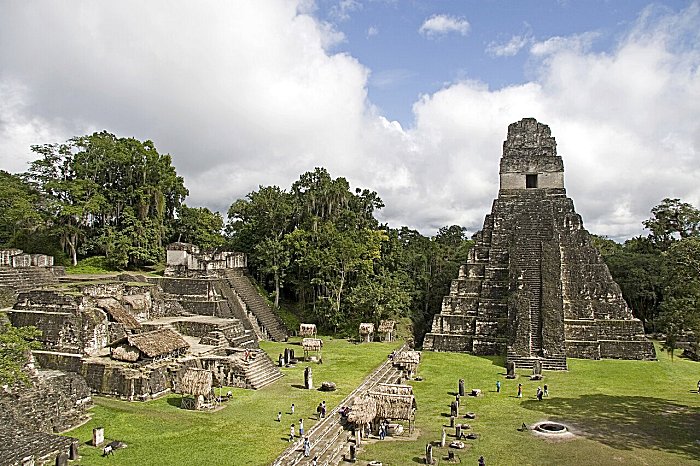
Archaeological Maya city Tikal in Guatemala – Plaza Mayor, Tikal National Park. Image credit: Mundo Maya – CC BY-SA 4.0
Mercury can harm humans and ecosystems, even at low concentrations.
New research (published in Science Advances by Matthew Neal Waters and his colleagues) shows how this led to widespread mercury pollution in northern Yucatán.
In their study, the team focused on sediment cores from affected areas, such as Lago Cobá and Cenote Xcach, and revealed mercury levels that for several centuries exceeded modern safety thresholds by a wide margin (at Lago Cobá Moderna up to 2.3 ppm and at Cenote Xcach up to 18 ppm around the year 720 e.Kr.).
Particularly interesting were analyses of biological traces in the sediments of algae, cyanobacteria, shell organisms, and mosquito larvae. They revealed that aquatic ecosystems collapsed and that life in the lakes dropped sharply during periods of high mercury content.
The study proposes that mercury originated from cinnabar, was mined in volcanic regions of Honduras and/or central México (Teotihuacan), and was transported as a liquid. It was then distributed through long-distance trade. When rain washed paint off temples and other surfaces, mercury flowed into streams and lakes, contaminating them. There, it built up in the food chain and became a dangerous poison for people who drank the water or ate fish and seafood. Other earlier studies linked mercury to obesity, as shown in ancient Maya artistic depictions of nobles and in evidence of the poison in human bones from the Maya region where mercury was present.
See also: More Archaeology News
However, documented mercury use by the ancient Maya is largely limited to the southern highlands and south-central lowlands, with only a single occurrence in the northern Yucatán lowlands.
The poison is generally associated with large urban centers such as Tikal, Quiriguá, and Kaminaljuyú in Guatemala, Copán in Honduras, and Caracol in Belize.
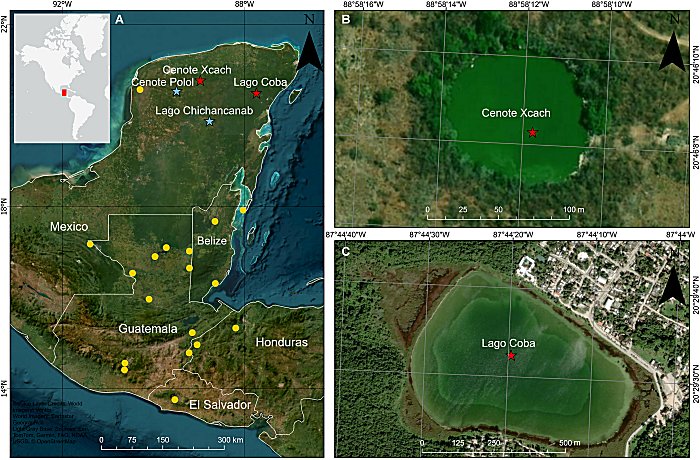
Map of Mesoamerica and study sites.
(A) Map of the ancient Maya region showing the locations of Maya archaeological sites where Hg has been detected (yellow circles), our Hg-rich study lakes, Lago Cobá and Cenote Xcach (red stars), and reference lakes, Lago Chichancanab and Cenote Polol (blue stars). Hg site locations are based on Cook et al. (5). (B and C) Core locations in each lake are shown as red stars. Image source
“Whereas climate-associated reductions in water quantity are well established as a regional stressor for the ancient Maya, our results suggest that declining water quality driven by [mercury] contamination constituted an additional and previously underappreciated environmental stressor,” Waters et al. wrote in their paper.
Source
Paper
Written by Conny Waters – AncientPages.com Staff Writer