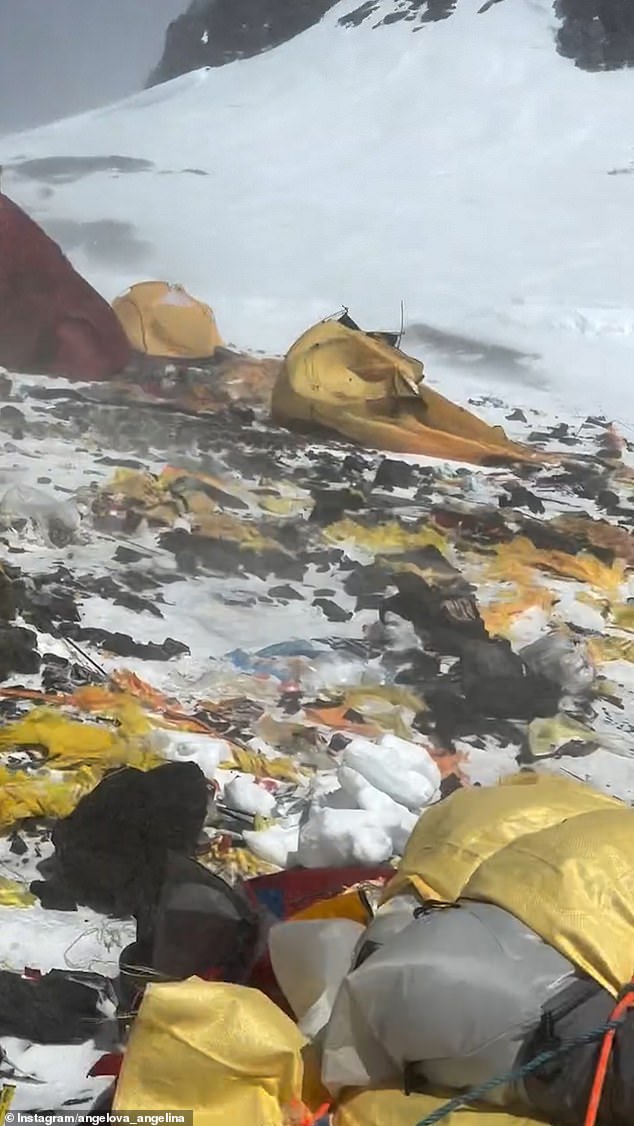
Mount Everest’s highest campsite has been transformed into a garbage heap, with a video showing abandoned tents, empty oxygen bottles and human waste littering the snow.
Footage published on social media shows Camp IV, the highest campsite on Earth, full of piles of rubbish left behind by climbing groups, with scores of worn-out yellow tents flapping in gale-force winds.
Situated on the South Col, Camp IV can be found between Mount Everest and Lhotse, the highest and fourth-highest mountains in the world, respectively.
At 26,000ft, the camp is the final place to rest before mountaineers attempt their push through the ‘Death Zone’ towards the 29,032ft summit.
‘What should be one of the most extraordinary places on the planet has, in many ways, become one of the ugliest faces of Everest’s commercialisation,’ Everest Today, an account dedicated to climbing the mountain, posted on X on Monday.
‘Abandoned tents, empty oxygen bottles, food cans, torn gear, and other waste are scattered across the South Col, turning the world’s highest campsite into a graveyard of climbing equipment.
‘The mountain deserves better.’
A record number of 274 people scaled Mount Everest via Nepal on a single day in May, with the influx of visitors exacerbating the litter issue.

Mount Everest’s highest campsite has been transformed into a garbage heap, with a video showing abandoned tents, empty oxygen bottles and human waste littering the snow

Footage published on social media shows Camp IV, the highest campsite on Earth, full of piles of rubbish left behind by climbing groups, with scores of worn-out yellow tents flapping in gale-force winds
While attempts have been made to clean up the waste that has built up over the years on the mountain, the high altitude and extreme weather make the task highly dangerous.
Good weather can quickly descend into blizzard conditions and oxygen levels are about a third of the normal amount.
Thousands of climbers have ascended the peak since it was first scaled by Edmund Hillary and Tenzing Norgay in 1953.
The milestone of 274 mountaineers reaching the summit in a single day on May 20 surpassed the previous record set on May 22, 2019, when 223 climbers scaled Everest from its southern side in Nepal.
Drone footage showed hundreds of climbers queuing to scale the mountain as they rushed to take advantage of the favourable weather this May, reviving debates about the over-commercialisation of Everest.
Almost 500 foreign climbers have been given permits to scale the peak this year – also a record high – as experts continue to raise the alarm about overcrowding and other safety risks.
Most climbers rely on supplemental oxygen to venture into the ‘Death Zone’ – the section of the mountain that sits at least 26,247ft above sea level.
Even then, climbing experts advise against staying in the zone for more than 20 hours.
In 2024, a group of Sherpas and Nepalese soldiers managed to clean up 11 tons of rubbish and retrieved four bodies from the mountain.
The mission wasn’t easy: it took two days for the team to recover one corpse which had been completely covered in ice.
‘The garbage left there was mostly old tents, some food packaging and gas cartridges, oxygen bottles, tent packs, and ropes used for climbing and tying up tents,’ Ang Babu Sherpa, who led the group of Sherpas, said at the culmination of the clean-up initiative.
Some of the debris that the team found dated back 69 years.
Since September 2025, mountaineers have had to pay $15,000 (£11,164) for a permit, up from the longstanding fee of $11,000, in the first price increase in nearly a decade.
Experts often criticise Nepal for allowing large numbers of climbers on the mountain, which sometimes leads to risky traffic jams or long queues in the area just below the summit, where the level of natural oxygen is dangerously below what is required for human survival.
Expedition organisers have acknowledged the dangers of congestion but say the risks can be managed.
‘If teams carry enough oxygen it is not a big problem,’ Lukas Furtenbach of the Austria-based Furtenbach Adventures told Reuters news agency.
‘We have mountains in the Alps like the Zugspitze where we have 4,000 persons on top per day. So 274 is actually not a big number, considering this mountain is 10 times bigger.’