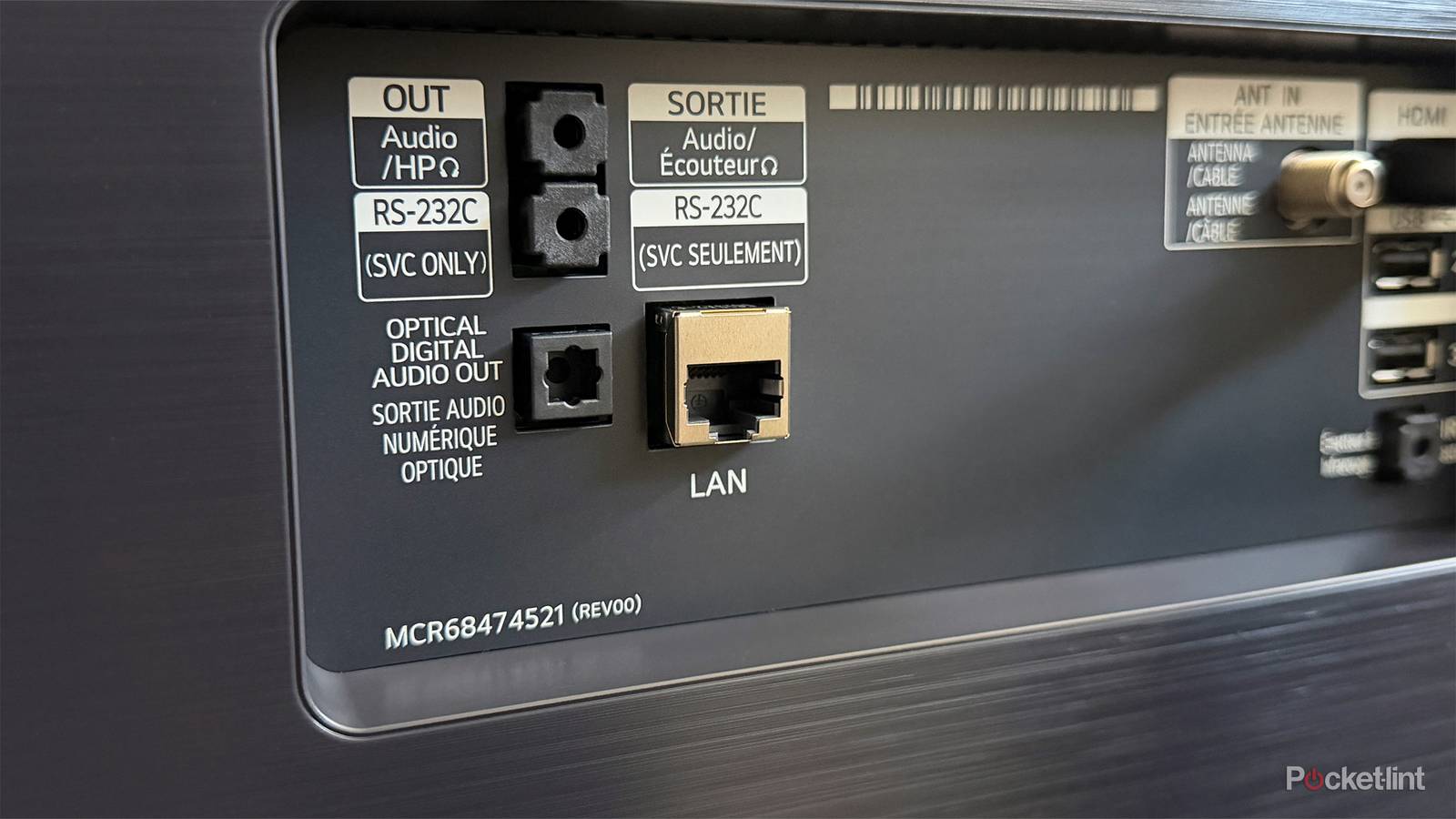
One of the myths about smart TVs is that connecting your TV to your router via Ethernet will automatically give you faster internet and, in a way, “upgrade” your TV. While that can happen, it’s not always guaranteed.
Using the Ethernet port on your smart TV will give you a more stable and reliable connection, but it isn’t always faster than Wi-Fi.
That’s because most smart TVs still use 10/100 Ethernet (Fast Ethernet), which caps wired speeds at 100 Mbps. Meanwhile, newer Wi-Fi standards like Wi-Fi 6 can easily exceed that, often delivering double or even triple the speeds. And when you compare 10/100 Ethernet to Gigabit Ethernet, the gap is even larger. Gigabit Ethernet is up to 10x faster, with speeds reaching 1 Gbps (1000 Mbps).
For example, when I use my LG TV’s Ethernet port, my speeds top out at just under 100 Mbps. But as soon as I disconnect it and switch back to Wi-Fi, I can reach speeds of 200 to 300 Mbps.
The problem is that while Wi-Fi can be faster on a smart TV, it’s also more prone to interference and less reliable than a wired connection. So that begs the question: how do you get the best of both worlds on your smart TV — faster speeds and the reliability of Ethernet? The answer is simpler than you might think.
How to get Gigabit Ethernet on your smart TV
It’s not as expensive as new TV

Since smart TV makers like Samsung, LG, Amazon, Sony, Hisense, and TCL are still shipping TVs with 10/100 Ethernet, even on newer 2026 models, you can’t buy a new TV with built-in Gigabit Ethernet yet.
So if you’re looking for faster internet on your TV — whether that’s for cloud gaming or streaming from a media server with apps like Plex or Jellyfin — upgrading your TV won’t solve the problem.
A better (and much cheaper) fix is to use a streaming device with Gigabit Ethernet. The catch is that not every streamer has it, as just like TVs, many are still limited to 10/100 Ethernet.
There are only a handful of options that actually support Gigabit Ethernet, including the Google TV Streamer, Apple TV 4K, and Nvidia Shield Pro.
The Google TV Streamer is the most affordable option at $100, though it often drops to around $80 on sale. Since it’s Android-based, you get the freedoms that come with it — like sideloading apps and using custom launchers.
A better (and much cheaper) fix is to use a streaming device with Gigabit Ethernet.

The Apple TV 4K with Ethernet comes in at $150, and it’s an easy recommendation if you’re already in the Apple ecosystem with an iPhone or Mac, since everything just feels familiar and seamless.
Then there’s the Nvidia Shield Pro at $200. It runs Android TV and, even though it launched back in 2019, it still delivers excellent performance. Like the Google TV Streamer, it also benefits from the freedoms Android offers.
As for devices to avoid if you’re looking for Gigabit Ethernet, that includes the Fire TV Cube, Roku Ultra, and the Onn 4K Pro. All of them are limited to 10/100 Ethernet, so they’re not great options if you’re trying to get the fastest possible speeds on your TV.
Gaming consoles like the PlayStation 5 and Xbox Series X also have Gigabit Ethernet, which you can use for streaming.
It’s time for TV manufacturers to wake up
It’s 2026, Gigabit Ethernet should be the standard

I still can’t wrap my head around the fact that even in 2026, so many smart TVs and streaming devices are stuck with 10/100 Ethernet instead of Gigabit Ethernet. This tech should’ve been phased out years ago, especially as access to faster internet has expanded greatly across the US in recent years.
What’s even more frustrating is that when you’re spending hundreds, if not thousands, of dollars on a new smart TV, there’s really no good reason for it to still have outdated Ethernet connectivity. At this point, it’s just manufacturers cutting corners.
Until smart TV makers wake up and realize it’s finally time to start making TVs with Gigabit Ethernet, streaming devices remain the best way to get faster Ethernet speeds on your TV.
I understand there’s an argument that 10/100 Ethernet is all you need, since most streaming services use only about 25 Mbps for 4K streaming. But as I mentioned earlier, for apps like cloud gaming on Xbox or GeForce Now, or for streaming from a media server using apps like Plex or Jellyfin, that higher bandwidth ceiling from Gigabit matters a lot, especially when streaming in 4K HDR with Dolby Atmos.
Until smart TV makers wake up and realize it’s finally time to start making TVs with Gigabit Ethernet, streaming devices remain the best way to get faster internet speeds on your TV. Hopefully, more streaming devices will adopt Gigabit Ethernet in the future as well.

- Dimensions
-
6.4 x 3 x 1-inch
- Connective Technology
-
Wi-Fi, Bluetooth
- Brand
-
Google
The Google TV Streamer is a streaming device designed to support the latest video and audio technologies with AI integration and smart home control.