



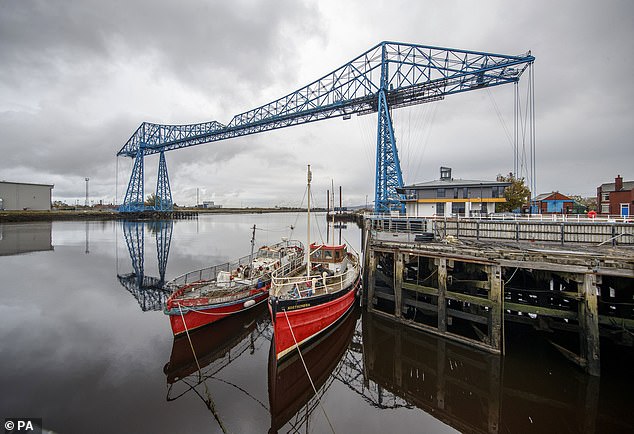
Teesside’s Transporter Bridge, an ex-working men’s club in Barrow-in-Furness and a disinfecting station in East London are among the most endangered buildings in the UK, the Victorian Society has revealed.
The charity, dedicated to the preservation of Victorian and Edwardian architecture, has released its yearly list of the top ten at-risk buildings in both England and Wales in a bid to bring national attention.
The Tees Transporter Bridge, which dates back to 1911 and is an iconic symbol of Middlesbrough’s industrial heritage, is one of the several buildings whose future hangs in the balance.
The Grade II-listed building was once a vital transport link carrying workers and goods across the river for over a century, but it closed its doors in 2019 due to structural concerns.
Responsibility for the bridge is shared between Stockton-on-Tees and Middlesbrough; however, the estimated £60 million required for repair and restoration is beyond their means, according to the society.
And now, in an attempt to save the bridge, the Victorian society has called for a coordinated national response to secure the bridge’s future and to avoid the structure falling into permanent disuse.
James Hughes, director of the society, said: ‘The Tees Transporter Bridge is one of Britain’s most remarkable feats of engineering and a defining landmark of the north-east.
‘Its future cannot be left to uncertainty. A clear strategy, supported at national level, is urgently needed to secure both its structure and its continued role in the life of the region.’
Griff Rhys Jones, the society’s President, said: ‘You don’t need me to tell you that people love this bridge. It is a symbol. It is a monument.

Pictured: The Tees Transporter Bridge in Middlesbrough, which was constructed in 1911

Pictured: Faenol Mausoleum in Bangor, which has suffered vandalism, with graffiti and damage to its stained glass
‘And more than that, it is a link and a potential working part of Stockton and Middlesbrough.
‘Got to be saved. Got to be operational again. If we can find money for new bridges, we can find money for this great survivor and all that it means.’
Meanwhile, the former Strand Railway Station and Railway Men’s Club in Barrow-in-Furness – also a Grade II listed building- is also endangered.
The building, which was constructed in 1863, is a significant survivor of the town’s earliest phase of rapid industrial growth
By 1856, 464,823 tons of iron ore were raised in Furness, of which 445,013 tons were transported via the Furness Railway and shipped from Barrow.
The opening of Devonshire Dock in 1867 further accelerated this growth, prompting Prime Minister William Ewart Gladstone to predict that Barrow would become ‘another Liverpool’.
However, as train journeys proved to be efficient from the station, by the early 20th century was adapted into the Railwaymen’s club, and after 101 years of operation and financial pressures, it closed its doors in 2008.
Presently, the building is owned by an absentee landlord and is ‘in visible decline’, the Victorian society has said, adding that ‘without intervention, further deterioration is inevitable’.
The heritage charity has called for the building to be brought back to active use through sensitive restoration, saying it ‘presents a clear opportunity for regeneration’.
‘This is a building that has continually evolved to meet the needs of the town, and can do so again,’ it added.
Meanwhile, a secluded mausoleum in north Wales, described as a ‘architecturally significant funerary building’ is in a state of visible decay and is at risk of further decline.
Listed as a rare and important Welsh example of its type, Faenol Mausoleum stands within an octagonal enclosure surrounded by iron railings.
Cadw, the Welsh Government’s historic environment service, says years of neglect has taken its toll on its ‘grandeur of design’.
The building has suffered vandalism, with graffiti and damage to its stained glass, and its condition continues to deteriorate.
The mausoleum was intended as the burial place of a powerful local dynasty, the Assheton-Smith, whose wealth was closely tied to the Dinorwig slate quarry, which, by 1882, was responsible for the majority of Britain’s slate production.
The parts of the wider Faenol estate have hosted a series of major cultural events, including Bryn Terfel’s Faenol Festival, the National Eisteddfod, and Radio 1’s Big Weekend.
Mr Hughes said: ‘This is a rare and evocative building that forms part of the historic fabric of the wider landscape.
‘Its current condition is a direct result of fragmented ownership and a lack of coordinated care.
‘With the right intervention, it could once again become a valued and accessible heritage asset.’
Mr Jones added: ‘What an extraordinary find and one that anyone walking the nearby great coastal path of Wales would be overjoyed to stumble on and explore and rest a while.
‘This is such a familiar story. The tangle of ownership needs to be cut aside by a latter-day perfect gentle knight, so this sleeping beauty, this unique monument, can come back to life.
Elsewhere in Essex, a Victorian home on the grounds of a modern hospital site and is decorated with a remarkable series of paintings by Elizabeth Arkwright as the property remains at risk following flooding in 2024.
James Hughes, Victorian Society Director, said: ‘This year’s list demonstrates both the richness of our Victorian and Edwardian heritage and the scale of the ongoing challenge in securing its future.
‘These buildings were created with foresight, ambition and a strong sense of civic purpose. Too often today they are left without clear ownership, investment or direction.
‘With the right commitment, every one of them could have a viable future; what is needed now is the will to act.’