Walt Disney’s once-forgotten private plane has been brought back to life after undergoing a huge makeover.
New photos show the Grumman Gulfstream I jet, that is now on display at the Palm Springs Air Museum, after a major three-year restoration project.
Affectionately nicknamed ‘Mickey Mouse One,’ a look inside the aircraft provides a fascinating insight into how one of the most influential figures in American entertainment chose to travel and work.
Georgia-based Phoenix Air Group assisted the museum in the meticulous revival of the time capsule to return it to the way it looked when Walt and his wife, Lillian, flew aboard in the 1960s.
After becoming disillusioned by commercial air travel, Disney approached the aircraft market looking for alternative way to get around.
He swiftly purchased a piston-engine Beechcraft Queen-Air 80 in 1962, however that was quickly deemed inadequate for increasingly frequent trips from Burbank in California to New York.
As a result Walt acquired a private jet dubbed ‘Mickey Mouse One’ in 1963, and it soon became a mobile headquarters during a transformative period for his company.
Over the course of its 28 years in service, the plane logged nearly 20,000 flight hours and carried an estimated 83,000 passengers, helping shuttle Walt and Disney executives across the country.

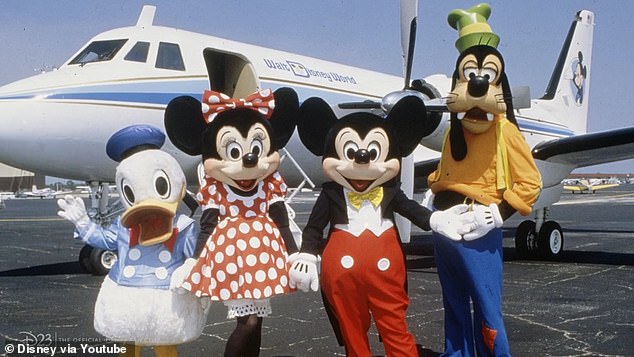
For Disney devotees, the restoration is a chance to step inside a piece of company history that was once thought lost. Disney’s most famous characters are pictured with the plane in its glory days

Then: Archival images of the aircraft show rows of broad passenger seats and soft beige and cream furnishings

Now: Images recently released by Disney reveal the renovations which have aimed to retain a sense of what it was like in the 1960s

Walt used the plane as more than merely a mode of transport. It was also his office and had a living room feel to it
The newly-released images reveal the transformation of the cream-and-wood cabin in the 15-passenger plane that featured a galley kitchen, two couches, two tables, a drop-down desk and two restrooms – one for the passengers and the three-person crew and another for Walt.
The jet was not a celebrity indulgence or a vanity purchase. Walt used the aircraft as a workspace in the sky, a hub where he could review plans, hold discussions and think through ideas while moving rapidly between projects.
It was aboard this very aircraft that he famously surveyed Central Florida for what would eventually become none other than Walt Disney World Resort in Orlando.
The original undecorated interior and exterior was customized with input from Walt and Lillian, making the cabin a deeply personal environment rather than a generic company plane.
Walt and his wife chose an autumnal color scheme of rust, orange, brown and gold for the interior that was extremely popular in the 1960s.
A clear divider filled with leaves and long grasses collected from the Disney family backyard separated Walt’s private space on the plane from the rest of the cabin.
A sense of that color scheme and similar updated dividers have been included in the makeover.
Walt’s plane had the feel of a compact living room and boardroom rolled into one with plenty of natural light flooding the aircraft.
The aircraft also featured Disney-branded touches, including Mickey Mouse silhouettes on notepads and matchbooks.

The layout of the 15-passenger plane in the 1960s is pictured in this sketch

Now: The galley section near the front of the plane where restoration work has recreated the compact kitchen space that once served Walt and his guests in the air

Now: the cockpit of the private jet that is now on display at the Palm Springs Air Museum in California

Walt is pictured on the tarmac in front of his beloved jet. The plane logged nearly 20,000 flight hours during its 28 years in service for Disney

After vanishing from public display the plane was left to slowly rot in a Florida field before being refurbished

As window sealant eroded and humidity and moisture began to penetrate the aircraft, the interior quickly began to deteriorate

The Georgia-based Phoenix Air Group assisted the museum in the restoration

The cabin was stripped when the Palm Springs Air Museum received it. The transformed work-in-progress interior is pictured
The N234MM registration number was emblazoned with the MM to honor the mouse that kickstarted a movement, was ultimately transferred from the Queen-Air to the tail of the Gulfstream.
A customized instrument panel with an altimeter, true airspeed indicator and Mickey Mouse clock allowed the aviation enthusiast to monitor flight conditions from his favorite cabin seat.
A nearby telephone handset provided him a direct line of communication to the pilot in the cockpit.
In a fun nod to Walt’s roots, Disney pilots often changed the ‘Two, Three, Four, Metro, Metro’ air traffic controller call to ‘Two, Three, Four, Mickey Mouse’ on approach to an airport.
In 1966, after Walt’s passing, the plane was still used for company business and made special appearances in two Kurt Russell-starring Disney movies, the 1969 flick The Computer Wore Tennis Shoes and Now You See Him, Now You Don’t in 1971.
The current restoration is especially remarkable given the condition the aircraft was in just a few years ago.
The plane had spent years in Florida after retiring from the Disney fleet on October 8, 1992.
After flying into Walt Disney World’s private airstrip for the final time, the aircraft was parked on display as part of the Studio Backlot Tour at Disney-MGM Studios, now known as Hollywood Studios, where curious fans caught glimpses of it.

Now: The plane is pictured on display at the Palm Springs Air Museum after a three-year restoration

The aircraft played host to a huge list of star-studded passengers, even accommodating the likes of presidents Jimmy Carter and Ronald Regan. A flight log is pictured

Throwback: Cocktail napkins onboard featured pilot Mickey and stewardess Minnie flying on a patched together cartoon plywood prop plane version of N234MM – the same tail number as Mickey Mouse One

A hands on boss! This is the customized instrument panel that Walt relied upon to monitor conditions during the flight

Then: Disney was a lifelong chain smoker who reportedly went through up to three packs of cigarettes a day, a habit he picked up while serving in the Red Cross during World War 1. Pictured are Disney-themed matches onboard

Mickey iconography even featured on the aircraft’s flight bags which depiected the mouse sitting on the tail of the plane

Then: Originally Mortimer Mouse was set to be the iconic character’s name, but Walt’s wife, Lillian, convinced him to change it to the friendlier ‘Mickey’. Disney later introduced the character Mortimer Mouse as an anthropomorphic mouse and Mickey Mouse’s longtime rival. He first appeared in the 1930 comic strip storyline Mickey Mouse in Death Valley

This was not the first aircraft that Disney purchased, in 1962 he bought a Piston-engine Beechcraft Queen-Air 80 however that was soon disregarded as Walt began to travel more
But when the attraction closed in 2014, the plastic-wrapped plane disappeared from public view and was moved backstage at Walt Disney World, where it sat gathering dust in a fenced off field for years.
Exposed to Florida’s punishing heat and humidity, the once-distinctive interior deteriorated badly.
The cabin was stripped and the twin Rolls Royce engines and everything in the cockpit were sold.
The plane was reportedly offered to Florida air museums with no takers before the Palm Springs Air Museum agreed to become the new home of Mickey Mouse One after being refurbished.
‘This little beauty has been basking in the Florida sun for about the last 40 years,’ then Disney CEO Bob Chapek previously said at the D23 Expo in 2022.
‘Three years ago, I got a call from Imagineering saying that this thing was in mothballs and it was just a shame that something of its historical relevance and importance to the company’s history was sitting out in the heat and humidity of Florida.’
After the convention, the aircraft was placed on long-term loan to the Palm Springs Air Museum under an agreement with the Walt Disney Archives, setting the stage for its revival.