A survivor has blamed suspected technical faults and the UK’s ageing railway network for a devastating train crash that has left one driver dead and at least 33 people seriously injured.
Passengers suffered broken bones and were left ‘spitting out blood’ when a Luton Airport Express service ploughed into the back of a stationary East Midlands Railway train at around 5.15pm on Friday.
Some travellers reported being ‘flung’ from their seats into the chairs and tables in front, before seeing the carriages fill with smoke.
Brett Byatt, a teacher from Bedford, who was travelling on one of the trains, said while yesterday he felt shocked, today his overwhelming emotion is ‘anger’.
He also questioned why a train driver had lost his life in the collision, adding that signal failures happen all the time on the UK’s railway network.
‘Yesterday I was pretty, like, shocked,’ he said. ‘This morning, it feels surreal, and I think I’ve moved into the stage of anger now. I’m feeling pretty angry.’
He added: ‘I don’t know at whom, who specifically, but it’s more about we’ve got one of the oldest railway networks and signal failures happen a lot, and now I’m just wondering… why wasn’t that signalled to my train and why did that train driver lose his life over this?’
Investigations are ongoing and there has been no official finding as to the cause of the crash.

Passengers suffered broken bones and were left ‘spitting out blood’ when a Luton Airport Express service ploughed into the back of a stationary East Midlands Railway train

A video taken inside one of the carriages after the crash shows panicked travellers lying on the floor and crying out for help

Brett Byatt, a teacher from Bedford, questioned why a train driver had lost his life in the collision, adding that signal failures happen all the time on the UK’s railway network

Aerial image shows the aftermath of the train crash in Bedford yesterday afternoon
Mr Byatt told the BBC that he thought 90 per cent of people on his carriage had serious injuries, could not stand or move their neck.
Investigators are examining whether a fault with the stationary train’s safety systems may have played a role in the crash. The system is designed to automatically apply the brakes if a driver fails to acknowledge an approaching red signal.
It is understood the Luton Airport Express train collided with the East Midlands Railway service, while its driver was reporting the issue to maintenance staff by phone.
A railway expert said today that investigators would ‘already know’ what happened in the Bedford rail crash from ‘second by second’ airline black box-style recorders in the trains.
Tony Miles said they recorded ‘every switch that was pressed and every control that was activated’ in both trains.
He also praised staff on the trains who were able to get off for ‘acting very quickly to protect the railway’ by ‘laying wires across the adjacent tracks’ to trigger a secondary signalling system in case the first one had failed.
Mr Miles from Modern Railways magazine told the BBC the questions that will be asked are ‘were the signals showing red and the train went past them or were the signals showing that the line was clear and, if so, how were they able to know when the train in front was stopped?’.
‘That should be impossible because as long as the track is occupied, it shouldn’t be possible to clear the signals,’ he explained.
Mr Miles said that while a driver could theoretically make a decision to cross a red signal if he wanted to ‘they would normally only do that because they had been given permission by a signal box because there was a fault’.

Injured passengers gather by the side of the tracks after two trains collided near Bedford last night

A Luton Airport Express train crashed into a stationary train causing serious injuries and bloodied passengers on board
‘The drivers would stop at a red signal regardless and talk on their radio,’ he explained.
‘So the two questions will be ‘were the signals showing red and the train went past them?’ or ‘has something catastrophically gone wrong with the electronics system that interlocks itself so it can’t allow a dangerous situation to happen that allowed the train to go past?’.
He said the moving train was ‘going quite slowly as it was crossing a lot of points to get to the other line’ so the question would be ‘was it cleared to do that?’.
Eleven people suffered very serious injuries in the crash, while 22 had serious injuries and 56 were left with minor injuries.
A video taken inside one of the carriages shows panicked travellers lying on the floor and crying out for help.
One person can be heard frantically saying ‘we need to get off’.
Eyewitness, Dr Pete Knapp, 40, who was travelling in the front carriage of one of the trains, said his first thought was that a ‘terrorist bomb’ had gone off.
‘There was a moment of being flung into the chair in front, and then I saw smoke. People were crying, screaming, people were so scared and confused,’ he said.
‘I got up and I saw a lot of people who were unable to speak, had broken legs, and then I managed to get out of the train and because I’m quite thin I was able to squeeze out through the gap in the doors.’
He added that some people were ‘spitting out blood’.
On Saturday, a Buckingham Palace spokesperson said: ‘His Majesty is greatly saddened by the rail crash in Bedford yesterday evening and is being kept regularly updated on developments.
‘His thoughts and sympathies are with the family of the deceased and with all those injured or affected by such a tragic incident.’
Eddie Dempsey, the general secretary of the National Union of Rail, Maritime and Transport Workers confirmed last night that the person who had died was a train driver.
He said in a statement: ‘We are devastated to learn that a train driver and former RMT rep has tragically died as a result of today’s crash between Luton and Bedford.
‘The thoughts of RMT are with their family, friends, colleagues and the ASLEF trade union at this awful time.’
Dave Calfe, general secretary of the train drivers’ union Aslef, added: ‘Our thoughts tonight are with the family and friends of the driver who died in the crash near Bedford today and with the passengers who were injured in the accident.

East Midlands Railway services to and from London St Pancras were suspended for the rest of the day and commuters experienced severe delays to their journeys. Picture from scene

Police block a road that gives access into an area near the scene of a collision involving two trains near Bedford
‘We want to thank the emergency services who responded so quickly, to help those on board, and are still at the scene.’
East Midlands Railway services to and from London St Pancras were suspended for the rest of the day and commuters experienced severe delays to their journeys.
Luton and Dunstable University Hospital told the public to avoid attending the emergency department unless they have a genuine emergency.
Prime Minister Sir Keir Starmer has said his thoughts are with the family of the driver who died in the train collision, as well as the people who were injured.
In a statement on X, Sir Keir said: ‘Hugely concerning reports of a collision involving two passenger trains near Bedford. First and foremost, my thoughts are with the family of the person who has sadly lost their life, and with those who have been seriously injured.
‘I am grateful to the emergency services for their swift response to this tragic incident.’
Health Secretary James Murray wrote on X: ‘I am being kept updated on the collision of two trains between Luton and Bedford.
‘A number of people have been injured and I thank first responders who are helping those affected.’
The two trains involved were the 4.40pm departure from Corby and the 3.50pm departure from Nottingham, both to London St Pancras.
Most carriages of the two southbound trains remained on the tracks but at least one derailed.
There was a huge emergency response to the crash, which happened just south of the Elstow interchange between the A421 and the A6.
It included multiple air ambulance helicopters and road vehicles.
EMR trains between Bedford and London St Pancras have been suspended until at least Monday.
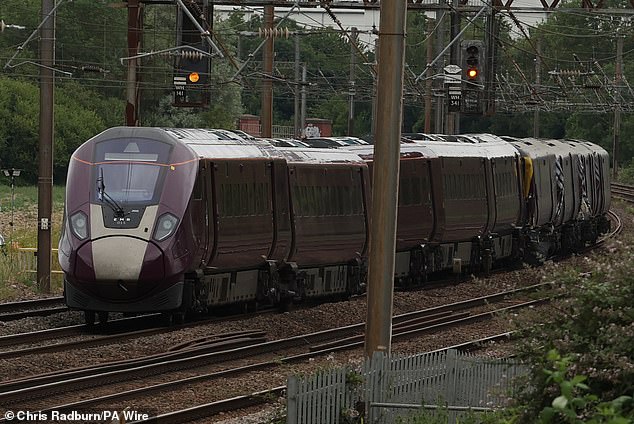
Online train trackers show the rolling stock involved in the crash were a class 360 and class 810.
The front of the former hit the rear of the latter.
EMR began rolling out class 810s in December last year, and class 360s are at least 20 years old.
Tony Miles told Sky News the damage to the trains looked ‘fairly minimal’.
He said: ‘Obviously it’s a rear end collision, they were going in the same direction, so one of them, the rear one was going faster than the one it’s caught up with, for some reason. That’s not a complicated assumption.
‘So, the question has to be how has that train that’s in the rear got into contact with the train that it was following, and obviously it’s either gone past the signal that was telling it it should stop, or the signal was faulty, or the driver’s made a mistake in some way, or didn’t read the signal, or something.
‘Over the years, all of those different scenarios have happened, and it’s now a question of finding out why did one train catch up with the train that was in front of it, that was obviously going more slowly.
‘Whether it was stopped. I don’t know, but I say from the collision damage it looked like a relatively low speed collision.
‘So either the train in the rear was already slowing down or they were both going fairly slowly, and something’s happened, but it’s not a high-speed crash, certainly from the damage.’
He added: ‘Even if you’re going 40 miles an hour and you come to a halt in a few meters, you’ve got the energy of a 40-mile-an-hour body in you, and you’re going to move until you hit something, unfortunately. So, even relatively low speed collisions can be dangerous for people that are on board.’