



Holidays to Mediterranean hotspots could be most at risk if the jet fuel crisis continues, experts warned today.
Jet fuel prices have surged since Iran began blocking the Strait of Hormuz on February 28 – choking a crucial supply route for around 20 per cent of the world’s oil and liquefied natural gas.
Today it remains effectively closed to shipping due to continuing safety fears, including fears of undersea mines. Donald Trump is mounting his own blockade of Iranian ports.
European airports have warned that they are about three weeks away from ‘systemic’ jet fuel shortages if the waterway is not fully reopened.
According to experts, Mediterranean ‘leisure airports’ in Spain , Greece and Italy could be hit especially hard due to operating on ‘thin fuel buffers’, while airports in Asia are also vulnerable due to their reliance on supplies from the Gulf.
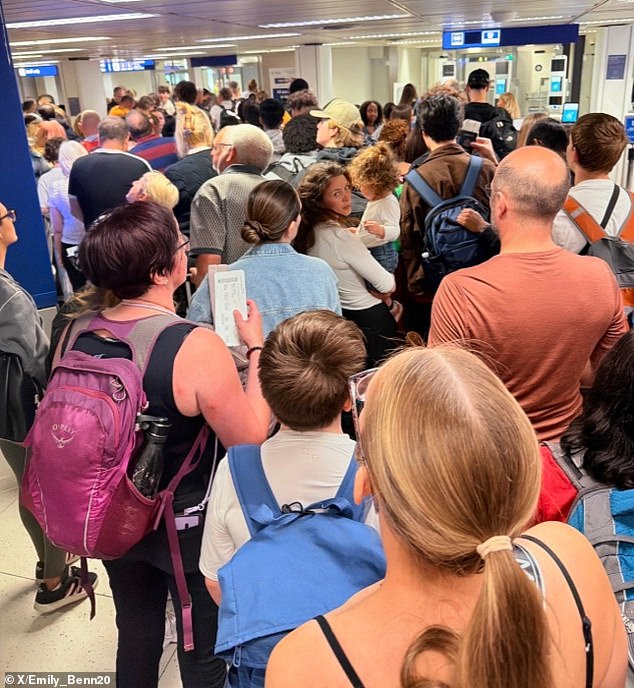
It comes as passengers continue to struggle with the rollout of the EU’s new border system, with airports in 15 European countries currently experiencing ‘very bad’ delays.
Passengers at regional airports and key hubs including in France, Germany, Belgium, Italy, Spain and Greece are waiting up to three hours at border checks, the Airports Council International (ACI) warned.

Passengers left behind in Milan Linate airport yesterday due to border control chaos
‘This situation, in the coming weeks and certainly over the peak summer months, is going to be simply unmanageable,’ Olivier Jankovec, director of the ACI European division, told the FT.
‘We are seeing those queueing times now, at peak times, when traffic is just starting to build up.’
The Entry/Exit System (EES) requires travellers from third-party countries, including the UK, to have their fingerprints and photos taken as they enter the Schengen area.
Further checks take place when they leave. As these can take hours, some travellers have found themselves still stuck in line at passport control after their flights have already departed.
In heatwave-hit Milan, airline passengers were left vomiting and passing out after waiting for up to three hours on Sunday.
Around 100 easyJet customers were abandoned at Linate airport while waiting to board the flight to Manchester after the crew decided to leave without them.
Travellers could face further disruption if the jet fuel crisis is not resolved soon, with the CEO of Lufthansa, Europe’s biggest airline, has already warned of planes being grounded due to a lack of fuel to power them.
Meanwhile, Virgin Atlantic has placed an extra £50 fuel surcharge on economy tickets, with both premium economy and business class fares increasing by £180 and £360 respectively.
Virgin’s chief executive, Corneel Koster, said the recent failure of peace talks between the US and Iran was ‘not good news’ for the air industry, as he warned travellers will face further increased prices for the next few months – and possibly the rest of the year.
The airline boss also predicted the sale of economy seats becoming ‘relatively weaker’ in comparison to business class tickets as the crisis in the Middle East continues to tighten people’s purse strings.
Virgin have also refused to divulge if they will be axing routes due to the skyrocketing price of jet fuel, coupled with a slump in demand.
So far, the firm has avoided significant changes to its network besides cancelling its winter-only services to Dubai as well as journeys to Riyadh.
Mr Koster said Virgin had to adjust so it did not lose ‘unnecessary amounts of money on weaker routes and frequencies’.
The UK, in particular, is dependent on jet fuel from the Middle East, with Kuwait sending four million tons in supplies annually to Britain.
However, a slew of attacks on Kuwait’s Mina Al-Ahmadi refinery has meant that even if the Strait were to open once again, it may not be able to meet demand.
Elsewhere, the European Commission has also been concerned about a lack of jet fuel supply in the near future.
‘There is no evidence for fuel shortages in the European Union at present, but supply issues could occur in the near future in particular for jet fuels,’ said spokeswoman Anna-Kaisa Itkonen.
‘That remains our primary concern,’ she told reporters.
The airport industry association ACI Europe warned the commission of a risk of ‘systemic’ jet fuel shortages if maritime traffic is not restored in the Strait of Hormuz by the end of April.
Join the discussion
Should airlines pass huge fuel costs onto passengers or find other ways to keep travel affordable?
Europe could start seeing physical shortages of jet fuel by June if the region can only replace half of the fuel supplies it usually receives from the Middle East, the International Energy Agency said in its monthly report.
Global jet fuel and kerosene demand averaged 7.8 million barrels per day in 2025, with Gulf exports the largest source to the global market, averaging nearly 400,000 barrels per day (bpd), the report added.
Europe is the most dependent on jet fuel from the war-torn region, with the Middle East accounting for 75 per cent of Europe’s net jet fuel imports.
Within Europe, levels of stockpiled fuel vary from country to country. Spain, with plentiful stocks, is a net exporter of jet fuel, while Britain, which is also the Middle East’s largest consumer, imports 65 per cent of its demand.
If Europe manages to replace all of its Middle East imports and volumes, jet fuel stocks will adequately cover the IEA’s assessment of 2026 demand.
But if stocks of jet fuel were to drop below 23 days of demand cover, physical shortages and demand destruction would occur at select airports.
Europe’s stocks have not dropped below 29 days’ cover since 2020.
If the continent can only replace 75 per cent of its Middle East volumes, there would be insufficient inventory to meet demand in the summer, and stocks would drop below the 23-day level by August.
But if only 50 per cent of the supply is replaceable, then stocks will hit the 23-day level in June.
The conflict has upended routes between Asia and Europe that relied on Gulf hubs, while a doubling of jet fuel prices and tightening of supplies are hitting airlines hard.
Since the US-Israeli strikes on the Islamic Republic began, carriers have hiked air fares, introduced fuel surcharges and cut routes.
Qantas has also delayed a planned share buyback, citing higher and volatile fuel prices, one of the first major carriers to stall shareholder returns.
Lufthansa CEO Carsten Spohr warned that jet fuel supplies will remain constrained, driving up costs.
‘Kerosene will remain in short supply and therefore more expensive for the rest of the year,’ Spohr told German newspaper Frankfurter Allgemeine Zeitung.
Lufthansa has not yet grounded planes due to shortages, but this ‘may be unavoidable’ as kerosene availability is already critical at some airports, particularly in Asia.
The crisis comes amid the introduction of new EU border rules – the Entry/Exit System (EES) – which requires travellers from third-party countries, including the UK, to have their fingerprints and photos taken as they enter the Schengen area, contributing to long delays.
Further checks take place when tourists attempt to fly home, and because these can take hours, some travellers have been stuck at passport control after their flights have already left.
Passengers travelling across Europe were hit by delays and cancellations over the weekend, with long queues forming at destinations including Geneva, Lisbon and Malta – while others faced two-hour waits yesterday in Brussels and Amsterdam.
Rory Boland, editor of Which? Travel, said delays caused by the EES could be ‘significantly worse over the summer’, and urged travellers concerned about jet fuel shortages to book a package holiday, which should be refunded if a flight is axed.
In South Korea, low-cost carrier T’way Air plans to furlough some cabin crew without pay in May and June, among the first carriers to reduce staffing.
A two-week ceasefire has provided little relief, with the Strait of Hormuz still shut, removing 20 per cent of global oil and liquefied natural gas supplies from the market and refineries will take time to repair damage inflicted on them.
‘Despite the pause in the conflict, we remain concerned about jet kerosene supply and price increase,’ UBS analyst Jarrod Castle said on Tuesday, adding that December jet kerosene futures prices are still up more than 50 per cent year-on-year.
Fuel, typically airlines’ second-largest cost after labour, accounts for about 27 per cent of operating expenses.
Prices have more than doubled since the conflict began, far outpacing a roughly 50 per cent rise in crude oil prices before the ceasefire.