


Follow us
Add us as a preferred source on Google
STARBASE, Texas — SpaceX launched the 15th test flight of its massive Starship rocket today (Nov. 13) and is preparing the vehicle’s upper stage for its first-ever return to the launch site in less than 24 hours.
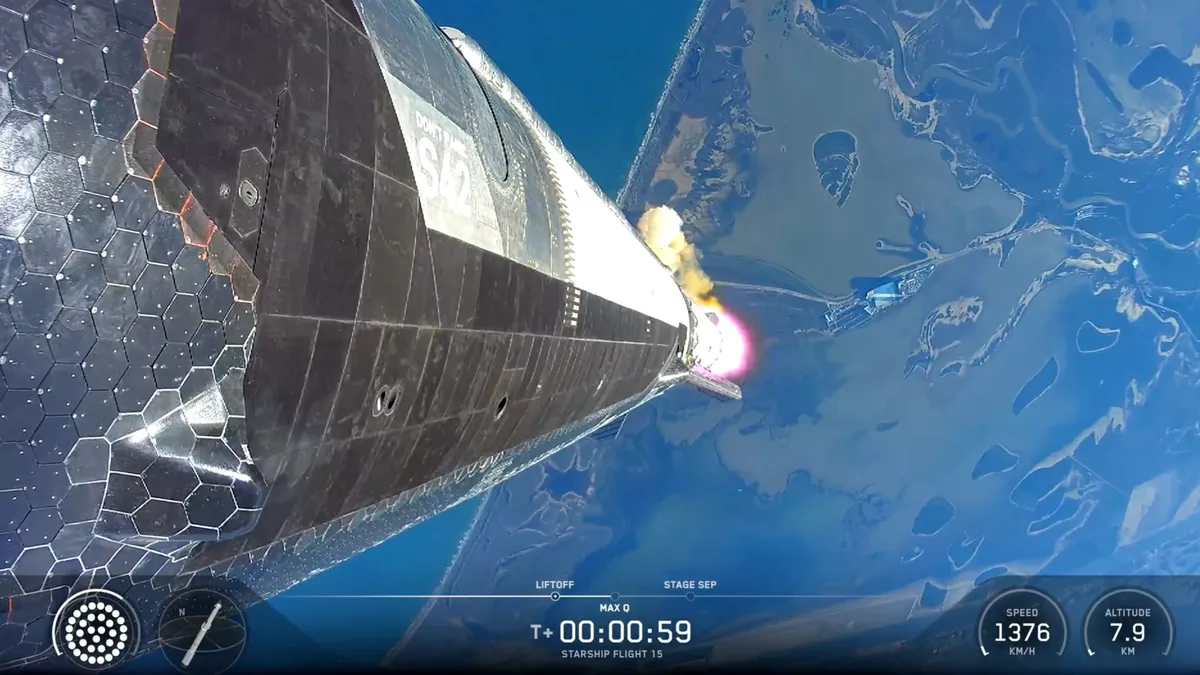
Flight 15 lifted off from SpaceX‘s Starbase facility here in South Texas at 5:47 p.m. ET (2247 GMT; 4:47 p.m. local Texas time). The towering Super Heavy booster and Ship upper stage cleared the tower without incident and climbed into the skies under more than 18 million pounds of thrust from the booster’s 33 Raptor 3 engines.
The flight continued nominally through its initial ascent, with the successful execution of Super Heavy’s main engine cutoff and Ship’s subsequent hot-staging — firing its own Raptors during separation from the booster — about 2.5 minutes after launch. Following stage separation, Super Heavy reoriented for a planned return to Starbase as Ship powered its way toward low Earth orbit (LEO).

SpaceX originally planned to catch Super Heavy with the Starbase launch tower’s giant mechanical “chopstick” arms. But it wasn’t to be: The company called off the catch attempt and brought the booster down for a controlled splashdown in the Gulf of Mexico about 6.5 minutes after launch, for reasons that were not immediately clear.
A successful catch would have been a significant milestone for SpaceX and its efforts to design Starship as a fully and rapidly reusable launch vehicle. It would have been the first successful recovery of a Version 3 (V3) Super Heavy, which SpaceX began flying earlier this year. The company previously recovered three of its V1 Super Heavy vehicles and reused two of those in later flights.
Ship goes to orbit
Ship’s Raptors continued to fire following stage separation, completing their first burn just after eight minutes into flight. All went according to plan after that for Ship as well: A second engine burn lasting about 20 seconds parked Ship in LEO at an altitude of around 170 miles (275 kilometers) at T+26 minutes and 10 seconds.
“We’ve got a nominal orbit insertion, so Starship now in orbit around Earth for the second time ever,” SpaceX’s Dan Huot said during today’s Flight 15 launch webcast. “That’s a really great moment.”
Ship first reached orbit on Flight 14, which launched on Sept. 28.
Ship is carrying 26 of SpaceX’s Starlink V3 spacecraft, which will be deployed into LEO today over a 42-minute span starting 35 minutes after launch, if all goes to plan.
The upgraded wireless internet satellites will be the second V3 batch to reach orbit, after a set of 26 that were delivered on Flight 14 . V3s are significantly more powerful than SpaceX’s V2 Starlinks, which currently number more than 11,000 in LEO. The addition of this new set of V3s will add a terabit of data capacity to the constellation, according to SpaceX’s Flight 15 mission outline. That’s equivalent to the amount contributed by 10 Starlink V2 launches, which are carried out by SpaceX’s Falcon 9 rocket.

Three of the V3 Starlinks flying today are equipped with cameras to point back at Ship after deployment in order to analyze its heatshield tiles and other hardware following its ascent to orbit. Their data will help SpaceX determine if Ship can indeed come home to Starbase on Saturday.
“Starship will only execute a return to launch site if the flight control team has ensured that the vehicle systems critical for reentry maneuvers and final landing burn and tower approach are healthy,” SpaceX wrote in its Flight 15 mission description.
SpaceX engineers will have ample time to go over Ship’s systems before making a final landing decision. Ship is scheduled to circle Earth 14 times, spending more than 21 hours in space before coming home.
To catch or not to catch?
SpaceX has reserved three contingency checkpoints during Flight 15’s mission timeline to allow for an early Pacific Ocean return, should engineers determine a catch attempt to be unfeasible or unwise. The first comes just 10 minutes after the completion of Starlink satellite deployment, the second at T+7 hours and 15 minutes, and a final one at T+20 hours and 41 minutes.
Should Ship continue to look good through each of these milestones, SpaceX will proceed with a 10-second deorbit burn at approximately T+21 hours and 36 minutes, setting the spacecraft on a trajectory back toward South Texas. Its plunge through Earth’s atmosphere will begin about 35 minutes later. SpaceX has also designated a contingency splashdown zone in the Gulf of Mexico, should conditions prevent a safe catch during Ship’s final approach.
If all goes according to plan, Ship will return to Starbase on Saturday at approximately 4:17 p.m. EST (2117 GMT; 3:17 p.m. Texas time), about 22.5 hours after liftoff. A successful catch would be a major milestone for SpaceX — the first-ever recovery of a Starship upper stage.
Full reusability is central to the company’s ambitions for launching its V3 Starlink satellites, as well as a proposed constellation of orbital data centers envisioned by company founder and CEO Elon Musk. The next-gen Starlink constellation will consist of about 100,000 satellites, while the AI network will be 10 times that size, Musk has said. Building and maintaining those constellations will require a mind-boggling number of launches. Indeed, SpaceX is targeting 10,000 Starship liftoffs per year by 2030, according to Musk.
Some of Starship’s other planned missions won’t necessarily require full reusability, but the spacecraft’s reliability will be critical to NASA’s Artemis program and its efforts to return astronauts to the moon. The space agency selected Starship as one of the program’s crewed lunar landers, and it’s slated to fly a demonstration mission with NASA’s Orion spacecraft and Artemis III astronauts to Earth orbit in the summer of 2027.

