SpaceX’s initial public offering (IPO) is shaping up to be the biggest in history—if, that is, the company achieves its targets. On the road show it has taken to investors, its stated mission is nothing less than “to build the systems and technologies necessary to make life multiplanetary, to understand the true nature of the universe, and to extend the light of consciousness to the stars.”
SpaceX has beaten long odds before. But its $1.75-trillion valuation depends far more on what it says it will build next than what it has already built—and that gap is immense.
The company’s pedigree is hard to argue with. SpaceX comes to the road show with its reusable Falcon 9 launch vehicle; the Starlink satellite network, which includes more than 10,000 satellites in orbit and counting; and a record of turning improbable space hardware into working systems. “Falcon 9 has achieved launch rates that, in the past, we only dreamed of,” says George Sowers, a former aerospace industry executive and rocket systems engineer who is now a professor of practice in the Space Resources Program at the Colorado School of Mines. One Falcon 9 first-stage booster, Booster 1067, completed its 35th mission this week, retaining its position as the most-flown member in SpaceX’s fleet. Starlink, too, is a real business, with millions of customers and a satellite network larger than any before it.
On supporting science journalism
If you’re enjoying this article, consider supporting our award-winning journalism by subscribing. By purchasing a subscription you are helping to ensure the future of impactful stories about the discoveries and ideas shaping our world today.
That record gives the next part of the pitch its force. SpaceX sorts its pitch to investors into three buckets—space, connectivity and artificial intelligence—but it really rides on two newer, riskier bets: orbital AI data centers and a fully reusable Starship that can carry people to the moon and eventually Mars.
The boldest bet is CEO Elon Musk’s proposal for a system of orbital data centers, including a constellation of up to one million satellites that would run AI workloads on solar power gathered in orbit. Days before the IPO, Musk unveiled the first detailed design of SpaceX’s AI1 satellite, the constellation’s prototype. Caleb Henry, director of research at Quilty Space, sees it as the company’s second great transformation. “They started as a launch company,” he says. “They began the evolution into a satellite Internet provider, which now dwarfs the launch piece of the business, and then this next evolution is to become an AI company enabled by its own data center infrastructure that the company wants to put in space.”
Getting the hardware into orbit will be tricky enough, but keeping it working there is another question entirely. Although SpaceX has the launch and constellation expertise, “I can’t tell you if it scales efficiently to an orbital data center,” Henry says. “But I know who is in the lead.”
Hugh Lewis, a professor of astronautics at the University of Birmingham, is more concerned. The proposed AI satellites, he says, look much larger and more complicated than today’s Starlink satellites. Bigger spacecraft make bigger collision targets, and more elaborate cooling systems offer yet more ways to fail. At the scale Musk is planning, even tiny failure rates become large-scale problems.
Lewis points to a contradiction: SpaceX has lowered the orbit of some Starlink satellites to cut aggregate collision risk, even as it seeks permission for vastly more satellites in similar orbital regions. Referring to the lowered satellites, he asks, “If they can’t keep 4,500 safe, how can they expect to keep a million?”
The scaling worries Jonathan McDowell, too. An honorary professor at Durham University’s Space Research Center, McDowell maintains a closely watched public catalog of everything in orbit. “It’s just a stupendous scale project,” he says. The biggest problem, he reckons, is what happens when satellites fail or retire. “Even very small percentages of failures lead to a very large number of space mines,” he says. Safely disposing of dead satellites—by dragging them down to burn up in Earth’s atmosphere or boosting them out of the way of other orbiting objects—is a problem the industry still hasn’t solved.
SpaceX argues that orbital data centers sidestep the land, water and power grid constraints squeezing terrestrial AI. McDowell isn’t convinced the comparison holds up. Solar panels and satellite factories carry environmental costs of their own—as do the rockets that launch them. “How does that compare to the environmental impact of doing the data centers on Earth?” he asks. “It’s really not clear that it’s better.”

A Falcon 9 first-stage booster returns to Cape Canaveral after launch. Reusing boosters helped SpaceX make frequent launches routine and gave credibility to its more ambitious Starship plans.
Paul Hennessy/SOPA Images/LightRocket via Getty Images
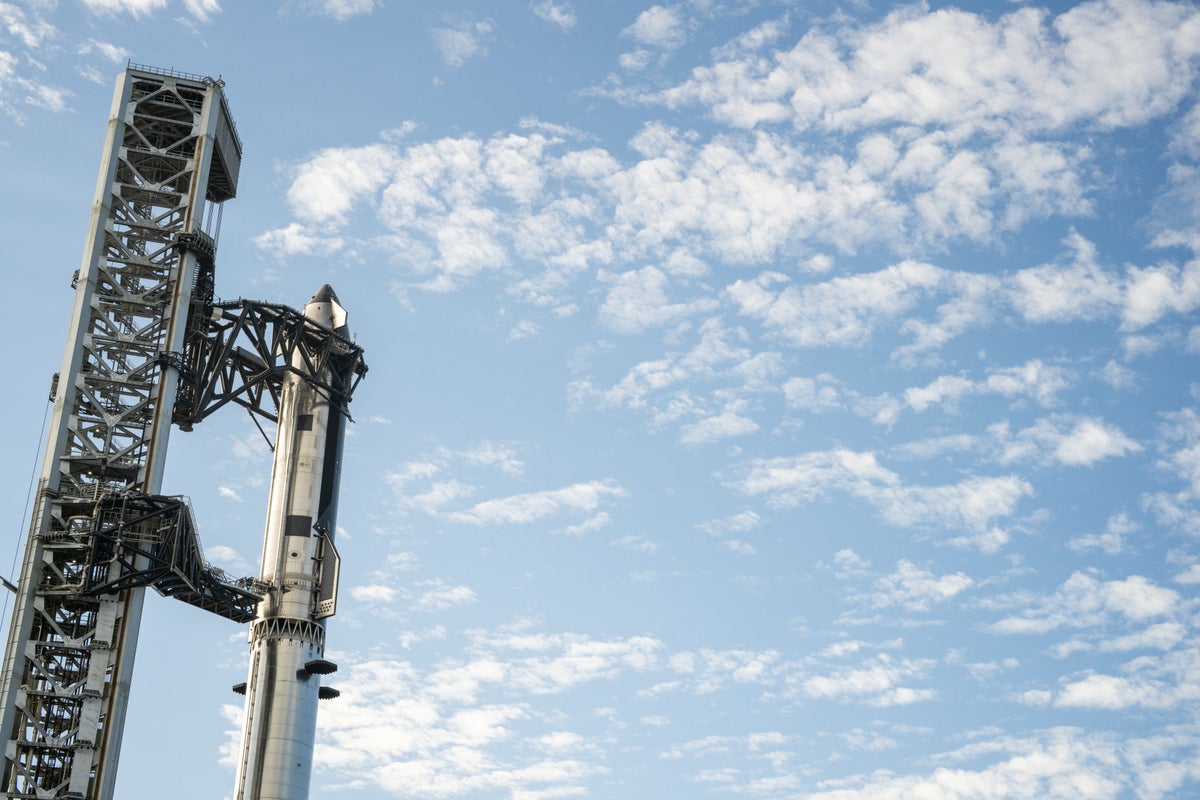
All of this depends on SpaceX getting a lot of stuff into orbit. On Falcon 9 launches, the company recovers the booster and payload fairings but tosses the upper stage, which puts a floor under how cheap each launch can get. Starship is meant to push costs lower still—and it is the vehicle Musk is counting on to carry people to Mars.
SpaceX has an aggressive schedule for getting there. Leaked documents suggest a crewed lunar landing by September 2028 using its Starship Human Landing System, a Starship variant that NASA has contracted to put astronauts on the Moon. Hitting it would require Starship to reduce launch costs by 99 percent and to fly a new rocket every four and a half hours by 2028. “I think they will make Starship work,” McDowell says. “But I don’t think it will happen as quickly as some of SpaceX’s fans think.”
Starship’s recurring engine issues worry Sowers. “That’s not good,” he says. “As a rocket guy, you don’t want your engines to fail.” He’s also skeptical about repeated orbital refueling. Refueling in space is possible, but a lunar mission would require SpaceX to do it cheaply and often. “You need to be really, really good at it to do it 14 times per mission,” he says.
None of this puts SpaceX’s goals out of reach. To some experts, the timelines and scale just seem overeager. Still, Henry says Musk has a way of clearing hurdles the industry thought impossible. “Even if he misses his own goal by 50 percent or more,” he says, “he still set the goalpost beyond what the rest of the world can currently do.”