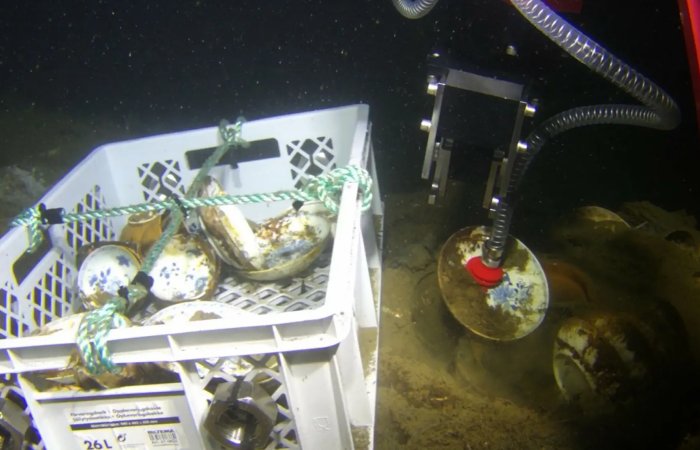
Conny Waters – AncientPages.com – Underwater archaeologists have identified this as the best-preserved shipwreck cargo of its kind in northern Europe, marking a significant discovery.
In September last year, Espen Saastad contacted archaeologists at the Norwegian Maritime Museum. Saastad is a watchmaker, a professional diver, and operates a small company specializing in seabed surveys.
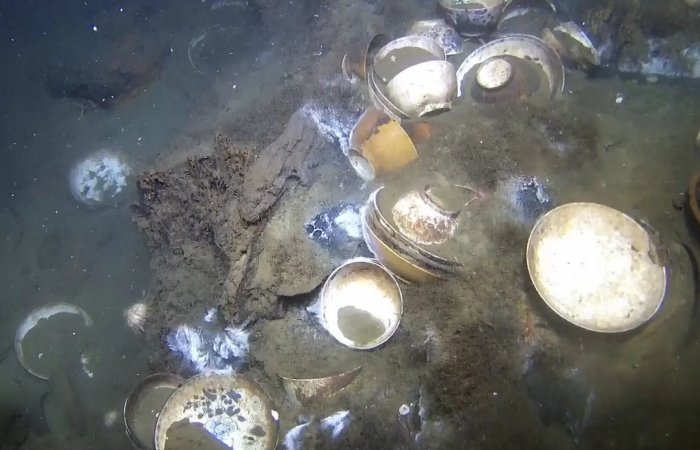
Chinese porcelain in the mud on the seabed (Photo: Espen Saastad and the Norwegian Maritime Museum)
On that day, he was conducting a seabed survey. His camera then captured something he instantly knew was very special. At a depth of 600 meters, there was a shipwreck along with a large amount of Chinese porcelain.
“We thought it was an incredible wreck,” says Sven Ahrens, the director of research at the Norwegian Maritime Museum.
“We often find cargo and freight, but it’s usually broken or covered by marine growth. Here, whole plates were lying in stacks on the seabed,” he says.
Ahrens explains that the archaeologists immediately identified the artifacts as 18th-century Chinese porcelain. Saastad’s video also revealed fragments of luxurious chandeliers and elegant stemware.
“These objects have material value in themselves. We were concerned that someone might discover the site and try to recover them,” he says.
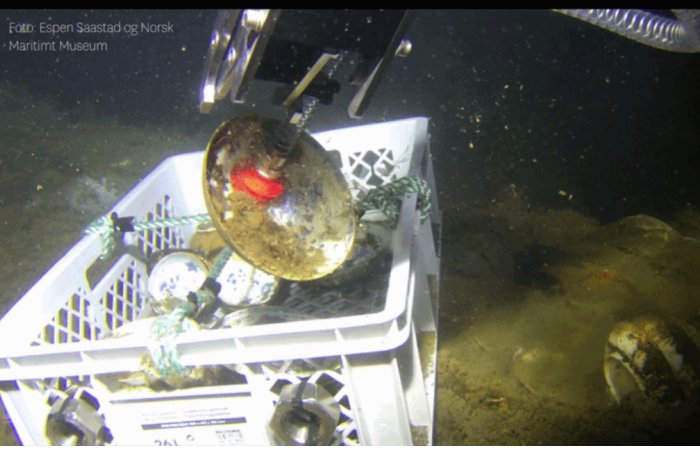
“No one has ever done this before in the Nordic region,” says Sven Ahrens of the Norwegian Maritime Museum, referring to the operation to recover the objects from the ship.
Credit: Espen Saastad and the Norwegian Maritime Museum
Ahrens and his colleagues brought the video to the offices of the Norwegian Directorate for Cultural Heritage. Among those present was marine archaeologist Ivar Aarrestad.
Secrets of the Porcelain Wreck
“When we sat in that meeting and saw what appeared on the screen, it was unlike anything I had ever seen before. It’s almost a career highlight, both in terms of the discovery itself and the archaeological significance it will have,” says the marine archaeology expert.
“These are not only beautiful, aesthetically impressive, and valuable finds. They will also play an important role in improving our understanding of our economic history,” he adds.
Since then, nearly 40 objects have been recovered from a depth of 600 meters.
“It’s almost a technological miracle,” says Arrestad. “The fact that it was found at all, that preservation conditions are so exceptional down there, and that despite the extreme depth we are still able to do something with it.”
The wreck, which archaeologists have named the Porcelain Wreck, lies in open waters off the Norwegian coast in the Skagerrak.
“No archaeological investigations in Northern Europe have ever been conducted at this depth and in open ocean conditions,” says Frode Kvalø, maritime archaeologist at the Norwegian Maritime Museum and leader of the Porcelain Wreck project.
“From a cultural-historical perspective, this discovery is particularly significant for our region in the north,” says Kvalø.
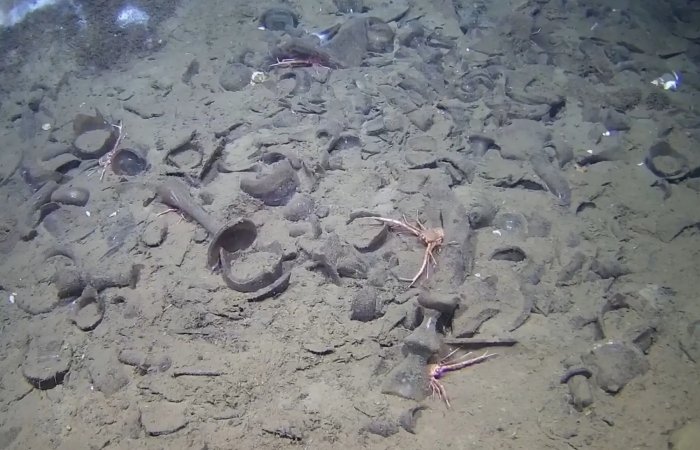
Various glassware and stemware, covered in mud, on the seabed. (Photo: Espen Saastad and the Norwegian Maritime Museum)
According to Kvalø, the 18th century saw the rise of the modern market economy and consumer culture, along with significant changes in trade and in the variety of goods available.
Several 18th-century wrecks have been discovered off the Norwegian coast, though most transported only one type of cargo, such as timber, iron, or fish.
“The Porcelain Wreck is the first wreck we have found that demonstrates the breadth of interregional commercial activity in Northern Europe during the 18th century,” says Kvalø. “We will gain an intimate insight into what trade systems were like in 18th-century Northern Europe.”
When Kvalø first reviewed the seabed footage, the glass components of the chandeliers were particularly striking.
“They are extraordinary, truly high-status European craftsmanship,” he says.
The archaeologists used the underwater drone’s robotic arm to open a damaged crate and attempted to confirm whether it contained porcelain.
However, the crate did not contain porcelain.
“Inside was a box with several compartments containing various substances. It could be tea, coffee, cocoa, perhaps medicines. We don’t know yet,” he says.
Many crates aboard the ship remain unopened, and archaeologists are uncertain about their contents.
The ship and its cargo are also remarkably well preserved.
Preservation at this depth is exceptionally favorable. The wreck has also largely avoided trawl nets, which often create precarious conditions on the seabed.
“Trawling is often very destructive for shipwrecks. The Porcelain Wreck has been hit a couple of times, but the damage appears limited,” Kvalø says.
The ship likely sank rapidly and nearly vertically, as it rests on the seabed in almost the same position as when afloat. Most of the cargo remains where it was originally loaded.
“We expect to learn more about how vessels were loaded during this period. That’s something we know quite little about because finds of this type tend to be very fragmented,” he says.
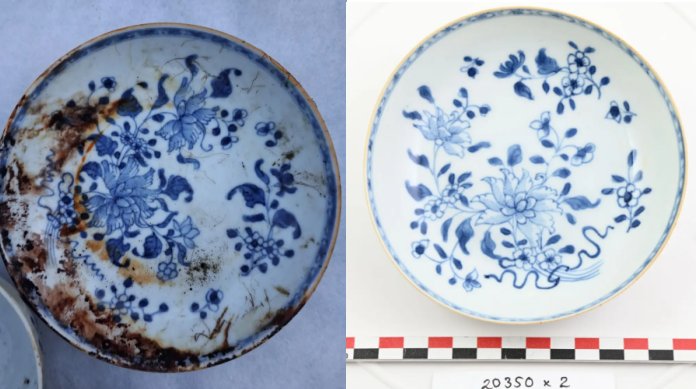
Left: Chinese porcelain that has lain on the seabed for 250 years. (Photo: Frode Kvalø, Norwegian Maritime Museum). Right: It looks as if it was bought yesterday. (Photo: Norwegian Maritime Museum)
Where did the ship originate, and what was its destination?
Archaeologists believe the Chinese porcelain was shipped in its original packaging from China or Indonesia, as rice straw was found inside the crates.
However, the ship itself had not traveled to China to collect these goods.
Researchers believe the vessel was a galiot, a small cargo ship that primarily operated in Northern Europe. The porcelain likely originated from an auction center such as Gothenburg, Copenhagen, or Amsterdam.
Among the recovered objects was a brick from the galley, the ship’s kitchen. Its maker’s mark enabled archaeologists to trace it to Lübeck, Germany.
“A ship may replace parts of its galley during its lifetime, and repairs may also be necessary. So the only thing we can say with certainty is that the ship was in Lübeck at some point,” says Kvalø.
At that time, all merchant ships were required to pay the Sound Dues to Denmark when passing between Helsingør and Helsingborg. These toll records have been digitized, and a maritime historian is now searching the archives to identify the Porcelain Wreck.
The ROV is equipped with a specially made arm that can lift a porcelain cup without breaking it. (Photo: Espen Saastad and the Norwegian Maritime Museum)
“It’s something of a dream wreck,” says Ahrens, the department director from the Maritime Museum. “There are just so many different things in the cargo, and at that depth the preservation is absolutely fantastic, even organic materials have survived remarkably well.”
To date, only about 40 objects have been recovered, while thousands remain at the wreck site. These include decorated stove panels that may indicate the ship’s origin, as well as finely crafted porcelain figures resembling plants.
“Recovering the objects we have brought up required significant effort. This has not been done before in the Nordic region,” says Ahrens. “We were uncertain it would succeed, and the process was nerve-wracking. However, we managed to recover roughly what we had hoped for.”
Ahrens and Kvalø hope to have the opportunity to recover additional items from the ship.
“As a leading offshore nation, Norway should absolutely be pioneering this type of work,” Ahrens believes.
See also: More Archaeology News
The marine archaeologists aim to conduct a full archaeological excavation of the Porcelain Wreck at a depth of 600 meters, rather than only recovering select objects.
“We now have enough data to design a full excavation project,” says Kvalø. “So far, we have a fairly good understanding of what we are dealing with. But there are still unopened crates, and they may contain surprises.”
Source: Science in Norway
Written by Conny Waters – AncientPages.com Staff Writer