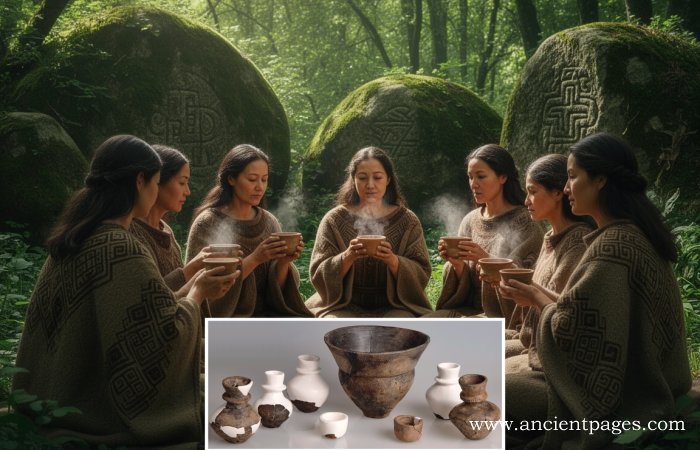
Jan Bartek – AncientPages.com – A recent archaeological discovery is providing important new insights into women’s secret societies in Neolithic Europe.
Around the fourth millennium BC, the Funnel Beaker Culture (Trichterbecherkultur, or TRB) emerged in Central Europe and southern Scandinavia. Descended from the first farming communities, TRB groups practiced mixed farming and helped drive new social and religious developments.
During this time, Europe was linked by extensive networks of exchange and interaction, stretching from Lesser Poland and south-central Germany to the Eastern Alps, and from southern Poland, Moravia, and Slovakia through Hungary down to Serbia.
New Burial Traditions And Drinking Rituals
This period saw significant changes in attitudes toward death and burial. Traditional monumental architecture was increasingly questioned, and new practices, such as settlement burials and cremation, emerged. As a result, settlements became spaces where everyday domestic life and ritual activities overlapped.
Growing connections between the TRB and the Baden Culture facilitated the exchange of luxury goods, such as high-quality flint, and led to shared customs in public drinking rituals. Within this context, evidence has emerged for the existence of secret female societies.
In Poland, archaeologists have found ceramic vessels used about 5,500 years ago to drink lactose-reduced milk beverages, probably during ritual feasts associated with funerals. At the site of Sławęcinek in Kujawy, over 6,000 pottery fragments were recovered, including a distinctive set of libation vessels: one large funnel-shaped beaker, five collared flasks, and two small cups.
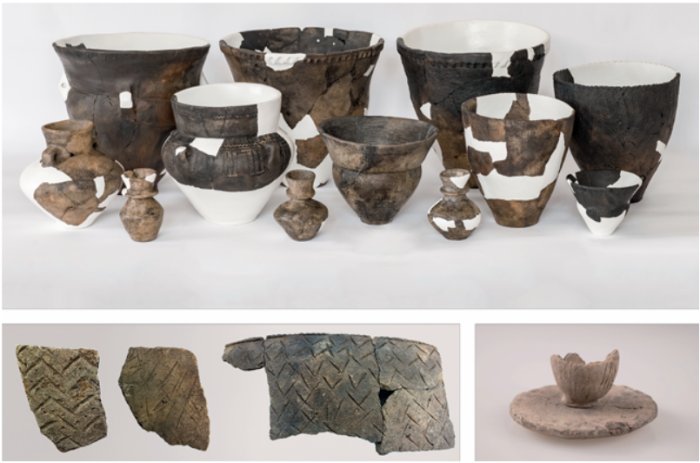
Examples of storage and serving vessels from Sławęcinek. On the left are fragments of pottery decorated with a motif characteristic of Boleráz vessels (photo credit: W. Ochotny). Source: Praehistorische Zeitschrift
“We identified proteins derived from both cow’s milk and sheep’s or goat’s milk. These products were likely produced using a process similar to cheese or whey production. Lactose intolerance was common during the Neolithic, affecting almost every inhabitant of Europe until the late Bronze Age. Processing milk into products with a lower lactose content was therefore an important way to utilize this valuable resource,W said Łukasz Kowalski, lead author of the study from the Institute of Archaeology of the Nicolaus Copernicus University in Toruń.
A Secret Female Society In Neolithic Europe
We therefore hypothesized that the rituals that took place in Sławęcinek may have been related to matrilineality, a kinship system in which lineage, inheritance, and family ties are traced through the mother’s side of the family and possibly also to secret women’s societies.
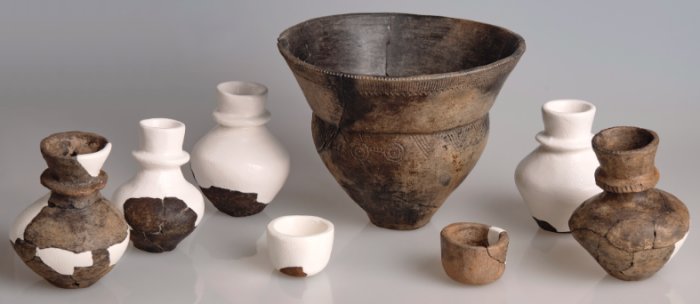
Drinking set from Sławęcinek. (photo credit: W. Ochotny). Source: Praehistorische Zeitschrift
In many traditional societies, such organizations played an important role in maintaining social bonds and transferring knowledge. The use of collared flasks for serving and consuming dairy products, which could be perceived as a liquid of fertility and health symbolizing the mother, opens the possibility of interpreting these practices as rituals strengthening bonds between women within the group,’ Kowalski said.
“If we consider social drinking beyond the ethos of warrior males, we must also reflect on the role of women and the ways they engaged in providing social and ideological resources in the second half of the fourth millennium BC in Europe. Thus far, the existence of women’s secret societies in the TRB area has been inferred from the deposition of ceramic amphorae (often decapitated) in watery locations.
Despite its limitations, this study has gone some way towards extending our reading of the events portrayed at Slawecinek as a complex interplay between female burials, funeral feasts, and the breakdown of the mortuary deposition pattern of male-gendered collared flasks. The use of collared flasks for dispensing and consuming milk-based products (potentially viewed as the fluid of fertility and health-giving that symbolises the mother) invites an interpretation of secret rites or rituals as a means of solidifying female members of the group, and demonstrates that dynamic, female-associated forms of power should be accounted for in our narratives,” the researchers write in their study.
Burials With Only Females
A substantial quantity of animal bones, mainly from cattle and pigs, was found near the vessels, indicating that communal feasting likely accompanied the ritual consumption of beverages. Burial sites uncovered in the surrounding area contained only female remains. Evidence suggests that funeral rituals and associated feasts took place in close proximity to household spaces, which anthropological interpretations often link with women’s activities and social roles.
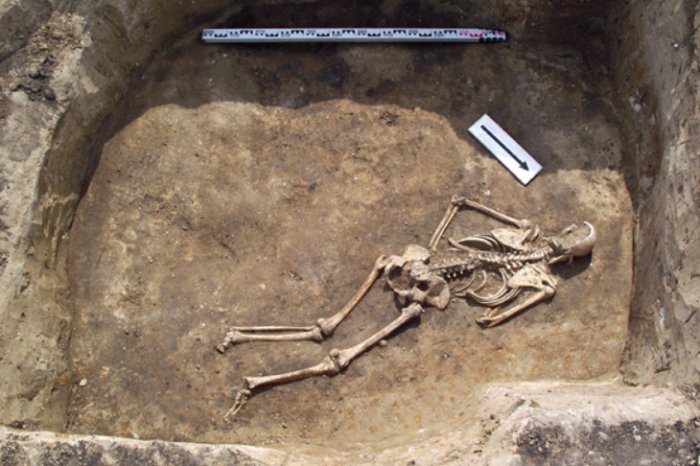
Settlement burial of a mature woman (photo credit: J. Śledziński). Source: Praehistorische Zeitschrift
“If this interpretation is correct, the decoration on the vessel from Sławęcinek is among the oldest known depictions of wheeled transport in the world. Similar depictions have also been discovered on other vessels from Poland, including the one in Kałdus and especially the famous vase from Bronocice. Radiocarbon dating indicates that they were made in the second half of the 4th millennium BCE. These dates coincide with the oldest known evidence of wagon use in both Europe and the Middle East,” Kowalski said.
See also: More Archaeology News
The Sławęcinek settlement, accidentally discovered in 2016 during construction of the Inowrocław bypass, has proven to be a significant archaeological site. Covering nearly five hectares, it has yielded over a thousand artifacts, offering valuable insights into Neolithic life. Ongoing and future excavations are expected to reveal further details about the daily activities, social structures, and material culture of the people who lived there thousands of years ago.
The study was published in the Praehistorische Zeitschrift.
Written by Jan Bartek – AncientPages.com Staff Writer